
[Paper Review] SOLAR 10.7B: Scaling Large Language Models with Simple yet Effective Depth Up-Scaling
SOLAR 10.7B introduces a simple yet effective depth up-scaling (DUS) method that scales a 32-layer Llama 2-based model to 10.7B parameters via depthwise scaling and continued pretraining, achieving state-of-the-art performance on NLP benchmarks and surpassing Mixtral-8x7B-Instruct in instruction-following tasks, with the model released under the Apache 2.0 license for broad accessibility.
We introduce SOLAR 10.7B, a large language model (LLM) with 10.7 billion parameters, demonstrating superior performance in various natural language processing (NLP) tasks. Inspired by recent efforts to efficiently up-scale LLMs, we present a method for scaling LLMs called depth up-scaling (DUS), which encompasses depthwise scaling and continued pretraining. In contrast to other LLM up-scaling methods that use mixture-of-experts, DUS does not require complex changes to train and inference efficiently. We show experimentally that DUS is simple yet effective in scaling up high-performance LLMs from small ones. Building on the DUS model, we additionally present SOLAR 10.7B-Instruct, a variant fine-tuned for instruction-following capabilities, surpassing Mixtral-8x7B-Instruct. SOLAR 10.7B is publicly available under the Apache 2.0 license, promoting broad access and application in the LLM field.
Motivation & Objective
- To develop a simple, efficient, and widely compatible method for scaling large language models without complex architectural changes.
- To address the challenge of scaling high-performance LLMs from smaller models while maintaining computational efficiency and ease of use.
- To improve instruction-following capabilities through fine-tuning, resulting in a model that surpasses larger MoE-based models like Mixtral-8x7B-Instruct.
- To promote open research by releasing SOLAR 10.7B and its instruction-tuned variant under the Apache 2.0 license.
Proposed method
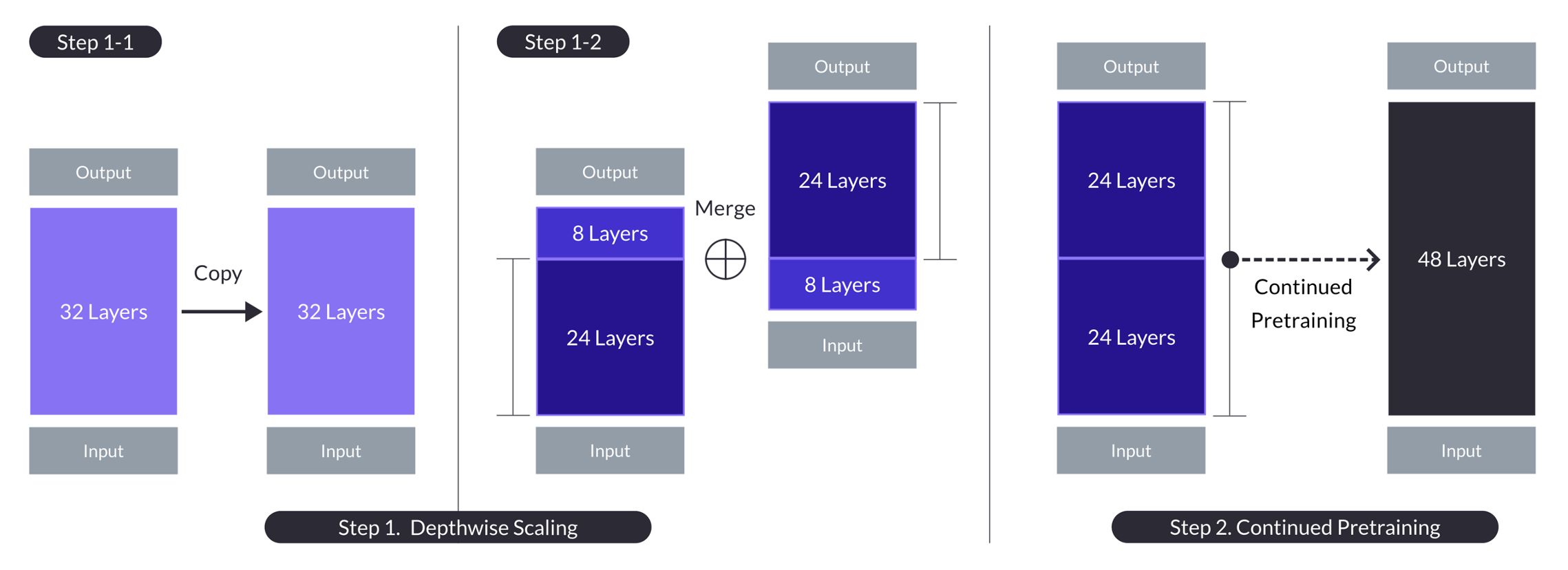
- Depth up-scaling (DUS) involves duplicating a base model, removing m layers from the end of one and m layers from the start of the other, then merging them to form a deeper model.
- The method uses depthwise scaling inspired by Tan and Le (2019), adapted for transformer architectures, without introducing mixture-of-experts or dynamic routing.
- The scaled model undergoes continued pretraining on a diverse mix of datasets to restore and enhance performance after scaling.
- The instruction-tuned variant, SOLAR 10.7B-Instruct, is fine-tuned on instruction-following datasets including Alpaca-GPT4, OpenOrca, and Synth. Math-Instruct.
- Model merging techniques such as average weighting and SLERP are evaluated to combine model heads, with 'Merge v1' selected based on performance stability.
- The approach is fully compatible with HuggingFace and standard LLM frameworks, requiring no changes to training or inference pipelines.
Experimental results
Research questions
- RQ1Can a simple depthwise scaling strategy effectively scale a small LLM into a high-performing large model without architectural complexity?
- RQ2Does continued pretraining after depth scaling significantly improve model performance compared to scaling alone?
- RQ3Can a depth-up-scaled model outperform larger, more complex models like Mixtral-8x7B-Instruct in instruction-following benchmarks?
- RQ4How robust are the results to different model merging strategies during the final aggregation phase?
- RQ5To what extent does the DUS method maintain performance and compatibility with standard LLM frameworks?
Key findings
- SOLAR 10.7B achieves state-of-the-art performance on multiple NLP benchmarks, outperforming Llama 2 and Mistral 7B across various tasks.
- SOLAR 10.7B-Instruct surpasses Mixtral-8x7B-Instruct on all evaluated instruction-following metrics, demonstrating that smaller models can exceed larger MoE models when properly scaled.
- The depth up-scaling (DUS) method enables efficient scaling of LLMs with minimal changes to training and inference frameworks, maintaining compatibility with HuggingFace.
- Model merging via average weighting and SLERP showed minimal performance differences, indicating robustness to merging strategy when candidates have complementary strengths.
- The model was released under the Apache 2.0 license, enabling broad community access and fostering open innovation in LLM research.
- The method shows low data contamination in evaluation, indicating strong data curation and processing protocols.
Read this paper
Open the full text in the Nubint reader and ask about any passage as you read.
Read this paper on NubintThis review was generated by AI from the original paper. Please check the paper before citing it.