
[Paper Review] Solving stiff ordinary differential equations using physics informed neural networks (PINNs): simple recipes to improve training of vanilla-PINNs
This paper proposes simple, effective recipes to improve training of vanilla physics-informed neural networks (PINNs) for stiff ordinary differential equations (ODEs). By modifying the loss function to better incorporate initial conditions or conserved quantities like energy, and by using a progressive, moving collocation grid with growing time intervals, the method significantly enhances convergence and accuracy—demonstrated on stiff IVPs and BVPs like the high-Reynolds convection-diffusion equation with minimal collocation points.
Physics informed neural networks (PINNs) are nowadays used as efficient machine learning methods for solving differential equations. However, vanilla-PINNs fail to learn complex problems as ones involving stiff ordinary differential equations (ODEs). This is the case of some initial value problems (IVPs) when the amount of training data is too small and/or the integration interval (for the variable like the time) is too large. We propose very simple recipes to improve the training process in cases where only prior knowledge at initial time of training data is known for IVPs. For example, more physics can be easily embedded in the loss function in problems for which the total energy is conserved. A better definition of the training data loss taking into account all the initial conditions can be done. In a progressive learning approach, it is also possible to use a growing time interval with a moving grid (of collocation points) where the differential equation residual is minimized. These improvements are also shown to be efficient in PINNs modeling for solving boundary value problems (BVPs) as for the high Reynolds steady-state solution of advection-diffusion equation.
Motivation & Objective
- To address the failure of vanilla-PINNs in solving stiff ODEs due to poor generalization from limited initial/boundary data.
- To improve training stability and convergence in stiff problems where standard PINNs fail with only initial condition knowledge.
- To propose lightweight, easily implementable modifications to the PINN framework that enhance performance without complex architecture changes.
- To demonstrate effectiveness on both initial value problems (IVPs) and boundary value problems (BVPs), including high-Reynolds convection-diffusion equations.
- To show that simple modifications can reduce the required number of collocation points and improve solution accuracy compared to standard PINN approaches.
Proposed method
- Introduce a hybrid data loss function that more effectively incorporates multiple initial conditions into the loss, improving the network's ability to learn the correct initial behavior.
- Add a physics-based partial loss term for conserved quantities such as total energy when applicable, to constrain the solution space and improve training stability.
- Implement a progressive training strategy using a moving collocation grid that expands over time, allowing the network to learn slowly evolving dynamics in stiff systems.
- Use a growing time interval for collocation points, starting from the initial time and progressively extending, to avoid early training failure in stiff problems.
- Apply the same strategy to BVPs by adapting the spatial collocation grid dynamically across the domain, particularly useful in boundary layer problems.
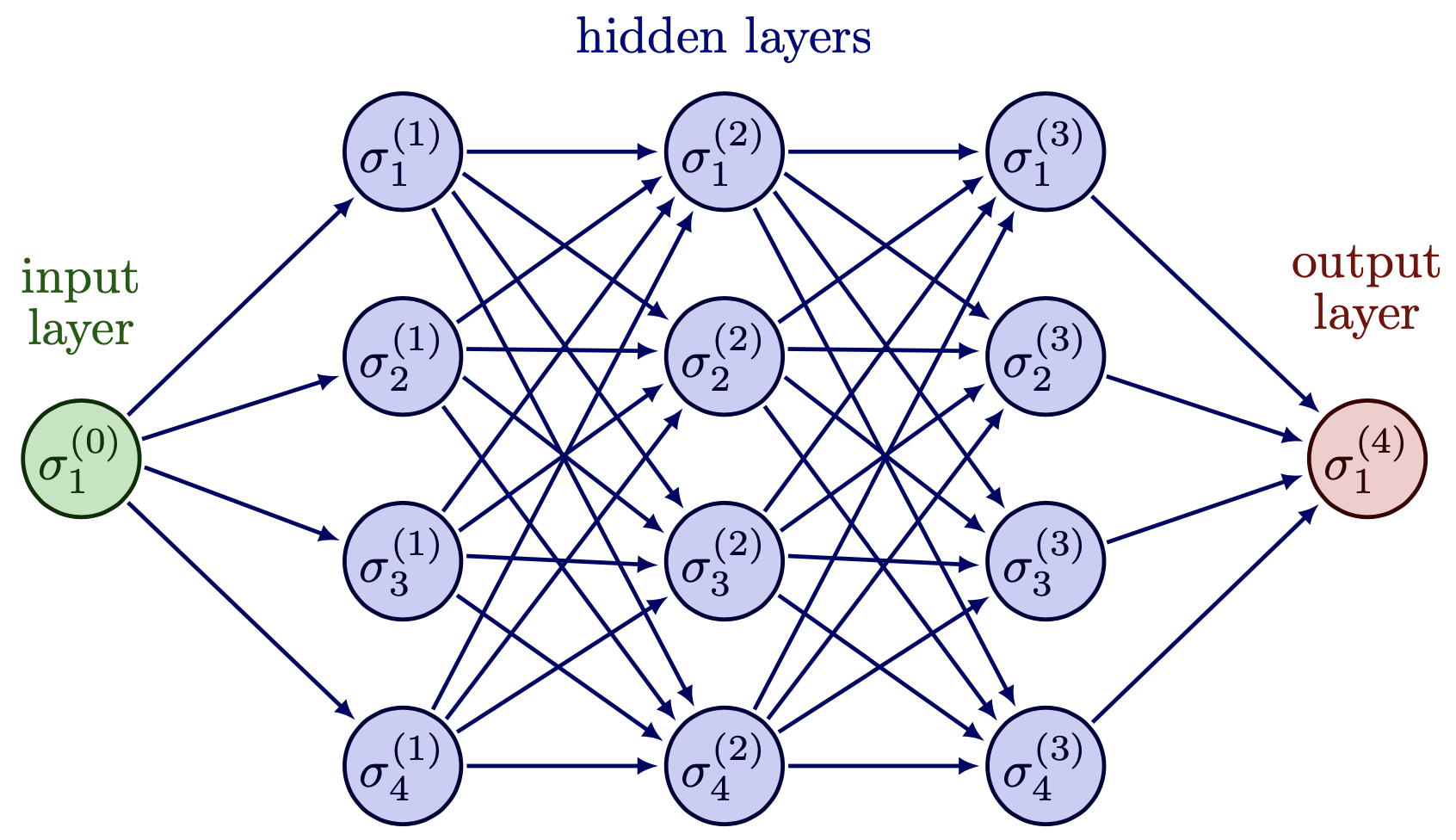
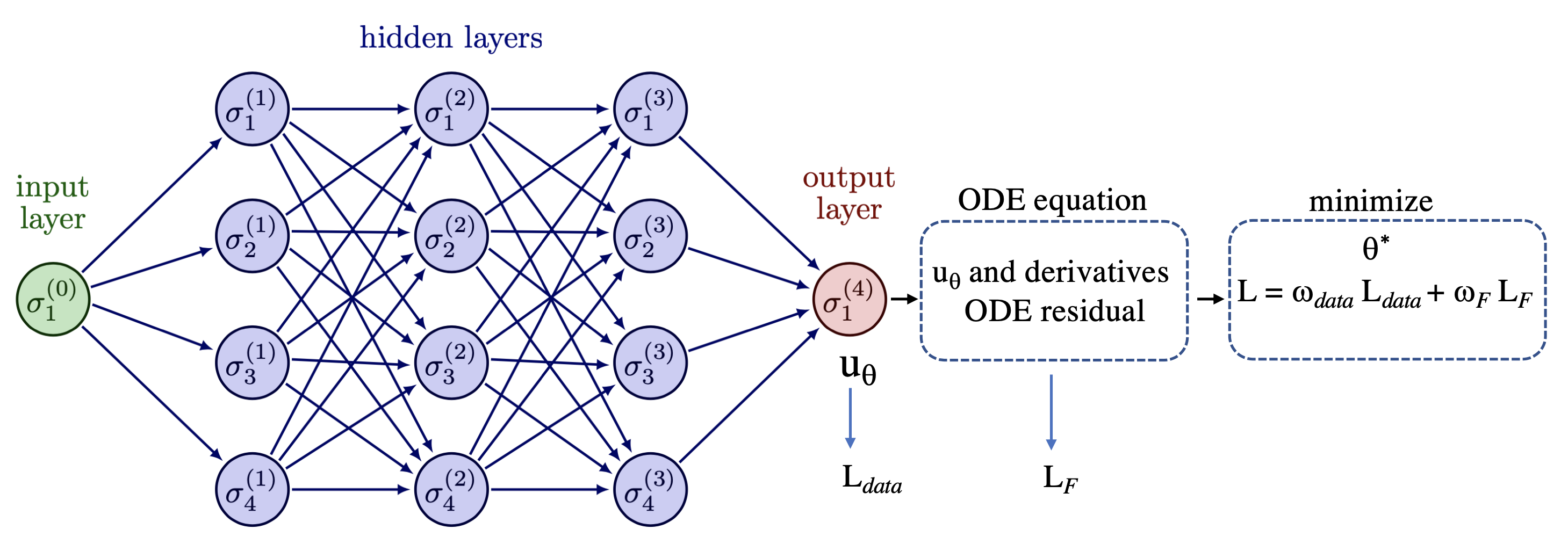
- Combine these techniques with standard PINN training using mean squared error (MSE) for data and residual minimization for the PDE, with adjustable loss weights.
Experimental results
Research questions
- RQ1Can a modified loss function that better encodes initial conditions improve PINN training for stiff ODEs?
- RQ2Does adding a physics-based loss term for conserved quantities like energy improve convergence and accuracy in stiff systems?
- RQ3Can a progressive, adaptive collocation grid strategy enhance training stability and solution quality in stiff ODEs?
- RQ4How does the moving grid approach compare to fixed-grid PINNs in terms of required number of collocation points for high-Reynolds BVPs?
- RQ5To what extent can these simple modifications replace more complex adaptive PINN architectures in stiff differential equation problems?
Key findings
- The hybrid data loss function significantly improves training convergence in stiff IVPs by better utilizing multiple initial conditions.
- Adding an energy conservation loss term enhances performance in systems where energy is conserved, such as certain oscillatory or conservative systems.
- The moving collocation grid with a growing time interval enables successful training of stiff ODEs even with only two initial data points and 27 collocation points.
- For the high-Reynolds 1D convection-diffusion BVP (R=50), the improved method achieved accurate solutions with only 27 collocation points, whereas standard PINNs required over 40.
- The method reduces the need for large training data or complex adaptive architectures, making it a practical and effective enhancement for vanilla-PINNs.
- The approach is robust across both IVPs and BVPs, demonstrating consistent improvement in solution accuracy and training stability.
Read this paper
Open the full text in the Nubint reader and ask about any passage as you read.
Read this paper on NubintThis review was generated by AI from the original paper. Please check the paper before citing it.