
[Paper Review] Spatial segregation of dust grains in transition disks. SPHERE observations of 2MASS J16083070-3828268 and RXJ1852.3-3700
This study uses multiwavelength VLT/SPHERE and ALMA observations to investigate dust grain segregation in two transition disks, J1608 and J1852, revealing that micron-sized grains extend farther radially and vertically than millimeter-sized grains due to radial drift and settling. Radiative transfer modeling shows that 15 of 22 transition disks exhibit cavities in scattered light smaller than those at millimeter wavelengths, indicating planet-driven clearing, with 15 systems consistent with giant planets below 13 M<sub>J</sub> and seven requiring more massive or multiple companions.
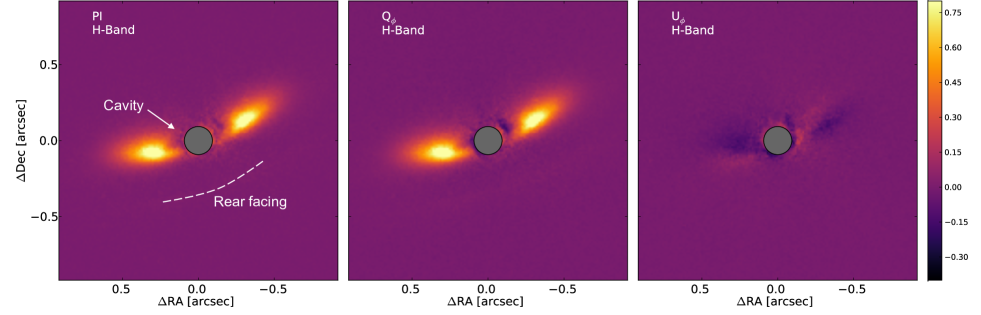
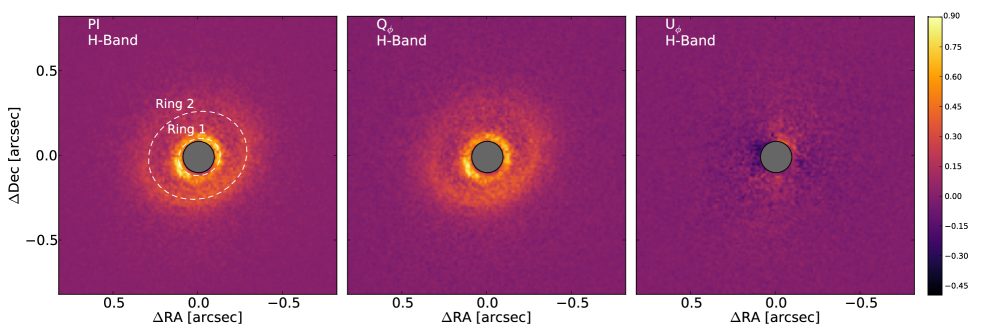
Context. The mechanisms governing the opening of cavities in transition disks are not fully understood. Several processes have been proposed but their occurrence rate is still unknown. Aims. We present spatially resolved observations of two transition disks and aim at constraining their vertical and radial structure using multiwavelength observations. Methods. We have obtained near-IR scattered light observations with VLT/SPHERE of the transition disks J1608 and J1852. We complement our datasets with ALMA observations and with unresolved photometric observations covering a wide range of wavelengths. We performed radiative transfer modeling to analyze the morphology of the disks and compare the results with a sample of 20 other transition disks observed with both SPHERE and ALMA. Results. The scattered light image of J1608 reveals a very inclined disk, with two bright lobes and a large cavity. J1852 shows an inner ring extending beyond the coronagraphic radius up to 15au, a gap and a second ring at 42au. Our radiative transfer model of J1608 indicates that the millimeter-sized grains are less extended vertically and radially than the micron-sized grains, indicating advanced settling and radial drift. We find good agreement with the observations of J1852 with a similar model, but due to the low inclination of the system, the model remains partly degenerate. The analysis of 22 transition disks shows that, in general, the cavities observed in scattered light are smaller than the ones detected at millimeter wavelengths. Conclusions. The analysis of a sample of transition disks indicates that the small grains can flow inward of the region where millimeter grains are trapped. While 15 out of the 22 cavities in our sample could be explained by a planet of less than 13 Jupiter masses, the others either require the presence of a more massive companion or of several low-mass planets.
Motivation & Objective
- To understand the mechanisms behind cavity formation in transition disks, particularly the role of planet-disk interactions.
- To investigate the spatial distribution of dust grains of different sizes in transition disks using multiwavelength observations.
- To determine whether observed cavity size differences between scattered light and millimeter emission are due to dust grain segregation from radial drift and vertical settling.
- To constrain the mass of potential planetary companions responsible for cavity formation using radiative transfer modeling and observational data.
- To assess the prevalence of planet-induced cavity clearing by analyzing a sample of 22 transition disks with both SPHERE and ALMA data.
Proposed method
- Acquired high-resolution near-infrared scattered light images of J1608 and J1852 using VLT/SPHERE in polarimetric mode.
- Complemented observations with archival ALMA data at millimeter wavelengths to probe larger dust grains.
- Combined with unresolved photometric data across a broad wavelength range to constrain dust properties.
- Perfomed 3D radiative transfer modeling to reproduce observed disk morphologies and infer grain size distributions and vertical/radial extents.
- Used the prescription of de Juan Ovelar et al. (2013) to estimate companion masses consistent with observed cavity sizes.
- Compiled and analyzed a sample of 22 transition disks imaged with both SPHERE and ALMA to assess general trends in cavity size differences.
Experimental results
Research questions
- RQ1Do micron-sized dust grains extend beyond millimeter-sized grains in transition disks due to radial drift and vertical settling?
- RQ2What is the origin of the observed discrepancy between cavity sizes in scattered light and millimeter emission?
- RQ3Can the observed cavity morphology in J1608 and J1852 be explained by a single giant planet or multiple companions?
- RQ4How common is dust grain segregation across a sample of transition disks, and what does it imply for planet formation mechanisms?
- RQ5What is the mass range of companions required to explain the observed cavity sizes in the 22-disk sample?
Key findings
- In J1608, scattered light is detected up to 0.54″ (108 au), revealing a highly inclined disk (i ~ 74°) with a large cavity and two bright lobes, with marginal detection of the backscattering surface.
- In J1852, an inner ring extends beyond the coronagraphic radius to 15 au, with a gap and a second ring at 42 au, indicating complex radial structure.
- Radiative transfer modeling shows that millimeter-sized grains in J1608 are less extended vertically and radially than micron-sized grains, confirming advanced settling and radial drift.
- The same model fits J1852 well, though the low inclination introduces degeneracy in the derived parameters.
- Among 22 transition disks with both SPHERE and ALMA data, scattered light cavities are consistently smaller than millimeter cavities, indicating dust grain segregation.
- Fifteen of the 22 disks are consistent with a single giant planet of less than 13 M<sub>J</sub>; the remaining seven require more massive companions or multiple low-mass planets.
Read this paper
Open the full text in the Nubint reader and ask about any passage as you read.
Read this paper on NubintThis review was generated by AI from the original paper. Please check the paper before citing it.