
[論文レビュー] Spatio-Temporal Graph Neural Networks for Predictive Learning in Urban Computing: A Survey
都市計画分野における予測学習のための Spatio-Temporal Graph Neural Networks (STGNNs) の包括的な調査で、データ構築、アーキテクチャ、ドメイン、データセット、今後の方向性を網羅します。
With recent advances in sensing technologies, a myriad of spatio-temporal data has been generated and recorded in smart cities. Forecasting the evolution patterns of spatio-temporal data is an important yet demanding aspect of urban computing, which can enhance intelligent management decisions in various fields, including transportation, environment, climate, public safety, healthcare, and others. Traditional statistical and deep learning methods struggle to capture complex correlations in urban spatio-temporal data. To this end, Spatio-Temporal Graph Neural Networks (STGNN) have been proposed, achieving great promise in recent years. STGNNs enable the extraction of complex spatio-temporal dependencies by integrating graph neural networks (GNNs) and various temporal learning methods. In this manuscript, we provide a comprehensive survey on recent progress on STGNN technologies for predictive learning in urban computing. Firstly, we provide a brief introduction to the construction methods of spatio-temporal graph data and the prevalent deep-learning architectures used in STGNNs. We then sort out the primary application domains and specific predictive learning tasks based on existing literature. Afterward, we scrutinize the design of STGNNs and their combination with some advanced technologies in recent years. Finally, we conclude the limitations of existing research and suggest potential directions for future work.
研究の動機と目的
- 広大な都市の時空データに対する予測学習を促進し、STGNNs を解決策としてレビューする。
- 都市ドメインと予測タスク別に STGNN の応用を分類する。
- STGNN アーキテクチャ(空間、時間、融合)と高度な手法との統合を分析する。
- 公開データセット、ベンチマーク、制限点、将来の研究方向を要約する。
提案手法
- 時空グラフがどのように構築されるかを記述する(トポロジーベース、距離ベース、類似性ベース、相互作用ベース)。
- 基本的な STGNN アーキテクチャを概説する:空間 GCNs、スペクトル GCNs、GATs、時系列学習のための RNNs/TCNs/TSANs、そして STGNN データフロー(DPM、STGLM、TPM)。
- 空間学習、時間学習、時空融合による STGNN 設計を分類し、強化型および高度なハイブリッド手法を含む。
- 他の学習フレームワークや新興技術との STGNN の統合について論じる。
実験結果
リサーチクエスチョン
- RQ1都市計算における時空グラフを構築する主な方法は何か?
- RQ2STGNN アーキテクチャは空間的、時間的、時空的依存関係を捉えるようにどのように設計されているか?
- RQ3STGNN が対象とする主な都市アプリケーション領域と予測タスクは何か?
- RQ4一般的に用いられるデータセットとベンチマークは何か、都市の予測学習における STGNN の主な制限点と今後の方向性は何か?
主な発見
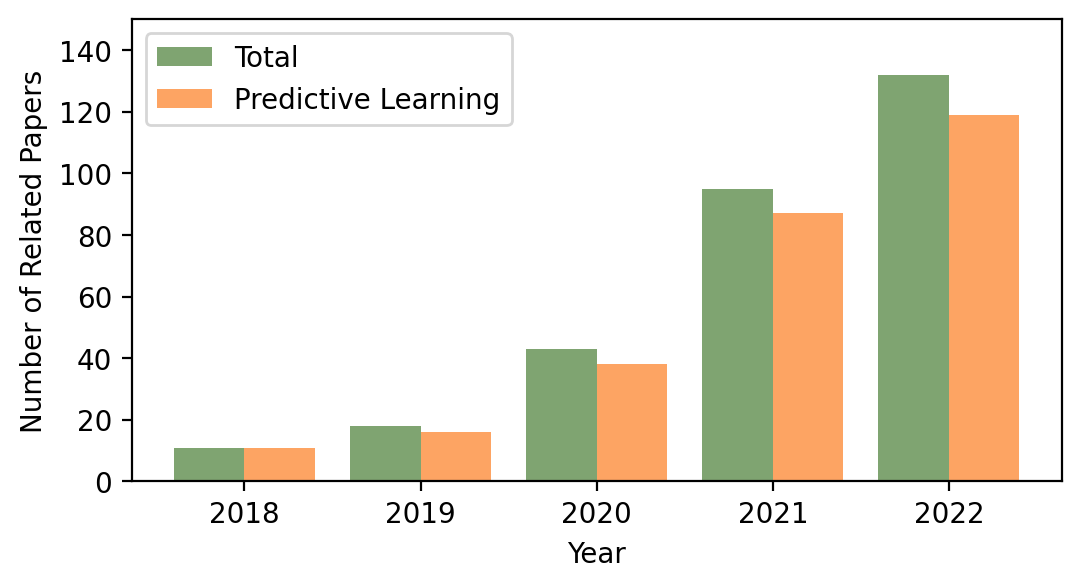
- STGNNs は輸送、環境、公共安全、公衆衛生などの分野で適用が拡大しており、輸送分野が文献の60%以上を占める。
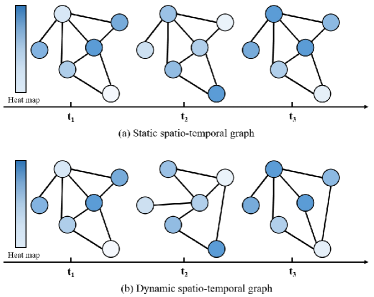
- 四つの主要な時空グラフ構築戦略が存在する:トポロジーベース、距離ベース、類似性ベース、相互作用ベース、さらに適応的グラフ学習アプローチ。
- STGNNs は通常、データ処理モジュール、時空グラフ学習モジュール、タスク指向の予測モジュールの順で構成される。
- STGNN の基本的なニューラルアーキテクチャには空間 GCNs(スペクトルおよび空間の派生型)とグラフアテンションネットワークがあり、時間学習者として RNNs、LSTMs/GRUs、TCNs、TSANs と組み合わせられる。
- この調査は分類法を提供し、データセット/ベンチマークを論じ、都市環境における予測学習の課題と今後の方向性を概説する。
より良い研究を、今すぐ始めましょう
論文設計から論文執筆まで、研究時間を劇的に削減しましょう。
クレジットカード登録不要
このレビューはAIが作成し、人間の編集者が確認しました。