
[Paper Review] Spiking Semantic Communication for Feature Transmission with HARQ
This paper proposes SNN-SC-HARQ, a spiking neural network-based semantic communication framework that dynamically adjusts transmission bandwidth via a Hybrid Automatic Repeat Request (HARQ) mechanism. By using a semantic similarity estimator (SimNet) to guide retransmission decisions, it achieves adaptive bandwidth scaling without performance loss, outperforming fixed-bandwidth models and avoiding the 'cliff effect' of traditional coding schemes under poor channel conditions.
In Collaborative Intelligence (CI), the Artificial Intelligence (AI) model is divided between the edge and the cloud, with intermediate features being sent from the edge to the cloud for inference. Several deep learning-based Semantic Communication (SC) models have been proposed to reduce feature transmission overhead and mitigate channel noise interference. Previous research has demonstrated that Spiking Neural Network (SNN)-based SC models exhibit greater robustness on digital channels compared to Deep Neural Network (DNN)-based SC models. However, the existing SNN-based SC models require fixed time steps, resulting in fixed transmission bandwidths that cannot be adaptively adjusted based on channel conditions. To address this issue, this paper introduces a novel SC model called SNN-SC-HARQ, which combines the SNN-based SC model with the Hybrid Automatic Repeat Request (HARQ) mechanism. SNN-SC-HARQ comprises an SNN-based SC model that supports the transmission of features at varying bandwidths, along with a policy model that determines the appropriate bandwidth. Experimental results show that SNN-SC-HARQ can dynamically adjust the bandwidth according to the channel conditions without performance loss.
Motivation & Objective
- Address the limitation of fixed-bandwidth transmission in existing SNN-based semantic communication models for feature sharing in collaborative intelligence.
- Overcome the 'cliff effect' in traditional coding schemes (e.g., LDPC) under high bit error rates by introducing a semantic-level retransmission mechanism.
- Enable dynamic bandwidth adaptation without requiring multiple codec models, reducing storage and computational overhead.
- Develop a semantic similarity metric that correlates with downstream task performance to guide transmission decisions autonomously.
- Achieve performance parity with manually tuned multi-rate models while enabling real-time adaptation to varying channel conditions.
Proposed method
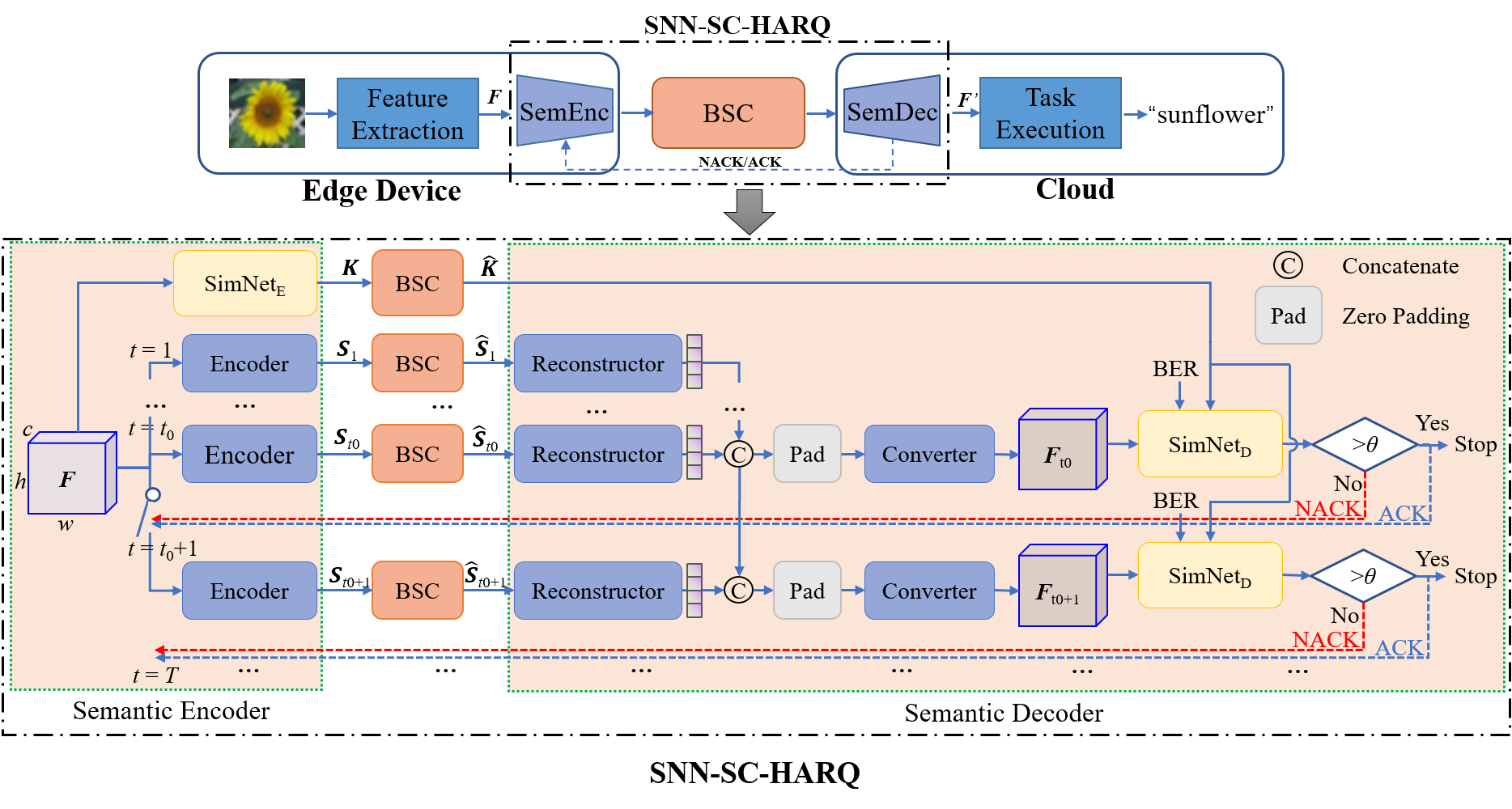
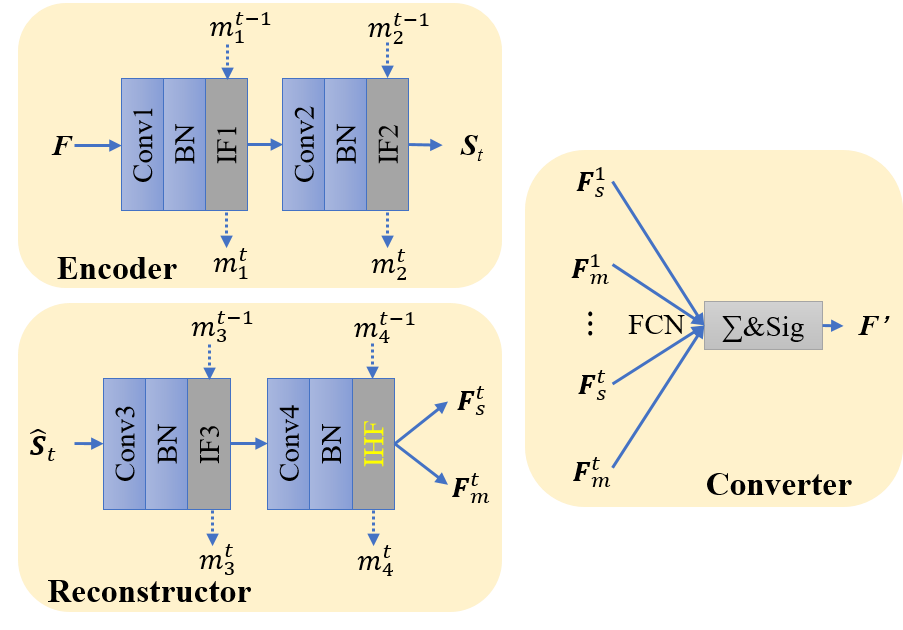
- Integrate a multi-rate SNN-SC model that reconstructs features at varying time steps (i.e., bandwidths) using a single learned architecture.
- Design SimNet, a two-part network (SimNet_E and SimNet_D) that estimates semantic similarity between original and reconstructed features using spiking representations.
- Use the estimated semantic similarity as a decision metric to trigger HARQ retransmissions: if similarity exceeds a threshold, send ACK; otherwise, send NACK and increase time steps.
- Implement a feedback loop where the edge device retransmits with increased time steps until the similarity threshold is met or maximum time steps are reached.
- Train the multi-rate SNN-SC and SimNet jointly to ensure semantic similarity estimation aligns with downstream classification accuracy.
- Leverage the binary output of SNNs for direct digital transmission, enabling robustness against channel noise and compatibility with existing digital systems.
Experimental results
Research questions
- RQ1Can a single SNN-based semantic communication model dynamically adjust its transmission bandwidth based on channel conditions without performance degradation?
- RQ2How does semantic similarity estimation compare to traditional CRC-based error detection in guiding retransmission decisions for feature transmission?
- RQ3To what extent does SNN-SC-HARQ mitigate the 'cliff effect' observed in conventional coding schemes like LDPC under high bit error rates?
- RQ4What is the performance gap between adaptive SNN-SC-HARQ and manually configured multi-rate SNN-SC under equivalent bandwidth conditions?
- RQ5Can a learned semantic similarity metric reliably predict downstream task performance (e.g., image classification accuracy) in a feature transmission setting?
Key findings
- SNN-SC-HARQ achieves adaptive bandwidth adjustment without performance loss, with absolute performance gaps between SNN-SC-HARQ and manually tuned multi-rate SNN-SC consistently near zero across all tested BERs.
- The model avoids the 'cliff effect' seen in SNN-SC+LDPC+HARQ, maintaining graceful degradation in classification accuracy as bit error rate increases beyond 0.1.
- At BER = 0.30, SNN-SC-HARQ with a threshold of 0.655 maintains classification accuracy comparable to multi-rate SNN-SC, while SNN-SC+LDPC+HARQ suffers a sharp decline due to LDPC failure.
- Transmission bandwidth in SNN-SC-HARQ increases gradually with worsening channel quality, unlike SNN-SC+LDPC+HARQ, which experiences abrupt jumps when error correction fails.
- The semantic similarity metric estimated by SimNet shows strong positive correlation with downstream classification accuracy, validating its use as a reliable proxy for task performance.
- By setting different thresholds in SimNet, the system can balance bandwidth usage and task performance, enabling trade-offs between efficiency and reliability.
Read this paper
Open the full text in the Nubint reader and ask about any passage as you read.
Read this paper on NubintThis review was generated by AI from the original paper. Please check the paper before citing it.