
[Paper Review] SplaTAM: Splat, Track & Map 3D Gaussians for Dense RGB-D SLAM
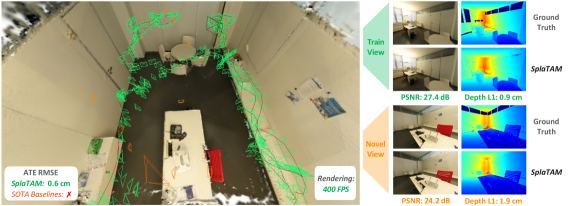
SplaTAM proposes a novel dense RGB-D SLAM system that uses 3D Gaussian Splatting as an explicit volumetric map representation, enabling real-time tracking and mapping with sub-centimeter localization accuracy. By leveraging differentiable rendering and silhouette-guided optimization, it achieves state-of-the-art performance in camera pose estimation, map reconstruction, and novel-view synthesis—outperforming prior methods by up to 2× in key metrics while rendering at 400 FPS.
Dense simultaneous localization and mapping (SLAM) is crucial for robotics and augmented reality applications. However, current methods are often hampered by the non-volumetric or implicit way they represent a scene. This work introduces SplaTAM, an approach that, for the first time, leverages explicit volumetric representations, i.e., 3D Gaussians, to enable high-fidelity reconstruction from a single unposed RGB-D camera, surpassing the capabilities of existing methods. SplaTAM employs a simple online tracking and mapping system tailored to the underlying Gaussian representation. It utilizes a silhouette mask to elegantly capture the presence of scene density. This combination enables several benefits over prior representations, including fast rendering and dense optimization, quickly determining if areas have been previously mapped, and structured map expansion by adding more Gaussians. Extensive experiments show that SplaTAM achieves up to 2x superior performance in camera pose estimation, map construction, and novel-view synthesis over existing methods, paving the way for more immersive high-fidelity SLAM applications.
Motivation & Objective
- To address the limitations of implicit neural representations in SLAM, such as computational inefficiency, lack of editability, and poor spatial control.
- To enable dense, real-time SLAM using a single unposed monocular RGB-D camera with high-fidelity reconstruction and accurate camera tracking.
- To leverage explicit 3D Gaussians for fast rendering, direct gradient flow, and structured map expansion via incremental densification.
- To achieve superior performance in camera pose estimation, scene reconstruction, and novel-view synthesis compared to existing radiance field-based and handcrafted SLAM methods.
Proposed method
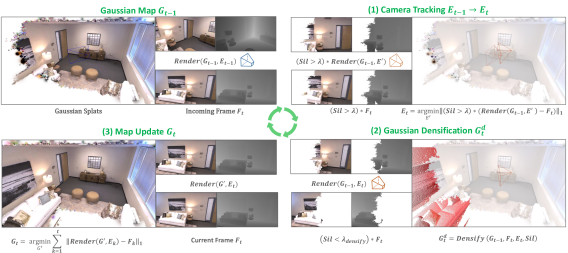
- The system uses 3D Gaussian Splatting as the underlying scene representation, with each Gaussian defined by 3D position, color, and scale.
- It employs differentiable rendering to compute photometric losses for both tracking and mapping, enabling end-to-end optimization of camera poses and Gaussian parameters.
- A silhouette-guided optimization strategy identifies unobserved regions by rendering the map's silhouette, restricting optimization to mapped areas to improve efficiency and accuracy.
- The method removes view-dependent appearance and uses isotropic Gaussians to accelerate rendering and optimization, achieving up to 400 FPS on high-resolution inputs.
- Map expansion is performed online by adding new Gaussians only in newly observed regions, ensuring structured and efficient densification.
- The pipeline integrates online tracking and mapping, with joint optimization using dense photometric losses on full-resolution images.
Experimental results
Research questions
- RQ1Can an explicit 3D Gaussian representation enable real-time, dense SLAM with a single unposed monocular RGB-D camera?
- RQ2How does 3D Gaussian Splatting compare to implicit neural representations in terms of optimization speed, map control, and editability for SLAM?
- RQ3Can silhouette-guided optimization improve tracking robustness in texture-less or challenging environments?
- RQ4To what extent can dense photometric losses be applied efficiently in SLAM using explicit volumetric representations?
- RQ5How does the integration of 3D Gaussians affect the trade-off between rendering speed, map fidelity, and tracking accuracy?
Key findings
- SplaTAM achieves a 0.27 cm ATE (Absolute Trajectory Error) on the Replica/Room 0 dataset, representing a 2× improvement over state-of-the-art methods.
- The method achieves 32.81 dB PSNR for novel-view synthesis, significantly outperforming baselines, with a 5× reduction in error at the 0.99 threshold for silhouette-based densification.
- Despite rendering full 1.2 million pixels per frame, SplaTAM maintains a runtime of 1.00s per frame for tracking and mapping on an RTX 3080 Ti, comparable to methods using only 200–1000 sampled pixels.
- The ablation study confirms that combining color and depth losses yields the best performance (ATE: 0.27 cm), while omitting either leads to significant degradation.
- The lightweight variant, SplaTAM-S, runs 5× faster with only minor performance drop (ATE: 0.39 cm), demonstrating scalability and efficiency.
- The system enables real-time photo-realistic rendering at 400 FPS for 876×584 resolution, showcasing high-fidelity visualization of dense 3D maps.
Read this paper
Open the full text in the Nubint reader and ask about any passage as you read.
Read this paper on NubintThis review was generated by AI from the original paper. Please check the paper before citing it.