
[Paper Review] Standby efficiency and thermocline degradation of a packed bed thermal energy storage: An experimental study
This experimental study investigates standby efficiency and thermocline degradation in a lab-scale packed bed thermal energy storage (PBTES) system using air as the heat transfer fluid. Results show that charging from bottom to top causes twice the entropy generation and 18% lower exergy efficiency after 22 hours of standby compared to top-to-bottom charging, due to intensified natural convection.
The waste heat potential from industrial processes is huge and if it can be utilized it may contribute significantly to the mitigation of climate change. A packed bed thermal energy storage system is a low-cost storage technology that can be employed to enable the utilization of waste heat from industrial processes. This system can be used to store excess heat and release this energy when it is needed at a later time. To ensure the efficient operation of a packed bed thermal energy storage its characteristics in standby mode need to be studied in great detail. In the present study, the standby efficiency and thermocline degradation of a lab-scale packed bed thermal energy storage in standby mode is experimentally investigated for different flow directions of the heat transfer fluid during the preceding charging period. Results show that, for long standby periods, the standby efficiency is significantly affected by the flow direction. The maximum entropy generation rate for a 22-hour standby process with the flow direction of the heat transfer fluid from bottom to top in the preceding charging process is twice as high as for the same process with the reverse flow direction. Energy and exergy efficiencies are lower for the process with reverse flow direction by 5% and 18% respectively.
Motivation & Objective
- To experimentally evaluate standby efficiency and thermocline degradation in a packed bed thermal energy storage (PBTES) system.
- To assess the impact of heat transfer fluid (HTF) flow direction during charging on long-term standby performance.
- To quantify energy and exergy losses due to natural convection and irreversibilities during extended standby periods.
- To provide data for economic and system design optimization of PBTES in industrial waste heat recovery applications.
Proposed method
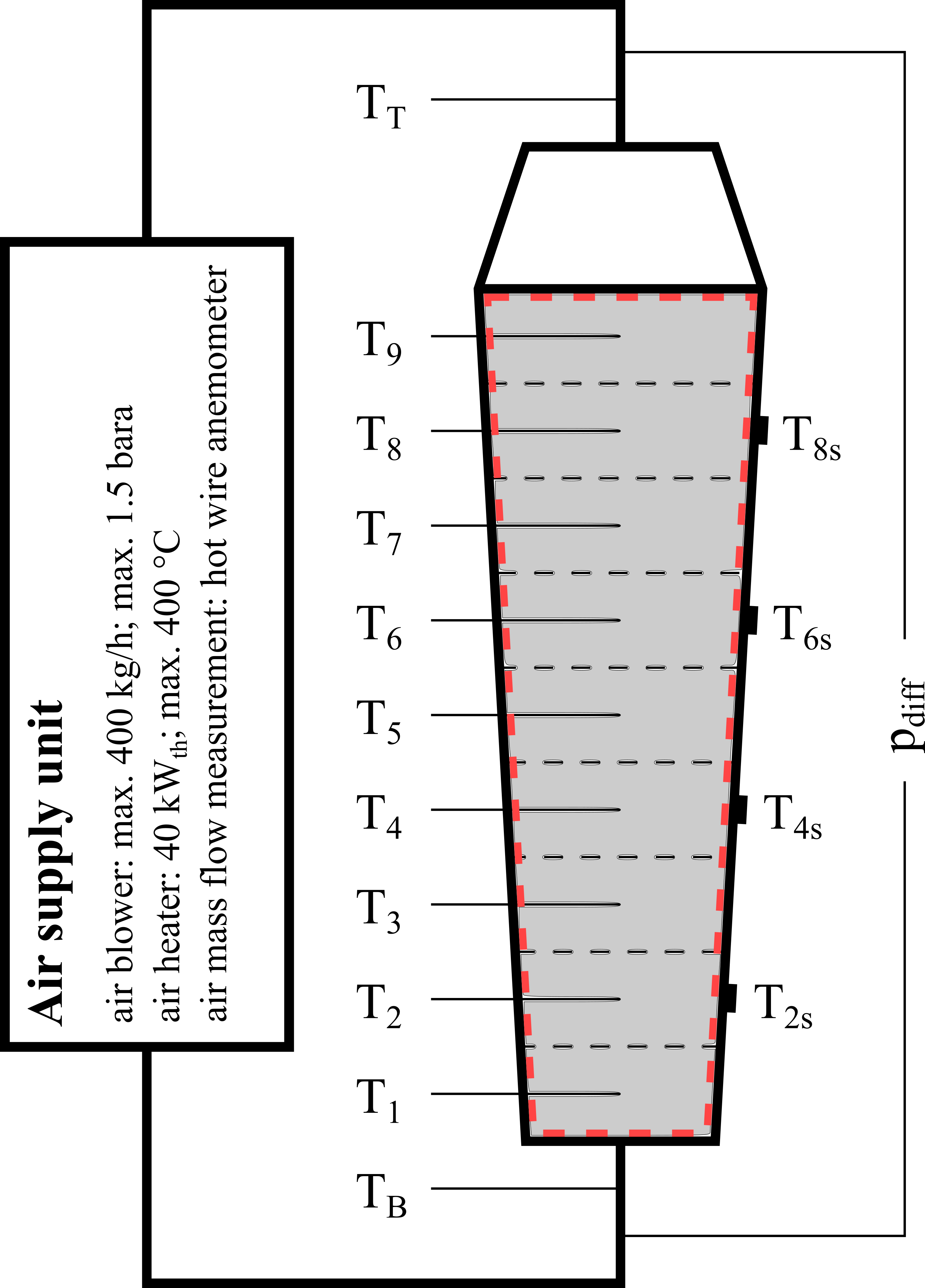
- Conducted experiments on a lab-scale PBTES with LD-slag as the storage medium and air as the HTF.
- Performed charging cycles with two flow directions: bottom-to-top (FWD) and top-to-bottom (REV).
- Measured temperature profiles across the packed bed during 22-hour standby periods to assess thermocline degradation.
- Applied second law analysis to calculate energy and exergy efficiencies based on stored and recovered energy/exergy.
- Used entropy generation rate as a key metric to evaluate irreversibility and thermodynamic losses.
- Processed experimental data to compare standby performance between FWD and REV charging configurations.

Experimental results
Research questions
- RQ1How does the flow direction of the heat transfer fluid during charging affect standby efficiency in a packed bed thermal energy storage?
- RQ2What is the extent of thermocline degradation during long standby periods in a PBTES system?
- RQ3How do energy and exergy efficiencies vary with standby duration for different charging flow directions?
- RQ4To what extent does natural convection contribute to entropy generation and exergy loss during standby?
- RQ5What is the critical time threshold beyond which flow direction during charging significantly impacts standby performance?
Key findings
- For a 22-hour standby period, the maximum entropy generation rate is twice as high in the FWD case (bottom-to-top charging) compared to the REV case (top-to-bottom charging).
- After 22 hours of standby, energy efficiency is 5% lower and exergy efficiency is 18% lower in the FWD case compared to the REV case.
- Exergy efficiency drops to 45% in the FWD case and 55% in the REV case after 22 hours of standby, indicating significant exergy loss in the FWD configuration.
- For standby times below 7 hours, the flow direction has negligible impact on efficiency, as natural convection has not yet fully developed.
- The FWD case leads to fully developed natural convection within approximately 7 hours, causing accelerated thermocline degradation.
- The results demonstrate that charging direction significantly affects long-term performance, with top-to-bottom charging being superior for minimizing exergy losses during extended standby.
Read this paper
Open the full text in the Nubint reader and ask about any passage as you read.
Read this paper on NubintThis review was generated by AI from the original paper. Please check the paper before citing it.