
[Paper Review] State Preparation on Quantum Computers via Quantum Steering
This paper presents a measurement-induced quantum steering protocol for preparing arbitrary quantum states on near-term superconducting quantum computers. By repeatedly entangling a system qubit with an ancilla qubit, measuring the ancilla, and actively resetting it to |0⟩, the system state is steered toward a desired target state—demonstrated for both qubits and qutrits—with exponential convergence and accelerated by classical feedback from measurement outcomes.
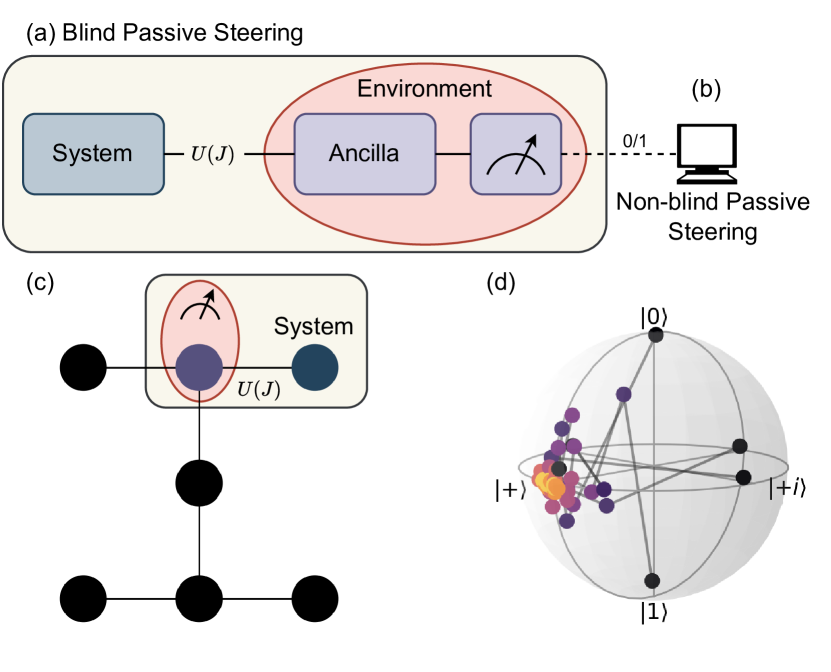
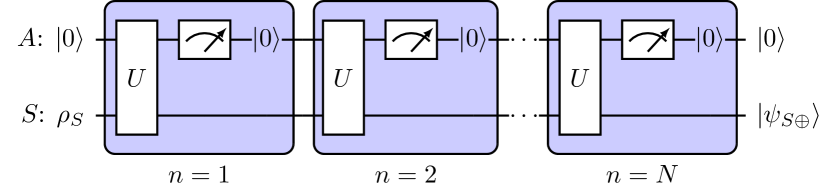
One of the major components for realizing quantum computers is the ability to initialize the computer to a known fiducial state, also known as state preparation. We demonstrate a state preparation method via measurement-induced steering on contemporary, digital quantum computers. By delegating ancilla qubits and systems qubits, the system state is prepared by repeatedly performing the following steps: (1) executing a designated system-ancilla entangling circuit, (2) measuring the ancilla qubits, and (3) re-initializing ancilla qubits to known states through active reset. While the ancilla qubits are measured and reinitialized to known states, the system qubits are steered from arbitrary initial states to desired final states. We show results of the method by preparing arbitrary qubit states and qutrit (three-level) states. We also demonstrate that the state convergence can be accelerated by utilizing the readouts of the ancilla qubits to guide the protocol in an active manner. This protocol serves as a nontrivial example that incorporates and characterizes essential operations such as qubit reuse (qubit reset), entangling circuits, and measurement. These operations are not only vital for near-term noisy intermediate-scale quantum (NISQ) applications but are also crucial for realizing future error-correcting codes.
Motivation & Objective
- To address the challenge of initializing quantum computers to arbitrary non-fiducial states, especially as passive thermalization becomes impractical with longer coherence times.
- To develop a scalable, non-gate-based state preparation method that avoids the need for precise gate calibration and extensive error mitigation.
- To characterize the holistic performance of key NISQ operations—entangling gates, mid-circuit measurement, and qubit reset—through state fidelity.
- To demonstrate the feasibility of state preparation for both qubits and higher-dimensional qudits (qutrits) on real IBM quantum hardware.
- To explore feedback-driven steering that accelerates convergence by leveraging ancilla measurement outcomes in real time.
Proposed method
- The protocol uses a unitary entangling interaction $ U(J) $ between a system qubit and an ancilla qubit, parameterized by coupling strength $ J $, to induce back-action on the system.
- After each entangling operation, the ancilla qubit is measured and actively reset to |0⟩ using mid-circuit measurement and quantum reset operations available on IBM processors.
- The system qubit evolves under repeated application of the entangling unitary and measurement-induced collapse, steering it toward a target state regardless of initial conditions.
- For active steering, classical feedback uses ancilla readout outcomes to adaptively adjust the protocol parameters, accelerating convergence.
- Qutrit state preparation is enabled via pulse-level control using Qiskit Pulse to calibrate Rabi oscillations and frequency sweeps for $ \pi_{1\to2} $ transitions.
- Quantum state tomography is performed using Gell-Mann matrices to reconstruct the density matrix of the system qubit or qutrit, with error mitigation applied to measurement readouts.
Experimental results
Research questions
- RQ1Can measurement-induced quantum steering enable arbitrary state preparation on current digital quantum computers without relying on gate-based state preparation?
- RQ2How does the convergence rate of the system state toward the target state depend on the number of iterations and coupling strength $ J $?
- RQ3To what extent can classical feedback from ancilla measurement outcomes accelerate the convergence of the steering protocol?
- RQ4What is the fidelity of state preparation for both qubits and qutrits when using active reset and measurement feedback on real hardware?
- RQ5How do the performance characteristics of mid-circuit measurement and active reset impact the overall state preparation fidelity?
Key findings
- The system state converges exponentially to the target state $ \ket{+} $ with increasing number of iterations $ n $, independent of initial conditions, as predicted by the theoretical model.
- The fastest convergence occurs at $ J = \pi/2 $, achieving full convergence in a single step in the ideal case.
- On IBM’s ibm_perth processor, the protocol successfully prepared arbitrary qubit states, with final states clustered near the target $ \ket{+} $ state on the Bloch sphere.
- Qutrit state preparation was achieved using calibrated $ \pi_{1\to2} $ pulses, with a measurement discriminator accuracy of 0.917 after error mitigation.
- Active reset fidelity improved with multiple consecutive resets, with measured $ \ket{0} $ preparation fidelity exceeding 90% on tested devices.
- Feedback-driven steering significantly accelerated convergence, reducing the number of iterations required to reach high-fidelity target states.
Read this paper
Open the full text in the Nubint reader and ask about any passage as you read.
Read this paper on NubintThis review was generated by AI from the original paper. Please check the paper before citing it.