
[Paper Review] Stochastic Video Prediction with Structure and Motion
This paper proposes a stochastic video prediction model that decomposes driving scenes into static (scene structure and ego-motion) and dynamic (foreground object motion) components, modeling their motion separately to improve future frame prediction. By conditioning dynamic motion on predicted static structure, the method achieves more accurate and diverse predictions in complex driving scenarios, outperforming prior methods on KITTI and Cityscapes while maintaining efficient inference.
While stochastic video prediction models enable future prediction under uncertainty, they mostly fail to model the complex dynamics of real-world scenes. For example, they cannot provide reliable predictions for scenes with a moving camera and independently moving foreground objects in driving scenarios. The existing methods fail to fully capture the dynamics of the structured world by only focusing on changes in pixels. In this paper, we assume that there is an underlying process creating observations in a video and propose to factorize it into static and dynamic components. We model the static part based on the scene structure and the ego-motion of the vehicle, and the dynamic part based on the remaining motion of the dynamic objects. By learning separate distributions of changes in foreground and background, we can decompose the scene into static and dynamic parts and separately model the change in each. Our experiments demonstrate that disentangling structure and motion helps stochastic video prediction, leading to better future predictions in complex driving scenarios on two real-world driving datasets, KITTI and Cityscapes.
Motivation & Objective
- To address the limitations of existing stochastic video prediction models in handling complex driving scenes with moving cameras and independently moving objects.
- To improve future frame prediction by explicitly modeling the underlying factors—scene structure, ego-motion, and object motion—rather than relying solely on pixel-level changes.
- To enhance prediction diversity and accuracy by conditioning dynamic motion on predicted static components, enabling better uncertainty modeling in foreground regions.
- To achieve high performance with efficient inference, making the method suitable for real-time autonomous driving applications.
Proposed method
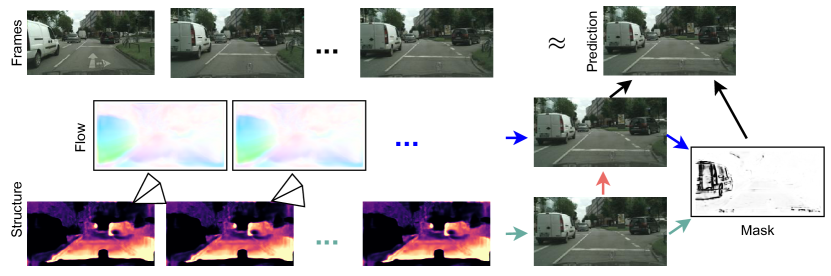
- The method factorizes video dynamics into static (scene structure and ego-motion) and dynamic (residual motion of foreground objects) components using depth, camera pose, and optical flow predictions.
- It models the static part using predicted depth and camera pose, which are used to warp frames and estimate background motion.
- Dynamic motion is modeled as residual flow on top of the ego-motion, conditioned on the predicted static structure to capture object-specific motion.
- A conditional latent variable model is used to predict future states of the static and dynamic components separately, then combined via a predicted segmentation mask.
- The model leverages domain knowledge about vehicle motion and scene geometry to improve generalization and uncertainty estimation.
- It employs a conditional architecture that allows the dynamic latent space to depend on the static prediction, improving motion consistency.
Experimental results
Research questions
- RQ1Can decomposing video dynamics into static and dynamic components improve stochastic video prediction in complex driving scenarios?
- RQ2How does modeling motion as residual on top of ego-motion enhance prediction accuracy and diversity?
- RQ3Can explicit modeling of underlying scene factors (structure, ego-motion, object motion) lead to better uncertainty estimation than pixel-level stochastic modeling?
- RQ4Does the proposed method maintain high efficiency while outperforming state-of-the-art models in both quality and diversity?
Key findings
- The proposed method achieves state-of-the-art performance on both KITTI and Cityscapes datasets in terms of FVD and LPIPS, with FVD scores of 16.8 and 18.5 respectively.
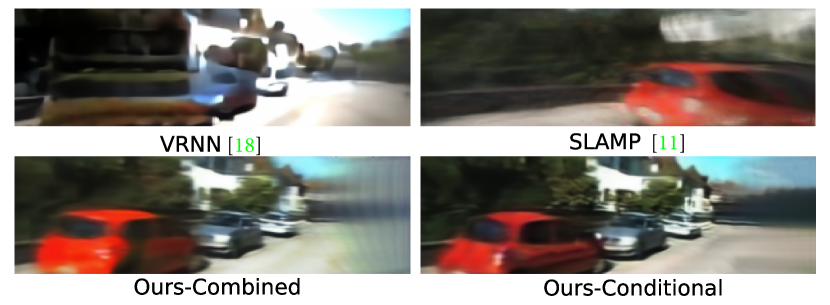
- The model generates more diverse and realistic predictions, with uncertainty concentrated on foreground objects—demonstrating improved uncertainty modeling compared to uniform uncertainty in baselines.
- Runtime is efficient, with 1.02s and 1.21s per 10 samples on KITTI and Cityscapes, respectively, comparable to baseline models and significantly faster than high-performing but costly models like Improved-VRNN.
- Visualizations confirm that the model correctly predicts ego-motion and residual foreground motion, enabling accurate scene warping and future frame generation.
- The conditional modeling of dynamic motion on static structure leads to better generalization in challenging scenarios, such as sharp turns, where previous methods fail.
- The method outperforms baselines in handling complex dynamics, especially when objects move independently of the camera, due to explicit disentanglement of motion types.
Read this paper
Open the full text in the Nubint reader and ask about any passage as you read.
Read this paper on NubintThis review was generated by AI from the original paper. Please check the paper before citing it.