
[Paper Review] Structural Attention-Based Recurrent Variational Autoencoder for Highway Vehicle Anomaly Detection
This paper proposes SABeR-VAE, an unsupervised structural attention-based recurrent variational autoencoder for highway vehicle anomaly detection that explicitly models lane structure and vehicle interactions. By integrating lane-vehicle attention and a Koopman operator-regularized latent space, it improves anomaly detection AUPR by 18% over STGAE-KDE on the MAAD dataset, with interpretable latent space transitions capturing abnormal behaviors like wrong-way driving.
In autonomous driving, detection of abnormal driving behaviors is essential to ensure the safety of vehicle controllers. Prior works in vehicle anomaly detection have shown that modeling interactions between agents improves detection accuracy, but certain abnormal behaviors where structured road information is paramount are poorly identified, such as wrong-way and off-road driving. We propose a novel unsupervised framework for highway anomaly detection named Structural Attention-Based Recurrent VAE (SABeR-VAE), which explicitly uses the structure of the environment to aid anomaly identification. Specifically, we use a vehicle self-attention module to learn the relations among vehicles on a road, and a separate lane-vehicle attention module to model the importance of permissible lanes to aid in trajectory prediction. Conditioned on the attention modules' outputs, a recurrent encoder-decoder architecture with a stochastic Koopman operator-propagated latent space predicts the next states of vehicles. Our model is trained end-to-end to minimize prediction loss on normal vehicle behaviors, and is deployed to detect anomalies in (ab)normal scenarios. By combining the heterogeneous vehicle and lane information, SABeR-VAE and its deterministic variant, SABeR-AE, improve abnormal AUPR by 18% and 25% respectively on the simulated MAAD highway dataset over STGAE-KDE. Furthermore, we show that the learned Koopman operator in SABeR-VAE enforces interpretable structure in the variational latent space. The results of our method indeed show that modeling environmental factors is essential to detecting a diverse set of anomalies in deployment. For code implementation, please visit https://sites.google.com/illinois.edu/saber-vae.
Motivation & Objective
- To address the limitation of existing anomaly detection models in identifying environment-structured anomalies like wrong-way driving, which are often missed when only vehicle interactions are modeled.
- To improve unsupervised anomaly detection in autonomous driving by incorporating explicit road structure (lane layout) into trajectory prediction.
- To enhance model interpretability by learning a structured, continuous latent space where abnormal transitions are explicitly encoded via a Koopman operator.
- To achieve high detection performance across diverse anomaly types, including non-interacting, off-road, and wrong-way driving behaviors.
- To demonstrate that environmental context and interaction modeling are essential for robust, generalizable anomaly detection in real-world highway scenarios.
Proposed method
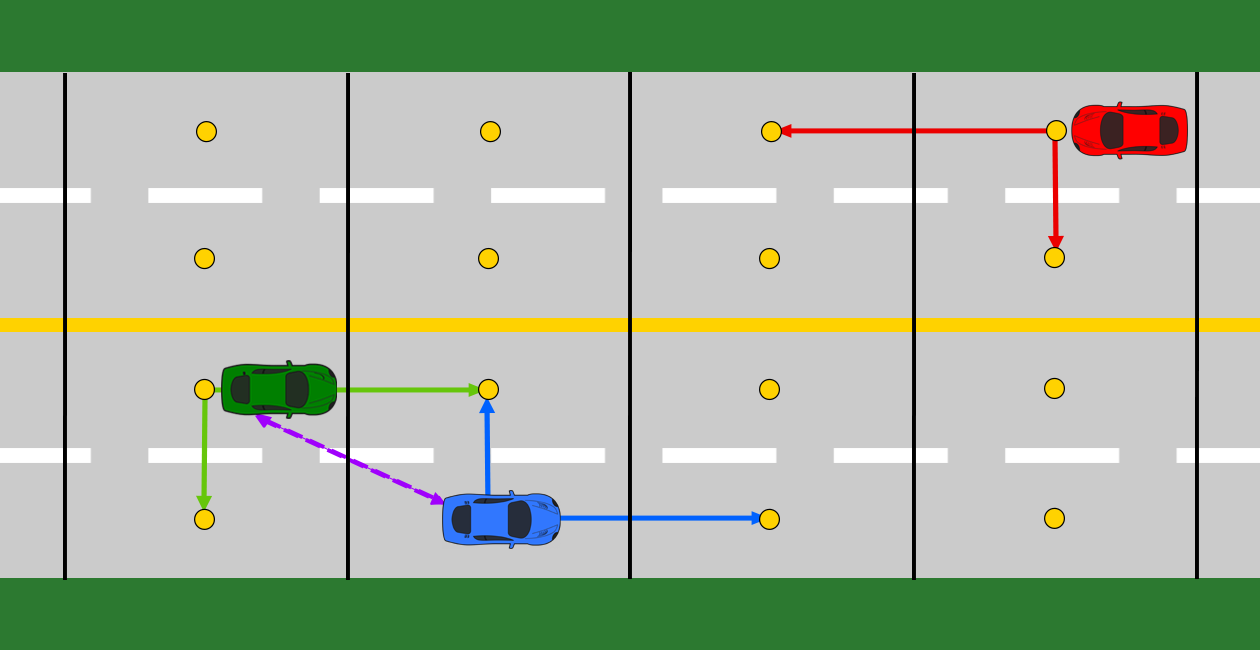
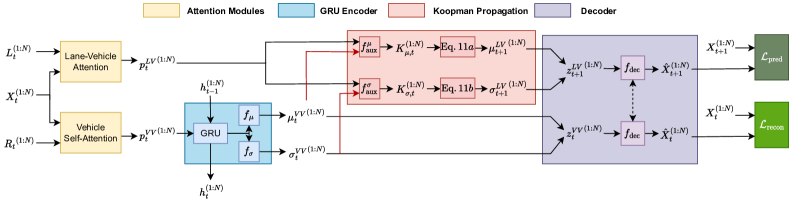
- The model uses a vehicle self-attention module to capture dynamic interactions among nearby vehicles in a highway scene.
- A separate lane-vehicle attention module models the relevance of permissible lanes to vehicle behavior, encoding road structure into the prediction process.
- A recurrent encoder-decoder architecture with a stochastic latent space, regularized by a Koopman operator, predicts future vehicle trajectories from attended features.
- The latent space is trained end-to-end via reconstruction loss on normal trajectories, enabling anomaly detection through high prediction error.
- The Koopman operator enforces interpretable, smooth transitions in the latent space, enabling visualization of behavioral shifts from normal to anomalous states.
- The deterministic variant, SABeR-AE, is also evaluated for ablation and comparison.
Experimental results
Research questions
- RQ1Can explicit modeling of lane structure improve the detection of environment-dependent anomalies such as wrong-way driving in autonomous vehicle systems?
- RQ2How does incorporating both vehicle interactions and road structure affect the performance and robustness of unsupervised anomaly detection in highway scenarios?
- RQ3To what extent can the learned latent space of a variational autoencoder provide interpretable representations of abnormal behavioral transitions?
- RQ4Does the Koopman operator regularization lead to more structured and meaningful latent dynamics that reflect real-world behavioral shifts?
- RQ5How does SABeR-VAE compare to state-of-the-art models like STGAE-KDE across diverse anomaly types, including non-interactive and high-impact behaviors?
Key findings
- SABeR-VAE improves abnormal AUPR by 18% over STGAE-KDE on the simulated MAAD highway dataset, demonstrating superior detection performance.
- SABeR-AE, the deterministic variant, achieves a 25% improvement in abnormal AUPR, confirming the effectiveness of the structural attention mechanism.
- The model detects wrong-way driving anomalies with a 35% improvement in AUPR over STGAE-KDE, highlighting the importance of lane structure modeling.
- The learned Koopman operator enforces interpretable, continuous transitions in the latent space, with abnormal behaviors clearly mapped to distinct regions or transitions between clusters.
- Anomalous trajectories with high prediction error are consistently encoded to the outskirts of primary clusters, while normal, low-error trajectories remain within dense cluster regions.
- Latent space visualization shows that the Koopman operator captures the shift from normal to anomalous behavior—e.g., a wrong-way turn causes a visible jump from the top to bottom/middle clusters—aligning with prediction loss spikes.
Read this paper
Open the full text in the Nubint reader and ask about any passage as you read.
Read this paper on NubintThis review was generated by AI from the original paper. Please check the paper before citing it.