
[Paper Review] Structural Chirality and Electronic Chirality in Quantum Materials
This paper establishes a unified framework linking structural chirality in quantum materials to electronic chirality via orbital-momentum locking, demonstrating how atomic-scale handedness induces spin polarization (CISS), diode-like transport (EMCA), and anomalous circularly polarized light emission (ACPLE). The key contribution is identifying orbital-momentum locking as the central mechanism underlying these chiral phenomena, with implications for spintronics, optoelectronics, and topological quantum materials.
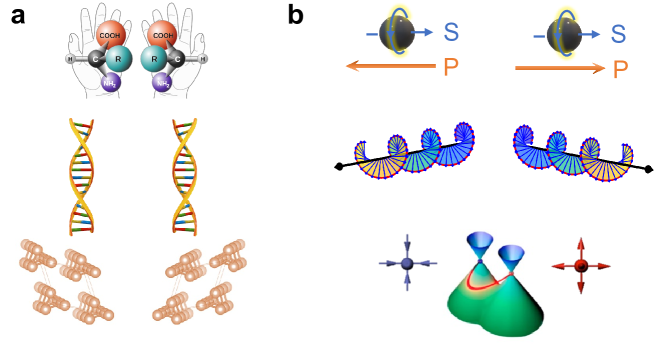
In chemistry and biochemistry, chirality represents the structural asymmetry characterized by non-superimposable mirror images for a material like DNA. In physics, however, chirality commonly refers to the spin-momentum locking of a particle or quasiparticle in the momentum space. While seemingly disconnected, structural chirality in molecules and crystals can drive electronic chirality through orbital-momentum locking, i.e. chirality can be transferred from the atomic geometry to electronic orbitals. Electronic chirality provides an insightful understanding of the chirality-induced spin selectivity (CISS), in which electrons exhibit salient spin polarization after going through a chiral material, and electric magnetochiral anisotropy (EMCA), which is characterized by the diode-like transport. It further gives rise to new phenomena, such as anomalous circularly polarized light emission (ACPLE), in which the light handedness relies on the emission direction. These chirality-driven effects will generate broad impacts in fundamental science and technology applications in spintronics, optoelectronics, and biochemistry.
Motivation & Objective
- To establish a microscopic connection between atomic-scale structural chirality and emergent electronic chirality in quantum materials.
- To explain the origin of chirality-induced spin selectivity (CISS) through orbital-momentum locking and spin-orbit coupling.
- To unify the understanding of EMCA and CISS by linking them to the same underlying mechanism of orbital-momentum locking.
- To explain the physical origin of anomalous circularly polarized light emission (ACPLE) in chiral organic semiconductors via the optical Berry phase.
- To propose a general theoretical framework for predicting and engineering chiral quantum phenomena in diverse materials, including hybrid perovskites and twisted 2D heterostructures.
Proposed method
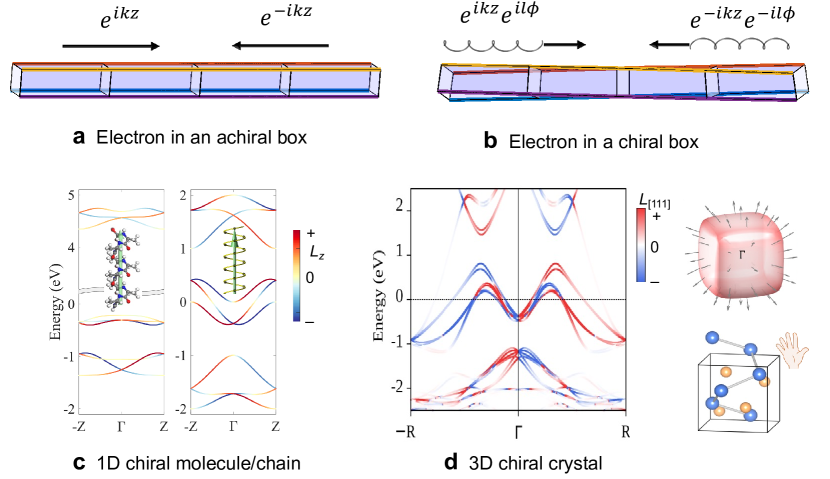
- Uses a toy model of a twisted 3D box to illustrate how chiral geometry induces orbital angular momentum (OAM) in electron wavefunctions, leading to orbital-momentum locking.
- Applies the concept of orbital-momentum locking to derive the wavefunction structure in chiral molecules, showing that $k$ and $l$ are locked in sign and magnitude.
- Introduces the role of spin-orbit coupling (SOC) in metal contacts to convert orbital polarization into spin polarization, enabling the CISS effect.
- Applies Onsager’s reciprocal relation to connect EMCA and CISS, showing their shared origin in time-reversal symmetry breaking via chiral electronic structure.
- Analyzes ACPLE through the optical Berry phase, showing that current-induced orbital polarization leads to direction-dependent circularly polarized light emission.
- Generalizes ACPLE to solids using the optical Berry curvature dipole, linking it to intrinsic band structure properties in noncentrosymmetric materials.
Experimental results
Research questions
- RQ1How does structural chirality in a material lead to intrinsic electronic chirality through orbital-momentum locking?
- RQ2What is the microscopic mechanism behind the chirality-induced spin selectivity (CISS) effect in chiral molecules?
- RQ3How are EMCA and CISS related, and what common physical origin underlies both phenomena?
- RQ4What is the role of the optical Berry phase in enabling anomalous circularly polarized light emission (ACPLE) in chiral organic semiconductors?
- RQ5Can the optical Berry curvature dipole in noncentrosymmetric solids be used to predict and engineer ACPLE in new materials?
Key findings
- Structural chirality in chiral molecules and crystals induces electronic chirality via orbital-momentum locking, where the electron’s orbital angular momentum (OAM) is locked to its momentum.
- The orbital-momentum locking mechanism explains the spin polarization observed in CISS, with spin filtering enabled by spin-orbit coupling in metal contacts.
- EMCA and CISS are shown to be two manifestations of the same underlying physics—time-reversal symmetry breaking due to chiral electronic structure—connected via Onsager’s reciprocal relation.
- Anomalous circularly polarized light emission (ACPLE) arises from current-induced orbital polarization, where the direction of emission determines the handedness of the emitted circularly polarized light.
- ACPLE is linked to the optical Berry phase in electron-hole recombination, with the same handedness observed in forward and backward emission due to angular momentum transfer from carriers to photons.
- The optical Berry curvature dipole provides a general framework to predict ACPLE in solid-state chiral materials, extending the phenomenon beyond organic semiconductors to perovskites and 2D heterostructures.
Read this paper
Open the full text in the Nubint reader and ask about any passage as you read.
Read this paper on NubintThis review was generated by AI from the original paper. Please check the paper before citing it.