
[Paper Review] Structure in Deep Reinforcement Learning: A Survey and Open Problems
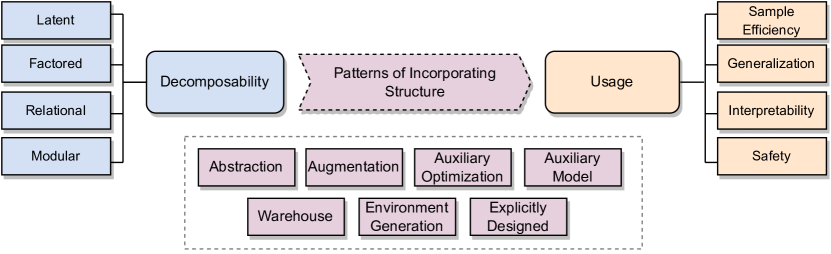
This paper proposes a unified framework for integrating structural inductive biases—such as latent, factored, relational, and modular decompositions—into deep reinforcement learning (DRL) through seven design patterns. By classifying structure as side information about problem decomposability and organizing methods into abstraction, augmentation, auxiliary optimization, auxiliary models, warehousing, environment generation, and explicitly designed patterns, the work enables more sample-efficient, generalizable, interpretable, and safe RL agents, offering a foundation for systematic design-pattern-driven RL research.
Reinforcement Learning (RL), bolstered by the expressive capabilities of Deep Neural Networks (DNNs) for function approximation, has demonstrated considerable success in numerous applications. However, its practicality in addressing various real-world scenarios, characterized by diverse and unpredictable dynamics, noisy signals, and large state and action spaces, remains limited. This limitation stems from poor data efficiency, limited generalization capabilities, a lack of safety guarantees, and the absence of interpretability, among other factors. To overcome these challenges and improve performance across these crucial metrics, one promising avenue is to incorporate additional structural information about the problem into the RL learning process. Various sub-fields of RL have proposed methods for incorporating such inductive biases. We amalgamate these diverse methodologies under a unified framework, shedding light on the role of structure in the learning problem, and classify these methods into distinct patterns of incorporating structure. By leveraging this comprehensive framework, we provide valuable insights into the challenges of structured RL and lay the groundwork for a design pattern perspective on RL research. This novel perspective paves the way for future advancements and aids in developing more effective and efficient RL algorithms that can potentially handle real-world scenarios better.
Motivation & Objective
- To address the limitations of deep reinforcement learning in real-world scenarios, such as poor data efficiency, limited generalization, and lack of interpretability.
- To unify scattered approaches for incorporating domain structure into DRL across diverse sub-fields.
- To establish a design-pattern perspective for RL by formalizing how structural inductive biases improve learning performance.
- To identify and categorize problem decomposability into four archetypes: latent, factored, relational, and modular.
- To provide a systematic framework for researchers to select appropriate structural integration patterns based on problem characteristics.
Proposed method
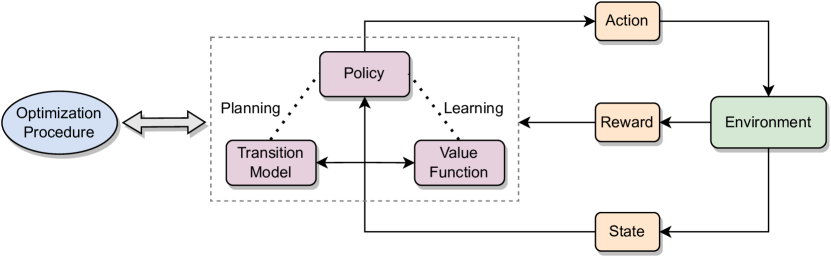
- Formalize reinforcement learning problems as Markov Decision Processes (MDPs) and define the RL pipeline with state, action, reward, and dynamics.
- Introduce 'side information' as a category of domain knowledge, with structure being a key form of such information.
- Define structure as side information about decomposability—specifically, the latent, factored, relational, and modular archetypes—representing a spectrum of problem organization.
- Propose seven patterns for incorporating structure: abstraction, augmentation, auxiliary optimization, auxiliary model, warehousing, environment generation, and explicitly designed.
- Map existing DRL methods from literature to these patterns, showing how structural inductive biases are already being used in practice.
- Use the framework to guide meta-RL research by linking task decomposability to adaptation strategies, curriculum design, and model warehousing.
Experimental results
Research questions
- RQ1How can structural inductive biases be systematically categorized and integrated into deep reinforcement learning to improve performance?
- RQ2What are the key archetypes of problem decomposability that capture the spectrum of structural information in RL problems?
- RQ3Which design patterns most effectively incorporate structural knowledge into the RL pipeline, and how do they differ in application?
- RQ4How can the integration of structure enhance sample efficiency, generalization, interpretability, and safety in RL agents?
- RQ5In what ways can this framework guide future research in meta-RL and real-world deployment of RL systems?
Key findings
- The paper identifies four core archetypes of decomposability—latent, factored, relational, and modular—that represent a spectrum of structural organization in RL problems.
- Seven distinct patterns for incorporating structure into the RL pipeline are formalized: abstraction, augmentation, auxiliary optimization, auxiliary model, warehousing, environment generation, and explicitly designed.
- The framework enables systematic mapping of existing methods to structural integration patterns, revealing shared principles across disparate sub-fields of RL.
- By linking structural decomposition to meta-RL, the framework suggests that task decomposability can guide adaptation strategies, curriculum learning, and model initialization.
- The work establishes a foundation for a design-pattern-oriented approach to RL, offering a common reference for researchers to select and develop methods based on problem structure.
- The authors conclude that while the proposed framework is a significant first step, it is not exhaustive, and future work should expand the pattern repertoire to further unify and advance the field.
Read this paper
Open the full text in the Nubint reader and ask about any passage as you read.
Read this paper on NubintThis review was generated by AI from the original paper. Please check the paper before citing it.