
[Paper Review] Study of the heavy quarks energy loss through medium polarization, elastic collision and radiative processes
This paper presents a comparative study of heavy quark energy loss in quark-gluon plasma (QGP) through three mechanisms: medium polarization, elastic collisions, and radiative processes. Using separate formalisms for each process and computing the nuclear modification factor $R_{AA}$, the study finds that medium polarization dominates at low momentum, challenging the common omission of this effect in prior models and emphasizing its essential role alongside elastic and inelastic processes for accurate QGP characterization in heavy-ion collisions.
Heavy quarks serve as crucial probes for exploring the properties of the hot and dense medium formed in heavy-ion collision experiments. Understanding the modification of their energy as they traverse the medium is a focal point of research, with various authors extensively studying this phenomenon. This study specifically concentrates on the equilibrium phase, the quark-gluon plasma, and offers a comparative analysis of heavy quark energy loss through medium polarization, elastic collisions, and radiation. Notably, while previous studies have compared polarization loss and radiation, our work extends this by incorporating elastic collisions for a more comprehensive examination. The significance of medium polarization, particularly at low momentum, is underscored, as it has been found to contribute substantially. The formalism for energy loss and drag coefficient in each case is presented, followed by the calculation of the nuclear modification factor ($R_{AA}$) for a holistic comparative study.
Motivation & Objective
- To provide a systematic and comparative analysis of heavy quark energy loss mechanisms in quark-gluon plasma (QGP), focusing on medium polarization, elastic collisions, and radiative processes.
- To address the gap in existing literature where medium polarization is often neglected despite its significant contribution, especially at low momentum.
- To compute and compare the nuclear modification factor $R_{AA}$ for each energy loss mechanism to assess their relative importance in RHIC and LHC energy regimes.
- To establish a formal framework for each process—using Wong equations for polarization, Fokker-Planck for elastic scattering, and bremsstrahlung for radiation—enabling quantitative comparison.
- To advocate for the inclusion of medium polarization in future transport models of heavy quarks in QGP to achieve a more comprehensive understanding of medium properties and dynamics.
Proposed method
- Formalism for medium polarization energy loss is derived using the Wong equations and the Boltzmann-Vlasov transport equation to compute the induced chromo-electric field and its back-reaction on the heavy quark.
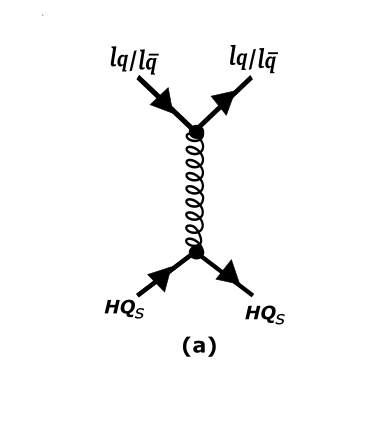
- Elastic collision energy loss is modeled via the Fokker-Planck equation, with matrix elements computed for $2\to2$ processes involving light quarks, antiquarks, and gluons, including degeneracy factors and color structures.
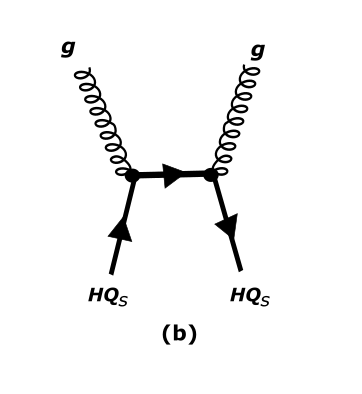
- Radiative energy loss is treated through soft gluon emission (bremsstrahlung), with matrix elements calculated for s-, t-, and u-channel processes involving gluons, including interference terms.
- The drag force and energy loss rate are computed for each mechanism separately, using relativistic kinematics and QCD coupling constants.
- The nuclear modification factor $R_{AA}$ is calculated using the Langevin equation, incorporating the drag and diffusion coefficients from each process to enable direct comparison.
- All results are evaluated at RHIC and LHC energy scales, with parameters such as temperature, quark mass, and Debye screening mass used consistently across cases.
Experimental results
Research questions
- RQ1How does medium polarization contribute to heavy quark energy loss compared to elastic and radiative processes in QGP?
- RQ2What is the momentum dependence of energy loss from each mechanism, particularly at low transverse momentum?
- RQ3To what extent does the inclusion of medium polarization alter the predicted $R_{AA}$ values for heavy quarks in heavy-ion collisions?
- RQ4Are the contributions from medium polarization, elastic scattering, and radiative processes comparable in magnitude across relevant energy scales?
- RQ5How does the dominance of polarization at low momentum affect the interpretation of experimental $R_{AA}$ data in heavy-ion experiments?
Key findings
- Medium polarization contributes significantly to heavy quark energy loss, especially at low momentum, where it dominates over elastic and radiative processes.
- The energy loss due to medium polarization is found to be comparable in magnitude to that from elastic and inelastic (radiative) processes, challenging the assumption that it is negligible.
- The nuclear modification factor $R_{AA}$ computed from medium polarization shows a distinct momentum dependence, peaking at low $p_T$, indicating its strong influence in the soft momentum regime.
- At RHIC and LHC energies, the three mechanisms—polarization, elastic scattering, and radiation—contribute similarly to total energy loss, suggesting that all must be included for accurate modeling.
- The inclusion of medium polarization improves the consistency of theoretical $R_{AA}$ predictions with experimental data, particularly in the low-$p_T$ region where suppression is most sensitive.
- Future modeling should incorporate memory effects and expanding medium dynamics, with polarization playing a key role in the build-up of $v_2$ and other flow observables.
Read this paper
Open the full text in the Nubint reader and ask about any passage as you read.
Read this paper on NubintThis review was generated by AI from the original paper. Please check the paper before citing it.