
[Paper Review] Sub-Terahertz Spatial Statistical MIMO Channel Model for Urban Microcells at 142 GHz
This paper proposes a spatial statistical MIMO channel model for 142 GHz in urban microcells based on extensive measurements, modeling cluster count and power distribution. Using a bi-directional channel generation procedure, it shows beamforming outperforms spatial multiplexing in LOS due to strong line-of-sight paths, while two-stream spatial multiplexing achieves optimal spectral efficiency in NLOS scenarios due to limited strong clusters.
Sixth generation (6G) cellular systems are expected to extend the operational range to sub-Terahertz (THz) frequencies between 100 and 300 GHz due to the broad unexploited spectrum therein. A proper channel model is needed to accurately describe spatial and temporal channel characteristics and faithfully create channel impulse responses at sub-THz frequencies. This paper studies the channel spatial statistics such as the number of spatial clusters and cluster power distribution based on recent radio propagation measurements conducted at 142 GHz in an urban microcell (UMi) scenario. For the 28 measured locations, we observe one to four spatial clusters at most locations. A detailed spatial statistical multiple input multiple output (MIMO) channel generation procedure is introduced based on the derived empirical channel statistics. We find that beamforming provides better spectral efficiency than spatial multiplexing in the LOS scenario due to the boresight path, and two spatial streams usually offer the highest spectral efficiency at most NLOS locations due to the limited number of spatial clusters.
Motivation & Objective
- To characterize spatial channel statistics at 142 GHz in an urban microcell environment for future 6G systems.
- To develop a statistical MIMO channel model based on empirical measurements of spatial clusters, power distribution, and angular spread.
- To evaluate spectral efficiency trade-offs between beamforming and spatial multiplexing in LOS and NLOS conditions.
- To provide a practical channel generation procedure for system-level simulations at sub-THz frequencies.
Proposed method
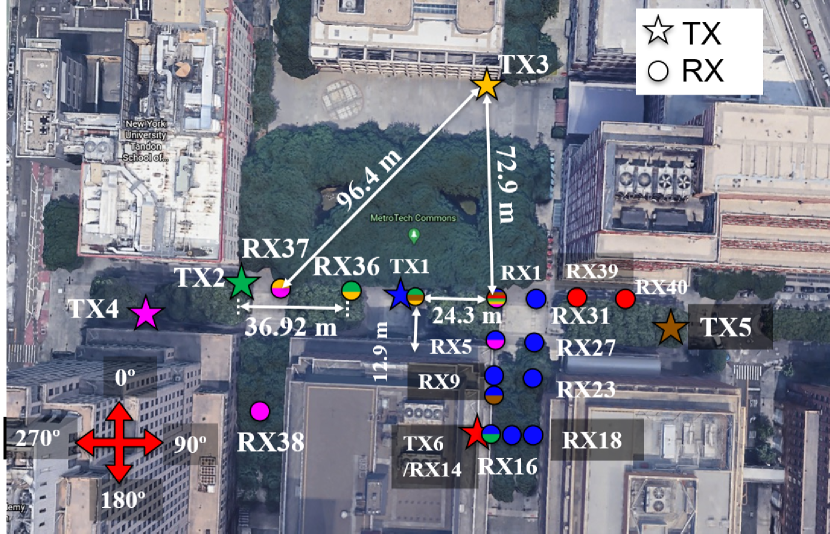
- Conducted 28 UMi propagation measurements at 142 GHz across 12.9–117.4 m distances using directional horn antennas with 27 dBi gain and 8° HPBW.
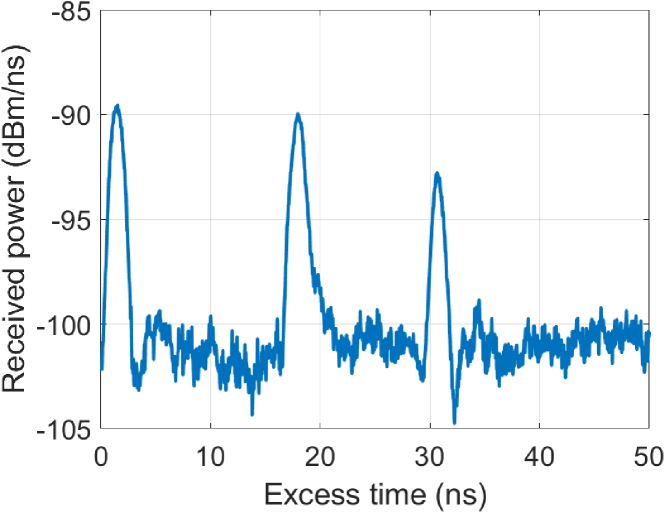
- Modelled the number of spatial clusters as a Poisson random variable with an average of ~2 clusters per location.
- Derived cluster power distribution and omnidirectional RMS angular spread from measured channel impulse responses.
- Proposed a bi-directional MIMO channel generation procedure using singular value decomposition (SVD) with eigenbeamforming for precoding and combining.
- Simulated thousands of channel matrices using the statistical model to evaluate spectral efficiency under beamforming and spatial multiplexing.
- Assumed perfect channel state information at the base station and used 16×8 and 4×2 uniform rectangular arrays (URAs) at BS and UE, respectively.
Experimental results
Research questions
- RQ1How many spatial clusters are typically present in sub-THz MIMO channels at 142 GHz in urban microcells?
- RQ2What is the distribution of cluster power and angular spread in LOS and NLOS propagation environments at 142 GHz?
- RQ3Under what SNR conditions does spatial multiplexing outperform beamforming in sub-THz MIMO systems?
- RQ4What is the optimal number of data streams for maximizing spectral efficiency in LOS and NLOS scenarios at 142 GHz?
Key findings
- The average number of spatial clusters across all 28 measurement locations is approximately two, with one to four clusters observed per location.
- In LOS scenarios, beamforming provides higher spectral efficiency than spatial multiplexing due to the strong boresight path, especially at low SNR.
- The spectral efficiency threshold for spatial multiplexing to outperform beamforming is 24 dB SNR in LOS and 15 dB SNR in NLOS conditions.
- In NLOS environments, two-stream spatial multiplexing achieves the highest spectral efficiency, as multiple clusters have comparable power and are more suitable for multiplexing.
- Even though up to six spatial clusters were observed, weak late-arriving clusters contribute negligible power and are unreliable for transmission.
- Cluster power distribution shows that first-arriving clusters carry significantly more power than later clusters, indicating strong dominance of early reflections or LOS components.
Read this paper
Open the full text in the Nubint reader and ask about any passage as you read.
Read this paper on NubintThis review was generated by AI from the original paper. Please check the paper before citing it.