
[Paper Review] Super-Resolution Analysis via Machine Learning: A Survey for Fluid Flows
This survey presents machine learning-based super-resolution techniques for reconstructing high-resolution vortical flows from low-resolution or sparse measurements in fluid dynamics. By integrating physics-informed loss functions and CNN architectures, the method successfully reconstructs turbulent flow structures even with limited data, demonstrating improved accuracy and robustness over traditional interpolation methods.
This paper surveys machine-learning-based super-resolution reconstruction for vortical flows. Super resolution aims to find the high-resolution flow fields from low-resolution data and is generally an approach used in image reconstruction. In addition to surveying a variety of recent super-resolution applications, we provide case studies of super-resolution analysis for an example of two-dimensional decaying isotropic turbulence. We demonstrate that physics-inspired model designs enable successful reconstruction of vortical flows from spatially limited measurements. We also discuss the challenges and outlooks of machine-learning-based super-resolution analysis for fluid flow applications. The insights gained from this study can be leveraged for super-resolution analysis of numerical and experimental flow data.
Motivation & Objective
- To survey recent machine learning-based super-resolution methods tailored for vortical flows in fluid dynamics.
- To investigate how physics-informed model designs enhance reconstruction accuracy from sparse or low-resolution data.
- To evaluate the performance of supervised, semi-supervised, and unsupervised learning approaches in reconstructing turbulent flow fields.
- To identify key challenges in applying super-resolution to real-world fluid flow problems with noisy or incomplete measurements.
- To explore future directions, including integration with data assimilation and multi-modal sensor data.
Proposed method
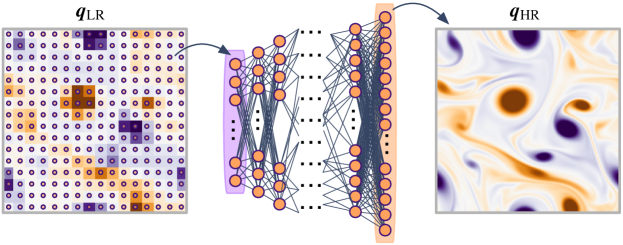
- Utilizes deep neural networks—specifically fully-connected networks, convolutional neural networks (CNNs), and generative adversarial networks (GANs)—to learn the nonlinear mapping from low-resolution to high-resolution flow fields.
- Employs physics-inspired loss functions that enforce physical consistency, such as divergence-free flow or energy conservation, to improve generalization and stability.
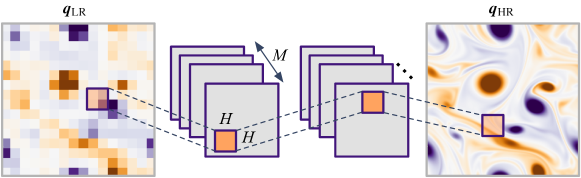
- Applies multi-scale CNN architectures with residual connections to capture fine-scale vortical structures across different spatial scales.
- Uses supervised training with paired low- and high-resolution flow data, and explores semi-supervised and unsupervised settings using unpaired data or self-supervised signals.
- Incorporates data assimilation techniques to combine real-time sparse observations with model predictions for improved temporal reconstruction.
- Validates models using two-dimensional decaying isotropic turbulence as a benchmark, comparing reconstruction fidelity against baseline interpolation and numerical solvers.
Experimental results
Research questions
- RQ1How can physics-informed machine learning models improve super-resolution reconstruction of vortical flows from limited or noisy data?
- RQ2What is the relative performance of supervised, semi-supervised, and unsupervised learning in reconstructing high-resolution turbulent flow fields?
- RQ3To what extent can physics-based loss functions enhance the generalization and robustness of super-resolution models in fluid dynamics?
- RQ4How can super-resolution be extended to real-world applications involving sparse, multi-modal, or time-evolving measurements?
- RQ5What are the key challenges in deploying super-resolution models for industrial and experimental fluid dynamics, particularly regarding data quality and uncertainty quantification?
Key findings
- Physics-informed loss functions significantly improve reconstruction accuracy and stability, especially when training data is limited or noisy.
- CNN-based models with multi-scale filters and residual connections successfully recover fine-scale vortical structures in two-dimensional decaying isotropic turbulence.
- Supervised learning with paired data achieves high-fidelity reconstruction, but unsupervised and semi-supervised methods show promise for real-world scenarios with unpaired or incomplete data.
- The integration of super-resolution with data assimilation enables dynamic, time-resolved reconstruction of flow fields using low-resolution simulations and sparse observations.
- Robustness to noisy inputs remains a critical challenge, and future models must include uncertainty quantification to ensure reliability in industrial applications.
- High-quality training data is essential, but the sensitivity of models to data quality underscores the need for systematic evaluation and data curation in fluid dynamics ML research.
Read this paper
Open the full text in the Nubint reader and ask about any passage as you read.
Read this paper on NubintThis review was generated by AI from the original paper. Please check the paper before citing it.