
[論文レビュー] Superconducting Diode Effect -- Fundamental Concepts, Material Aspects, and Device Prospects
A comprehensive review of the superconducting diode effect (SDE), covering fundamental mechanisms, material platforms, and device prospects, with emphasis on magnetochiral anisotropy, spin-orbit coupling, and finite-momentum pairing.
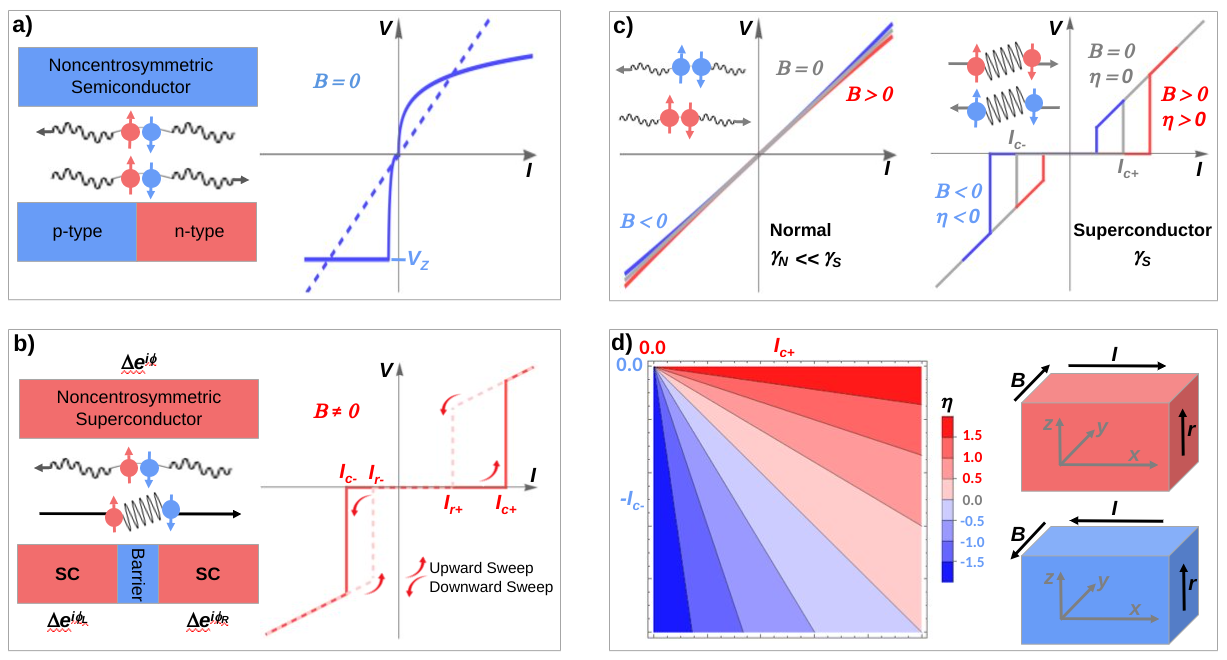
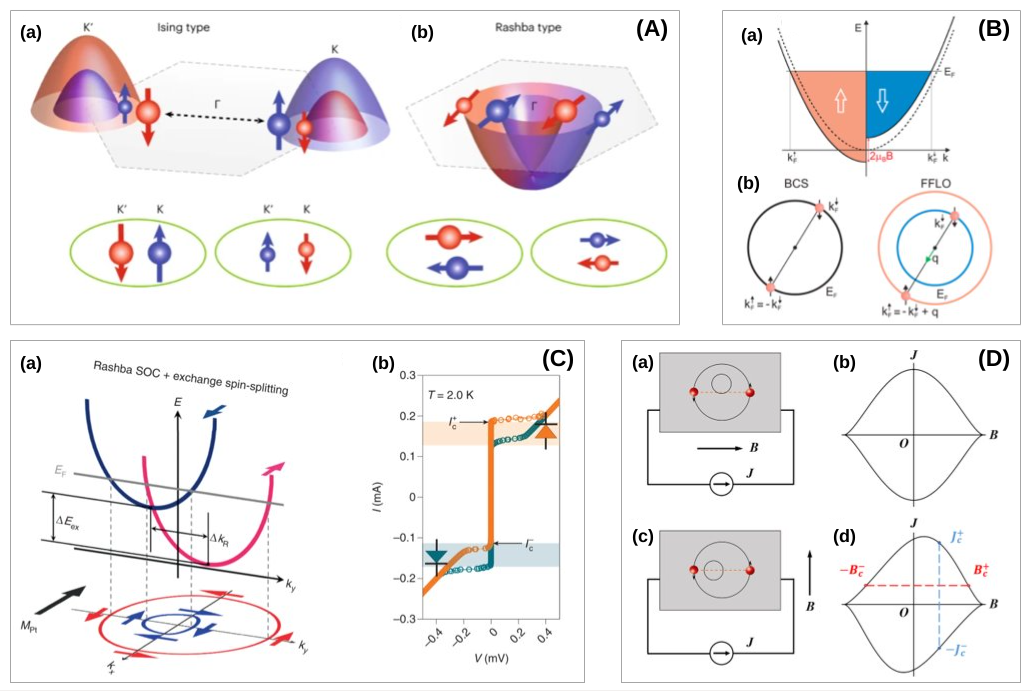
Superconducting diode effect, in analogy to the nonreciprocal resistive charge transport in semiconducting diode, is a nonreciprocity of dissipationless supercurrent. Such an exotic phenomenon originates from intertwining between symmetry-constrained supercurrent transport and intrinsic quantum functionalities of helical/chiral superconductors. In this article, research progress of superconducting diode effect including fundamental concepts, material aspects, device prospects, and theoretical/experimental development is reviewed. First, fundamental mechanisms to cause superconducting diode effect including simultaneous space-inversion and time-reversal symmetry breaking, magnetochiral anisotropy, interplay between spin-orbit interaction energy and the characteristic energy scale of supercurrent carriers, and finite-momentum Cooper pairing are discussed. Second, the progress of superconducting diode effect from theoretical predictions to experimental observations are reviewed. Third, interplay between various system parameters leading to superconducting diode effect with optimal performance is presented. Then, it is explicitly highlighted that nonreciprocity of supercurrent can be characterized either by current-voltage relation obtained from resistive direct-current measurements in the metal-superconductor fluctuation region ($T\approx T_c$) or by current-phase relation and nonreciprocity of superfluid inductance obtained from alternating-current measurements in the superconducting phase ($T
研究の動機と目的
- Summarize fundamental concepts and mechanisms that enable the superconducting diode effect (SDE).
- Review theoretical and experimental progress from bulk superconductors to engineered devices.
- Classify materials and device architectures where SDE has been observed.
- Discuss how SDE strength depends on system parameters and measurement approaches.
- Provide perspectives on future directions linking band topology and helical superconductivity.
提案手法
- Discuss symmetry breaking requirements (inversion and time-reversal) and magnetochiral anisotropy as origins of SDE.
- Describe how MCA affects current-voltage and inductance-based measurements in resistive and superconducting regimes.
- Summarize theoretical frameworks (Ginzburg-Landau, Bogoliubov–de Gennes, mean-field) used to model SDE.
- Outline experimental observation methods for SDE in dc resistive and ac inductive settings.
- Assess material parameters (SOI, magnetization, chemical potential, disorder) that optimize SDE.
実験結果
リサーチクエスチョン
- RQ1What symmetry conditions and mechanisms give rise to nonreciprocal supercurrent (SDE) in superconductors?
- RQ2How do material properties and device design influence the strength and tunability of SDE?
- RQ3Can SDE be realized intrinsically in junction-free bulk superconductors as well as in Josephson junctions?
- RQ4What measurement strategies (dc resistance near Tc vs. ac inductance in the superconducting phase) best characterize SDE?
- RQ5What is the role of spin-orbit coupling and helix/chiral superconductivity in enabling SDE?
主な発見
- スペース反転対称性と時間反転対称性が同時に破れると非 reciprocity が生じ、有限運動量のクーパー対が可能になる。
- Tc 付近の揺らぎ/抵抗域では MCA により大きな非対称電流が得られ、いくつかの材料では gamma_S が gamma_N を大きく上回る。
- ジャンクションなしの非中心対称バルク超伝導体および JJ ベースのデバイスで、さまざまな材料と障壁を用いて SDE を観測できる。
- SDE の強さは磁場の向き、温度、SOI、化学ポテンシャル、乱れに依存し、Tc 近傍の dc I–V や超伝導相の ac 誘導性測定で調べられる。
- Ising 型および Rashba 型のスピン軌道結合と適切な磁化方向は SDE を強化し、トポロジー/ねじれ系超伝導と関連する。
- 非従来型およびトポロジック超伝導体における SDE の観測は、超伝導電子工学および量子技術のより広いプラットフォーム機会を示唆する。
より良い研究を、今すぐ始めましょう
論文設計から論文執筆まで、研究時間を劇的に削減しましょう。
クレジットカード登録不要
このレビューはAIが作成し、人間の編集者が確認しました。