
[Paper Review] Superdiffusive to Ballistic Transports in Nonintegrable Rydberg Chains
This paper demonstrates that in strongly interacting Rydberg chains under the condition $g,h \ll k_{\textrm{B}}T \ll V$, energy transport transitions from superdiffusive ($\alpha = \frac{3}{4}$) to ballistic as a longitudinal field $h$ increases, driven by a Hilbert space factorization due to approximate symmetries. The findings, confirmed via Krylov-typicality and matrix-product-state simulations, reveal a novel dynamical universality class and a field-tuned superdiffusion-to-ballistic transition, verifiable in current Rydberg quantum simulators.
A common wisdom posits that transports of conserved quantities across clean nonintegrable quantum systems at high temperatures are diffusive when probed from the emergent hydrodynamic regime. We show that this empirical paradigm may alter if the strong interaction limit is taken. Using Krylov-typicality and purification matrix-product-state methods, we establish the following observations for the strongly interacting version of the mixed-field Ising chain, a nonintegrable lattice model imitating the experimental Rydberg blockade array. Given the strict projection owing to the infinite density-density repulsion $V$, the chain's energy transport in the presence of a transverse field $g$ is superdiffusive at infinite temperature featured by an anomalous scaling exponent $\frac{3}{4}$, indicating the existence of a novel dynamical universality class. Imposing, in addition, a growing longitudinal field $h$ causes a drastic factorization of the whole Hilbert space into smaller subsectors, evidenced by the spectral parsing of the eigenstate entanglement. Being a consequence of this approximate symmetry, a superdiffusion-to-ballistic transport transition arises at $h\approx g$. Interestingly, all the above results persist for large but finite interactions and temperatures, provided that the strongly interacting condition $g,h\ll k_ extrm{B}T\ll V$ is fulfilled. Our predictions are verifiable by current experimental facilities.
Motivation & Objective
- To investigate the transport properties of nonintegrable Rydberg chains under strong interaction limits where $H_{\textrm{int}} \to \infty$ and $H_0 \ll k_{\textrm{B}}T \ll H_{\textrm{int}}$.
- To determine how the interplay between transverse field $g$, longitudinal field $h$, and high temperature $T$ modifies energy transport beyond the standard diffusive paradigm.
- To identify the emergence of a new dynamical universality class characterized by anomalous scaling exponent $\alpha = \frac{3}{4}$ in the superdiffusive regime.
- To explore the transition from superdiffusive to ballistic transport as $h$ increases, and to understand its origin in Hilbert space factorization and approximate symmetries.
- To verify the robustness of these transport phases across finite but large $V$ and $T$, ensuring experimental relevance.
Proposed method
- Employing Krylov-typicality and purification matrix-product-state methods to simulate real-time dynamics in large Rydberg chains with $L \leq 65$.
- Using the return probability $\langle \psi_0 | e^{iHt} \mathcal{O} e^{-iHt} | \psi_0 \rangle$ with $\mathcal{O} = \sigma^x$ to probe energy transport via the ${XX}$ component.
- Applying finite-size scaling and data collapse techniques to extract the dynamical exponent $\alpha$ from spatiotemporal correlation profiles.
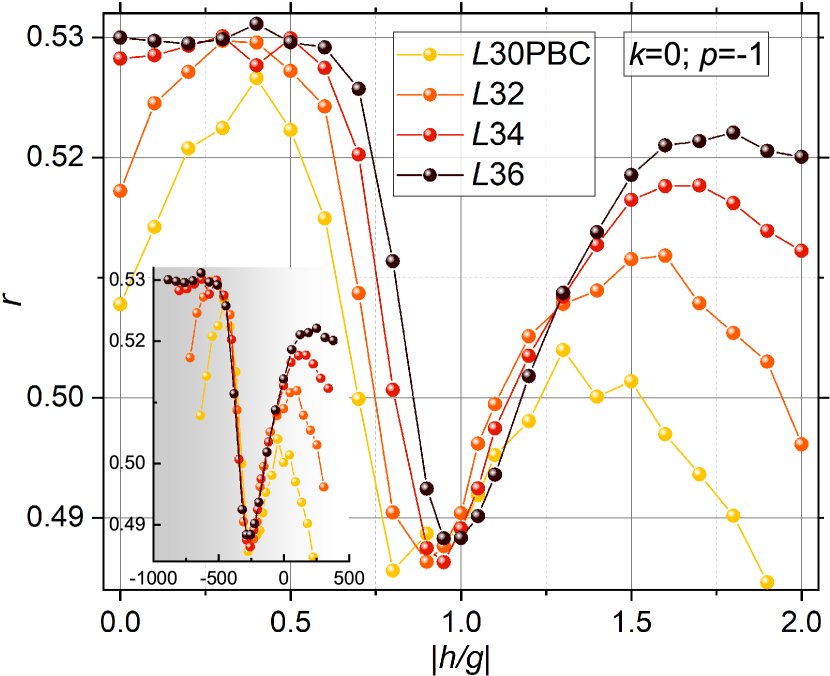
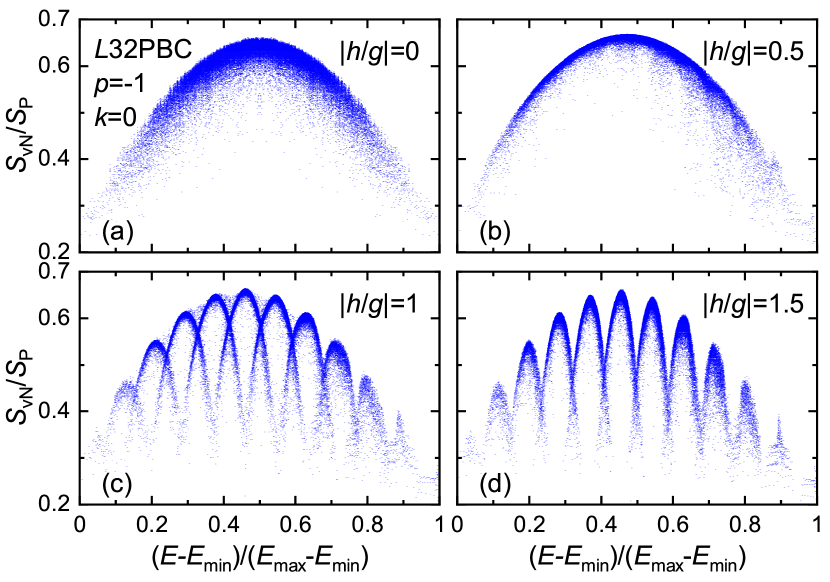
- Analyzing the level-spacing ratio $r$ and entanglement entropy to diagnose spectral statistics and eigenstate thermalization, confirming GOE behavior in the absence of $h$.
- Varying $k_{\textrm{B}}T$ and $h$ while fixing $V = 100g$ to map the temperature- and field-tuned crossovers between superdiffusion, normal diffusion, and ballistic transport.
- Using the scaling ansatz $|C^{{XX}}| \propto t^{-\alpha} f[(i-i_c)/t^{\alpha}]$ to test superdiffusive behavior and validate $\alpha = \frac{3}{4}$.
Experimental results
Research questions
- RQ1Does energy transport in nonintegrable Rydberg chains remain diffusive when strong interactions and high temperatures are simultaneously present?
- RQ2What is the nature of energy transport in the strongly interacting limit $V \to \infty$ with $g,h \ll k_{\textrm{B}}T \ll V$, particularly in the absence of a longitudinal field?
- RQ3How does the addition of a longitudinal field $h$ affect the transport properties and the underlying Hilbert space structure of the system?
- RQ4Can a superdiffusion-to-ballistic transport transition be induced by tuning $h$, and what is the mechanism behind it?
- RQ5Are the observed transport phases robust at finite but large $V$ and across a range of temperatures, making them experimentally accessible?
Key findings
- At $h = 0$, energy transport is superdiffusive with a dynamical exponent $\alpha = \nonefffrac{3}{4}$, confirmed via finite-size scaling across $L = 33, 49, 65$.
- The superdiffusive phase persists over a temperature range $k_{\textrm{B}}T \in [10g, 20g]$, with data collapse supporting the $\alpha = \frac{3}{4}$ scaling and deviation from Gaussian profiles.
- At $h = 3g$, the system exhibits ballistic energy transport, evidenced by a linear power-law decay $\sim t^{-1}$ in the return probability, stable up to $k_{\textrm{B}}T = 10g$.
- A temperature-tuned crossover from ballistic to normal diffusion occurs at $k_{\textrm{B}}T = 50g$, indicating a robust ballistic phase at moderate $h$.
- The transition from superdiffusion to ballistic transport at $h \approx g$ is linked to a factorization of the Hilbert space into smaller subsectors, as revealed by spectral parsing and entanglement diagnostics.
- The results are robust under finite $V = 100g$, confirming that the anomalous transport phases survive in the regime $g,h \ll k_{\textrm{B}}T \ll V$, making them experimentally verifiable in current Rydberg blockade arrays.
Read this paper
Open the full text in the Nubint reader and ask about any passage as you read.
Read this paper on NubintThis review was generated by AI from the original paper. Please check the paper before citing it.