
[Paper Review] Supervised Learning and Large Language Model Benchmarks on Mental Health Datasets: Cognitive Distortions and Suicidal Risks in Chinese Social Media
This paper introduces two new expert-annotated Chinese social media datasets for cognitive distortions and suicidal risk classification, and evaluates supervised learning versus large language models (LLMs) like GPT-3.5 and GPT-4 using zero-shot, few-shot, and fine-tuning strategies. GPT-4 consistently outperforms other models, while fine-tuning significantly improves GPT-3.5’s performance on suicide risk classification, highlighting LLMs' potential but also limitations in nuanced psychological text analysis.
On social media, users often express their personal feelings, which may exhibit cognitive distortions or even suicidal tendencies on certain specific topics. Early recognition of these signs is critical for effective psychological intervention. In this paper, we introduce two novel datasets from Chinese social media: SOS-HL-1K for suicidal risk classification and SocialCD-3K for cognitive distortions detection. The SOS-HL-1K dataset contained 1,249 posts and SocialCD-3K dataset was a multi-label classification dataset that containing 3,407 posts. We propose a comprehensive evaluation using two supervised learning methods and eight large language models (LLMs) on the proposed datasets. From the prompt engineering perspective, we experimented with two types of prompt strategies, including four zero-shot and five few-shot strategies. We also evaluated the performance of the LLMs after fine-tuning on the proposed tasks. The experimental results show that there is still a huge gap between LLMs relying only on prompt engineering and supervised learning. In the suicide classification task, this gap is 6.95% points in F1-score, while in the cognitive distortion task, the gap is even more pronounced, reaching 31.53% points in F1-score. However, after fine-tuning, this difference is significantly reduced. In the suicide and cognitive distortion classification tasks, the gap decreases to 4.31% and 3.14%, respectively. This research highlights the potential of LLMs in psychological contexts, but supervised learning remains necessary for more challenging tasks. All datasets and code are made available.
Motivation & Objective
- To address the lack of fine-grained mental health NLP resources in Chinese social media, especially for cognitive distortions and suicidal risk.
- To evaluate the comparative effectiveness of supervised learning and large language models (LLMs) on these new datasets.
- To investigate how prompt engineering strategies—zero-shot, few-shot, and fine-tuning—affect LLM performance in psychological text classification.
- To provide psychological insights into LLMs’ strengths and limitations in recognizing subtle emotional cues in mental health contexts.
- To release open-source datasets and code to support future research in mental health NLP and suicide prevention.
Proposed method
- Two novel, expert-annotated datasets were constructed from Sina Weibo comments, focusing on cognitive distortions and suicidal risk classification.
- A comprehensive benchmark was designed comparing traditional supervised learning models with LLMs (GPT-3.5, GPT-4, ChatGLM2-6B, GLM-130B) across three prompting strategies: zero-shot, few-shot, and fine-tuning.
- For LLMs, zero-shot used direct prompt templates; few-shot employed few labeled examples as demonstrations; fine-tuning involved fine-tuning on the full training set.
- Model performance was evaluated using standard NLP metrics such as F1-score, precision, and recall, with statistical significance testing.
- Psychological interpretation of model predictions was conducted to assess alignment with clinical understanding of cognitive distortions and suicidal ideation.
- All datasets and code were released via GitHub to ensure reproducibility and community reuse.
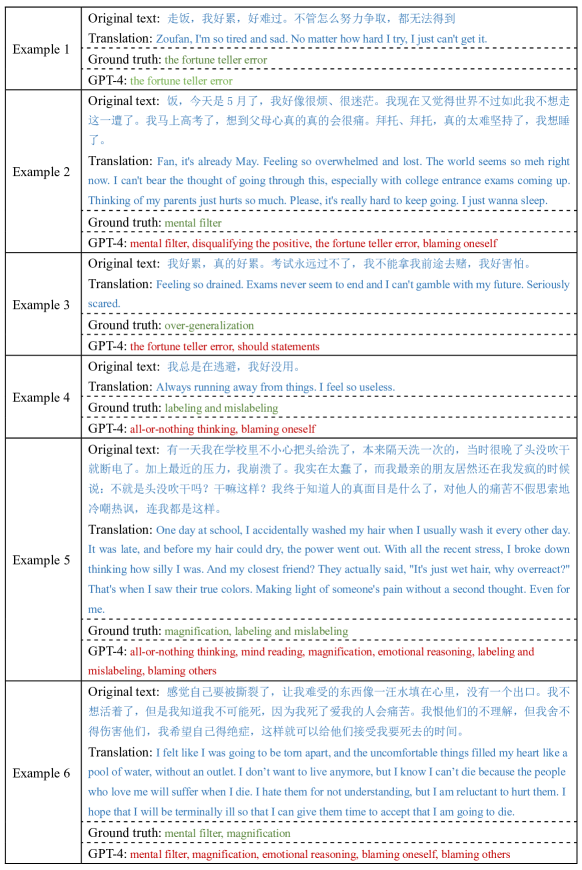
Experimental results
Research questions
- RQ1How do large language models (LLMs) perform in classifying cognitive distortions and suicidal risk in Chinese social media text compared to supervised learning models?
- RQ2Does fine-tuning improve the performance of LLMs on mental health classification tasks, particularly for complex or subtle emotional cues?
- RQ3How effective are zero-shot and few-shot prompting strategies in enabling LLMs to generalize to mental health text without task-specific fine-tuning?
- RQ4What are the psychological limitations of LLMs in distinguishing between subtle emotional nuances in mental health-related language?
- RQ5To what extent do model size and architecture influence performance on these psychologically sensitive NLP tasks?
Key findings
- GPT-4 demonstrated consistently strong performance across both cognitive distortion and suicide risk classification tasks, outperforming other models.
- GPT-3.5 showed marked improvement in suicide risk classification after fine-tuning, indicating that fine-tuning can significantly enhance performance on specific mental health tasks.
- Few-shot prompting did not consistently improve performance, suggesting that simply adding examples to prompts is not sufficient for complex psychological classification.
- The performance gap between supervised learning and LLMs remains notable, especially for fine-grained cognitive distortion detection, indicating LLMs are not yet a universal replacement.
- Model performance was highly dependent on task complexity and model size, with larger models like GPT-4 showing greater robustness to subtle linguistic cues.
- The study confirms that LLMs, while promising, still face challenges in accurately capturing nuanced psychological states, especially when distinctions are subtle.
Read this paper
Open the full text in the Nubint reader and ask about any passage as you read.
Read this paper on NubintThis review was generated by AI from the original paper. Please check the paper before citing it.