
[Paper Review] Surface-near domain engineering in multi-domain x-cut lithium niobate tantalate mixed crystals
This study demonstrates surface-near periodic poling in x-cut lithium niobate tantalate (LiNb1−xTaxO3) mixed crystals using electric field poling with lithographically structured electrodes. Despite challenges from naturally occurring head-to-head and tail-to-tail domain walls, periodic domain inversion is achieved when electrode gap size is comparable to or smaller than the intrinsic domain size (~10–30 µm), enabling quasi-phase matching for integrated nonlinear photonics applications.
Lithium niobate and lithium tantalate are among the most widespread materials for nonlinear, integrated photonics. Mixed crystals with arbitrary Nb-Ta ratios provide a new degree of freedom to tune materials properties, such as the birefringence, but also leverage the advantages of the singular compounds, for example, by combining the thermal stability of lithium tantalate with the larger nonlinear or piezoelectric constants of lithium niobate. Periodic poling is the prerequisite for any nonlinear optical application. For mixed crystals this has been challenging so far due to the lack of homogeneous, mono-domain crystals, which severely inhibit domain growth and nucleation. In this work we demonstrate that surface-near ($< 1$~$μ$m depth) periodic poling on x-cut lithium niobate tantalate mixed crystals can be achieved via electric field poling and lithographically structured electrodes. We find that naturally occurring head-to-head or tail-to-tail domain walls in the as-grown crystal inhibit domain inversion at a larger scale. However, periodic poling is possible, if the gap size between the poling electrodes is of the same order of magnitude or smaller than the average size of naturally occurring domains. This work provides the basis for the nonlinear optical application of lithium niobate tantalate mixed crystals.
Motivation & Objective
- To enable periodic poling in multi-domain x-cut lithium niobate tantalate (LNTx) mixed crystals, which are otherwise hindered by random domain structures.
- To investigate the role of naturally occurring head-to-head and tail-to-tail domain walls in inhibiting large-scale domain inversion during poling.
- To determine the conditions under which surface-near periodic domain engineering is feasible in LNTx, despite the absence of single-domain crystals.
- To explore the potential of conductive domain walls as nucleation sites for domain inversion under applied electric fields.
- To establish a foundation for nonlinear optical devices in the LNTx material system using localized poling techniques.
Proposed method
- Electric field poling at room temperature using lithographically defined metal electrodes with controlled gap sizes (g) on x-cut LNTx wafers.
- Application of multiple electrical pulses with alternating polarity to induce periodic domain inversion, even in initially multidomain crystals.
- Use of a 3 ms pulse duration and electric fields up to 60 kV/mm to drive domain nucleation and growth.
- Employment of polarization microscopy to image domain structures before and after poling, identifying nucleation sites and growth dynamics.
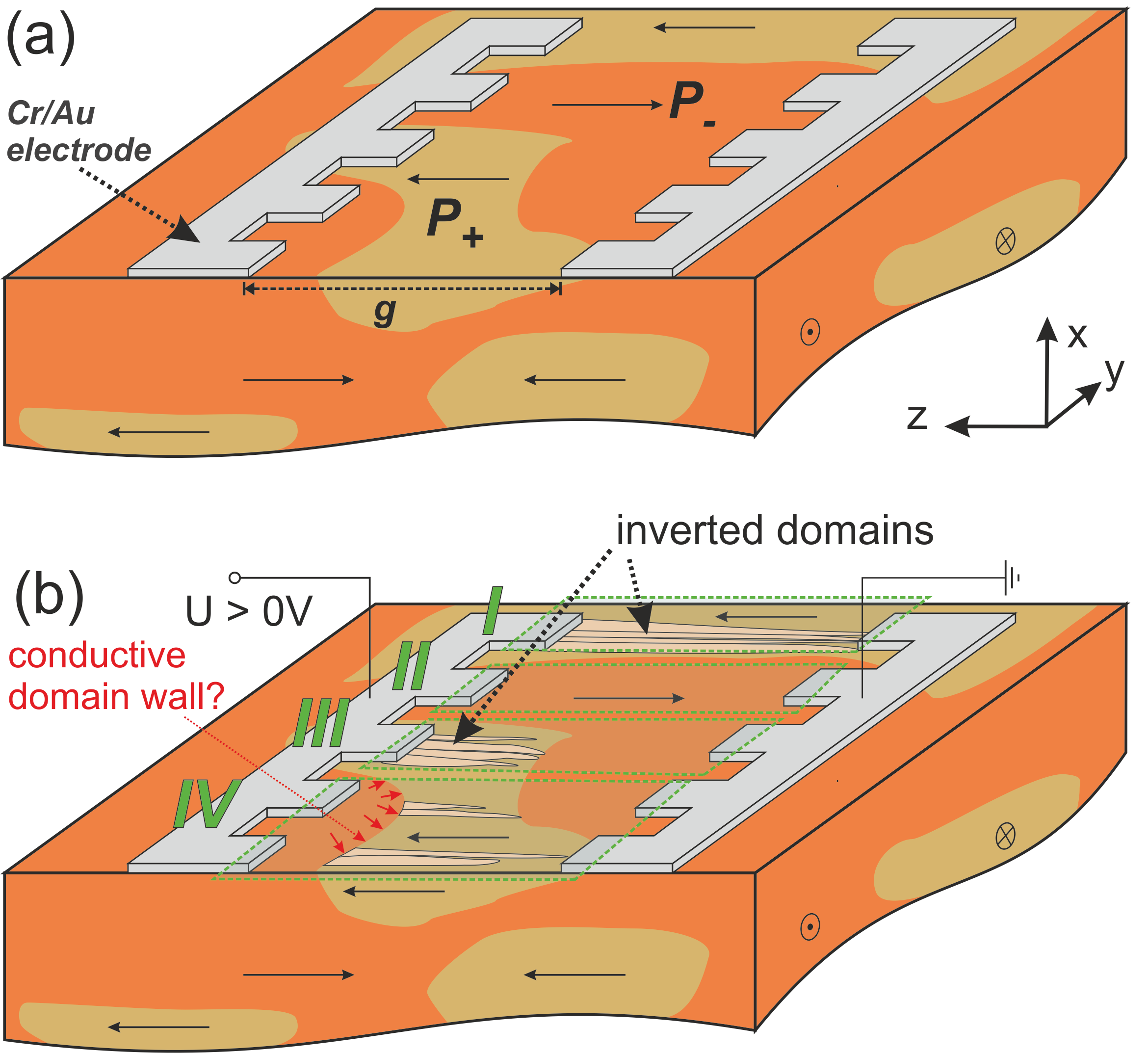
- Analysis of domain wall conductivity as a potential mechanism for nucleation at head-to-head domain walls, particularly when in contact with electrodes.
- Comparison of poling outcomes across different domain configurations (Case I, III, IV) to assess the influence of original domain orientation and defect structures.
Experimental results
Research questions
- RQ1Can surface-near periodic poling be achieved in multi-domain x-cut LiNb1−xTa xO3 crystals despite the presence of naturally occurring head-to-head and tail-to-tail domain walls?
- RQ2What is the critical relationship between electrode gap size and intrinsic domain size for successful periodic poling in LNTx crystals?
- RQ3Under what conditions can head-to-head domain walls serve as nucleation sites for domain inversion, and is their conductivity a necessary factor?
- RQ4How do defect structures and line defects within the crystal influence domain growth and poling stability?
- RQ5To what extent do existing domain patterns in as-grown LNTx crystals act as pinning centers that inhibit large-scale domain inversion?
Key findings
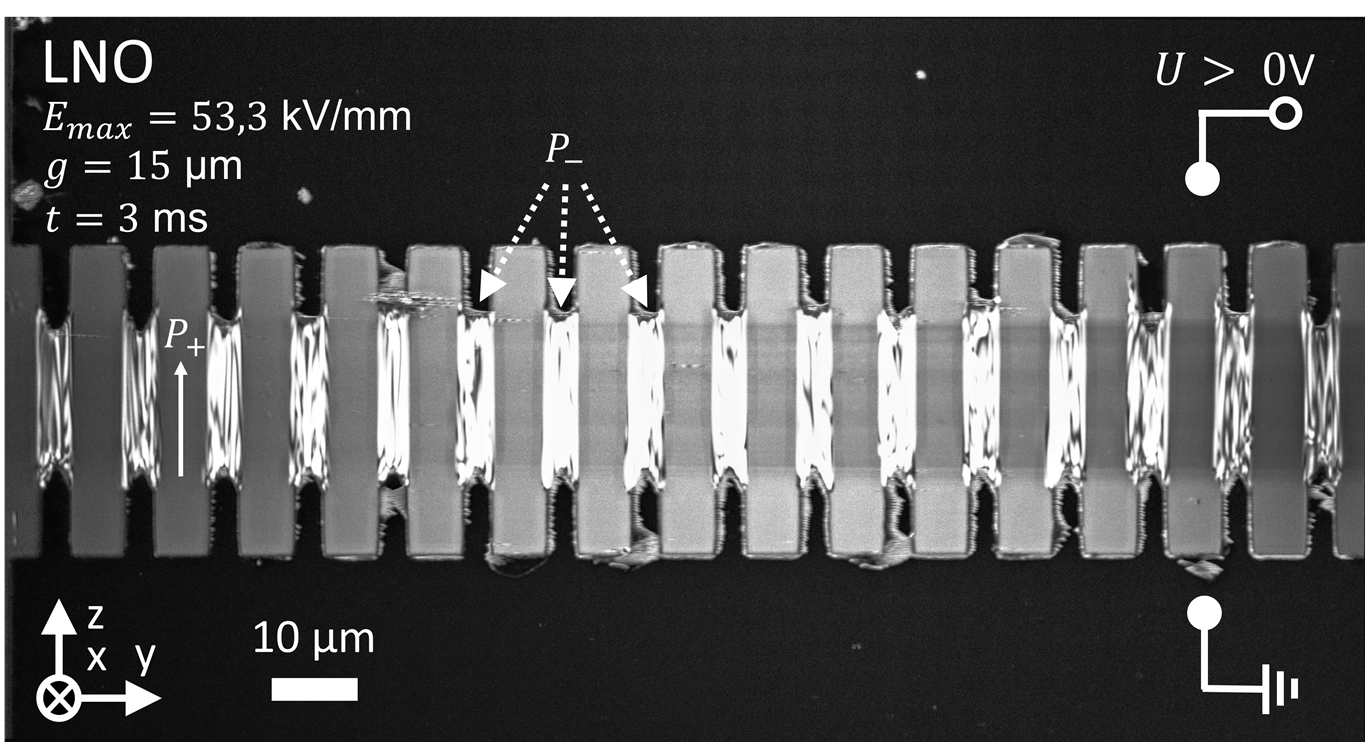
- Surface-near periodic poling with periods of 10 µm and gaps up to 30 µm is successfully achieved in x-cut LiNb1−xTa xO3 mixed crystals using electric field poling.
- Nucleation and growth of inverted domains occur when the original domain within the electrode gap is oriented opposite to the applied field, confirming the expected behavior for ferroelectric switching.
- Head-to-head domain walls can act as nucleation sites for domain inversion if they are conductive and in electrical contact with the electrodes, as evidenced by localized domain formation in Case IV.
- Even at high electric fields (up to 60 kV/mm), nucleation is suppressed in regions with high domain density (average spacing ≤5 µm), indicating strong pinning by the intrinsic domain structure.
- Reversed poling pulses cause only partial back-poling, indicating that many domains remain strongly pinned and stable, suggesting high energy barriers to reversal.
- Defects such as line defects can act as strong pinning sites, halting domain growth from both electrodes and enabling stable periodic poling with minimal reverse poling.
Read this paper
Open the full text in the Nubint reader and ask about any passage as you read.
Read this paper on NubintThis review was generated by AI from the original paper. Please check the paper before citing it.