
[論文レビュー] Surviving the Waves: evidence for a Dark Matter cusp in the tidally disrupting Small Magellanic Cloud
本研究では、ガウスEDR3の自己運動を用いた6,000個の赤色巨星を用いて、潮汐破壊中の小マジラン銀河(SMC)の頑健な質量モデルを構築した。新規の不純物除去手法(Binulator)とジェインズモデリング(GravSphere)を採用した。150 pcにおけるダークマター密度プロファイルがくびれを示す強力な証拠が得られ、ρ_DM(150 pc) = 2.81⁺⁰.⁷²₋₁.₀₇ × 10⁸ M⊙ kpc⁻³であり、ΛCDMと整合的である。また、19.22 ± 0.14 GeV² cm⁻⁵の高いJ要因を示すことから、ダークマターの消失・崩壊探査の優れた標的であることが判明した。
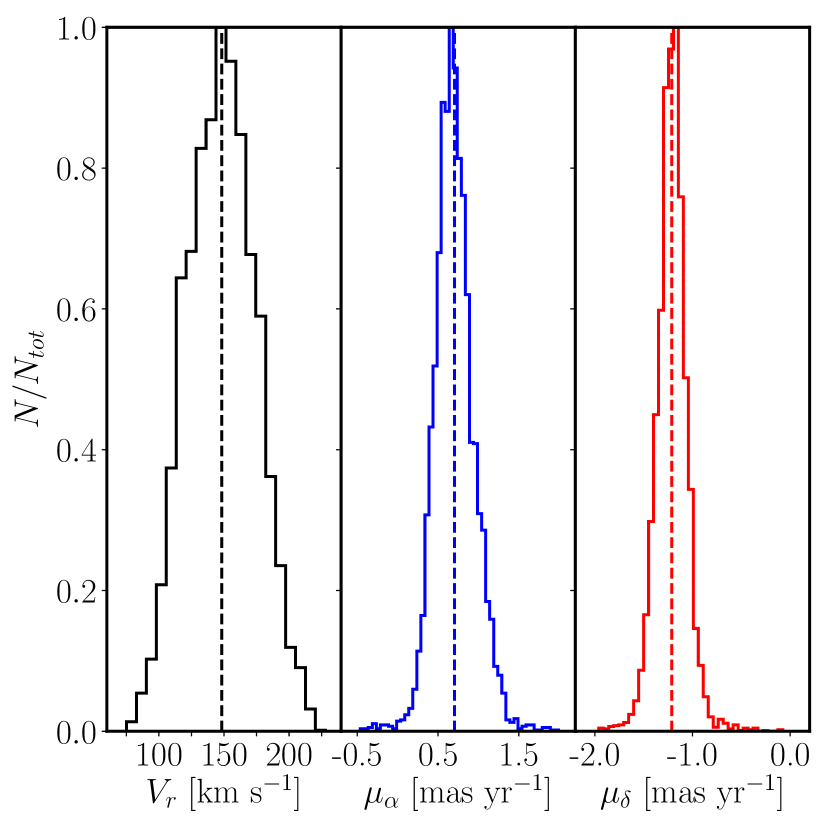
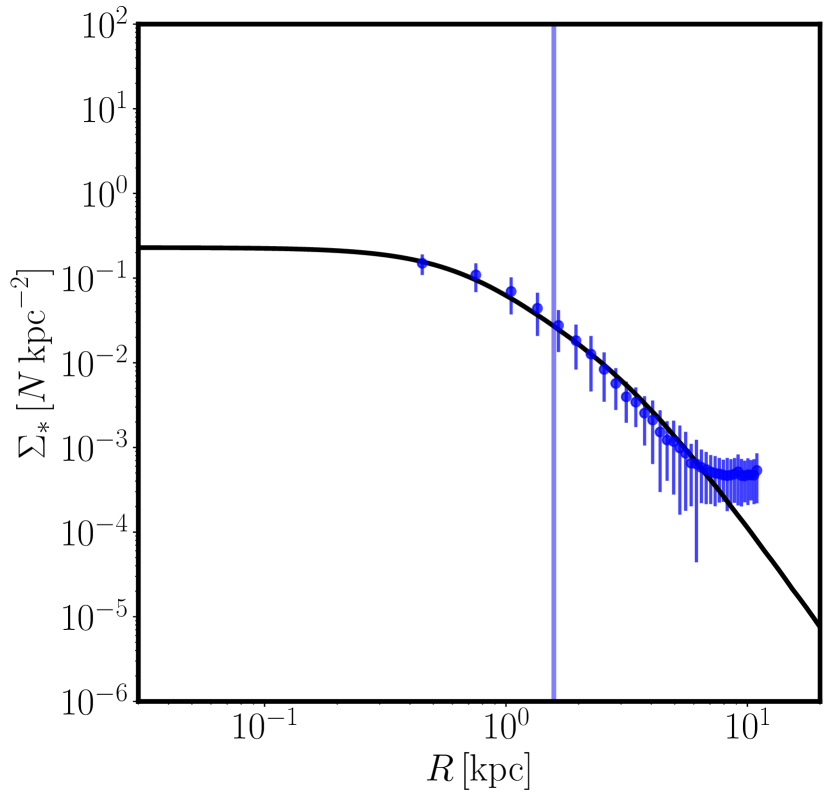
We use spectroscopic data for ${\sim}6,000$ Red Giant Branch (RGB) stars in the Small Magellanic Cloud (SMC), together with proper motion data from extit{Gaia} Early Data Release 3 (EDR3), to build a mass model of the SMC. We test our Jeans mass modelling method ( extsc{Binulator}+ extsc{GravSphere}) on mock data for an SMC-like dwarf undergoing severe tidal disruption, showing that we are able to successfully remove tidally unbound interlopers, recovering the Dark Matter density and stellar velocity anisotropy profiles within our 95\% confidence intervals. We then apply our method to real SMC data, finding that the stars of the cleaned sample are isotropic at all radii (at 95\% confidence), and that the inner Dark Matter density profile is dense, $ρ_{ m DM}(150\,{ m pc}) = 2.81_{-1.07}^{+0.72} imes 10^8 M_{\odot} m kpc^{-3} $, consistent with a $Λ$ Cold Dark Matter ($Λ$CDM) cusp at least down to 400\,pc from the SMC's centre. Our model gives a new estimate of the SMC's total mass within 3\,kpc ($M_{ m tot} \leq 3\,{ m kpc})$ of $2.34\pm0.46 imes 10^9 M_{\odot}$. We also derive an astrophysical extquote{$J$-factor} of $19.22\pm0.14$\, GeV$^2$\,cm$^{-5}$ and a extquote{$D$-factor} of $18.80\pm0.03$\, GeV$^2$\,cm$^{-5}$, making the SMC a promising target for Dark Matter annihilation and decay searches. Finally, we combine our findings with literature measurements to test models in which Dark Matter is extquote{heated up} by baryonic effects. We find good qualitative agreement with the Di Cintio et al. 2014 model but we deviate from the Lazar et al. 2020 model at high $M_*/M_{200} > 10^{-2}$. We provide a new, analytic, density profile that reproduces Dark Matter heating behaviour over the range $10^{-5} < M_*/M_{200} < 10^{-1}$.
研究の動機と目的
- 強い潮汐破壊を受ける矮星銀河の質量分布を正確にモデル化する手法を開発すること。ここでは、従来の平衡状態仮定が崩れる状況を想定する。
- SMCが潮汐ストリッピングを経験しても、ΛCDM理論で予測されるようにくびれ型のダークマター密度プロファイルを保持しているかどうかを検証すること。これは、ΛCDMにおけるくびれ-コア問題に挑戦する。
- 潮汐デブリによる汚染を考慮した動力学的データを用いて、SMCの全質量とダークマター密度プロファイルの頑健な推定を行うこと。
- γ線およびX線観測における検出可能性を評価するため、推定されたダークマター密度プロファイルからJ要因およびD要因を算出すること。
- 異なる星-ハロー質量比における理論的予測とSMCの観測特性を比較することで、バリオンのフィードバックモデル(特にダークマター加熱)を検証すること。
提案手法
- Binulator手法を導入し、視線方向の星の運動学的データを不純物除去することで、SMCの潮汐デブリから潮汐的に束縛されていない星を同定・除外する。
- この手法は、位相空間情報(径方向速度および自己運動)を用いて、模擬データおよび実データの両方で束縛星と不純物(未束縛)を区別する。
- 清浄化された星のサンプルにGravSphereを適用し、球対称性の下でジェインズモデリングを実施し、全質量およびダークマター密度プロファイルを回復する。
- ジェインズモデリングでは、視線方向の速度分散および自己運動データを完全に組み込むことで、動力学的制約を強化し、デゲネラシーを低減する。
- 観測されたSMCデータに適合する新しい解析的ダークマター密度プロファイルを導出し、星-ハロー質量比範囲10⁻⁵ < M_*/M_200 < 10⁻¹におけるダークマター加熱挙動を記述する。
- 推定されたダークマター密度プロファイルからJ要因およびD要因を計算し、γ線およびX線観測におけるSMCの検出可能性を評価する。
実験結果
リサーチクエスチョン
- RQ1標準的なジェインズモデリングを用いても、SMCのような強い潮汐破壊を受けている矮星銀河が、まだくびれ型のダークマター密度プロファイルを回復できるか?
- RQ2SMCの真の中心部におけるダークマター密度は何か? また、これはΛCDMシミュレーションで予測されるようにくびれを示すか?
- RQ3さまざまなM_*/M_200における理論的モデル(例:Di Cintio et al. 2014;Lazar et al. 2020)と比較した場合、SMCのダークマター密度プロファイルはどのように異なるか?
- RQ4SMCのJ要因およびD要因は何か? 他の既知のダークマター標的と比較するとどうなるか?
- RQ5星-ハロー質量比の広い範囲(10⁻⁵ < M_*/M_200 < 10⁻¹)において、観測されたダークマター加熱挙動を正確に再現できる新しい解析的ダークマター密度プロファイルを構築できるか?
主な発見
- SMCは150 pcにおけるダークマター密度がρ_DM(150 pc) = 2.81⁺⁰.⁷²₋₁.₀₇ × 10⁸ M⊙ kpc⁻³であり、少なくとも中心からの距離400 pcまでΛCDMのくびれと整合的である。
- 3 kpc以内の全質量はM_tot(≤3 kpc) = 2.34 ± 0.46 × 10⁹ M⊙と推定され、以前のバーリア推定の下限と整合的だが、潮汐デブリの影響を補正した。
- 95%信頼区間内で、すべての半径で星の速度異方性は等方的であり、束縛成分に強い径方向または接線方向の流れがないことが示された。
- 推定されたJ要因は19.22 ± 0.14 GeV² cm⁻⁵、D要因は18.80 ± 0.03 GeV² cm⁻⁵であり、これはダークマター消失および崩壊探査の観点で、最も有望な標的の一つであることを示している。
- Di Cintio et al. (2014)のダークマター加熱モデルと観測データは良い定性的一致を示すが、M_*/M_200 > 10⁻²の高域ではLazar et al. (2020)モデルとは乖離している。
- 星-ハロー質量比の範囲10⁻⁵ < M_*/M_200 < 10⁻¹において、観測されたダークマター加熱挙動を正確に再現できる新しい解析的ダークマター密度プロファイルが提案された。
より良い研究を、今すぐ始めましょう
論文の読解から最終レビューまで、研究時間を劇的に削減しましょう。
クレジットカード登録不要
このレビューはAIが作成し、人間の編集者が確認しました。