
[Paper Review] SuS-X: Training-Free Name-Only Transfer of Vision-Language Models
SuS-X proposes a training-free, name-only adaptation method for vision-language models (VLMs) like CLIP, using a curated support set (SuS) derived from class names via text-to-image models or retrieval, and a novel inference protocol (TIP-X) to achieve state-of-the-art zero-shot classification accuracy across 19 benchmarks—improving by up to 11.37% over baseline CLIP.
Contrastive Language-Image Pre-training (CLIP) has emerged as a simple yet effective way to train large-scale vision-language models. CLIP demonstrates impressive zero-shot classification and retrieval on diverse downstream tasks. However, to leverage its full potential, fine-tuning still appears to be necessary. Fine-tuning the entire CLIP model can be resource-intensive and unstable. Moreover, recent methods that aim to circumvent this need for fine-tuning still require access to images from the target distribution. In this paper, we pursue a different approach and explore the regime of training-free "name-only transfer" in which the only knowledge we possess about the downstream task comprises the names of downstream target categories. We propose a novel method, SuS-X, consisting of two key building blocks -- SuS and TIP-X, that requires neither intensive fine-tuning nor costly labelled data. SuS-X achieves state-of-the-art zero-shot classification results on 19 benchmark datasets. We further show the utility of TIP-X in the training-free few-shot setting, where we again achieve state-of-the-art results over strong training-free baselines. Code is available at https://github.com/vishaal27/SuS-X.
Motivation & Objective
- Address the limitations of zero-shot CLIP performance on distribution-shifted downstream tasks.
- Enable effective VLM adaptation without access to target task data or model fine-tuning.
- Develop a scalable, flexible method that only requires class category names for adaptation.
- Achieve state-of-the-art zero-shot classification performance across diverse benchmarks using only name-based support sets.
Proposed method
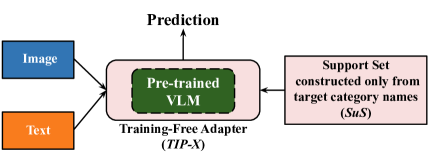
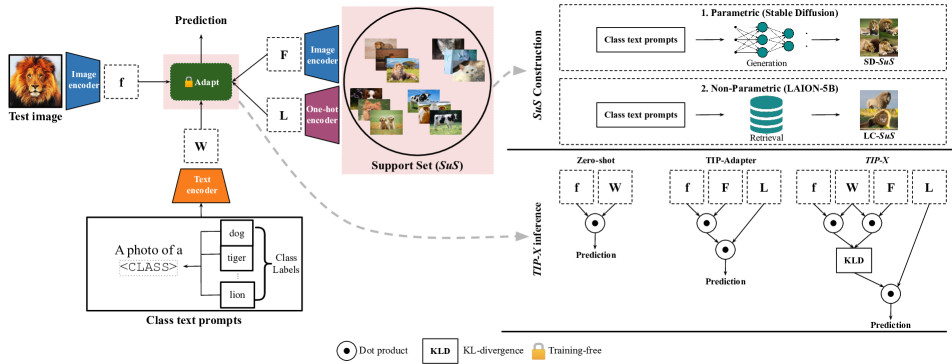
- Propose SuS (Support Sets), a dynamic curation strategy that generates or retrieves images for target classes using only their names.
- Use text-to-image diffusion models (e.g., Stable Diffusion) or retrieval from large vision-language datasets (e.g., LAION-5B) to build the support set.
- Introduce TIP-X, a training-free inference protocol that adapts VLMs using the curated support set as a proxy few-shot dataset.
- Apply TIP-X to compute class logits via similarity aggregation between query images and support-set prompts, avoiding fine-tuning.
- Support both parametric (text-to-image generation) and non-parametric (image retrieval) methods for support set construction.
- Cache task-specific support sets a-priori to enable dynamic switching across tasks without catastrophic forgetting.
Experimental results
Research questions
- RQ1Can vision-language models be effectively adapted to new downstream tasks using only class names and no target data?
- RQ2How effective is a training-free, name-only adaptation strategy compared to fine-tuning or data-augmented zero-shot methods?
- RQ3Can synthetic or retrieved images based on class names serve as effective proxies for few-shot adaptation in zero-shot transfer?
- RQ4Does the proposed TIP-X framework outperform existing training-free baselines in both zero-shot and few-shot settings?
- RQ5How robust is SuS-X across diverse downstream datasets with varying domain shifts?
Key findings
- SuS-X achieves state-of-the-art zero-shot classification accuracy across 19 benchmark datasets, improving average accuracy by 4.60%, 5.97%, and 11.37% over zero-shot CLIP for ResNet-50, ResNet-101, and ViT-B/16, respectively.
- On ImageNet, SuS-X-LC (using CLIP-based text-to-image generation) achieves 61.89% top-1 accuracy, outperforming the baseline ZS-CLIP (60.31%) and full fine-tuning (60.35%).
- In the few-shot regime, TIP-X outperforms strong training-free baselines, achieving 68.20% average accuracy on 11 datasets, surpassing prior SoTA methods.
- Using alternative text-to-image models (e.g., Kandinsky2.1, OpenJourney-4) yields consistent gains, with up to 9.03% improvement over baseline on average, confirming method robustness.
- Fine-tuning SuS-X (SuS-X-F) yields further gains (e.g., 63.22% on ImageNet), but the training-free variant remains highly effective and avoids catastrophic forgetting.
- The method is scalable and dynamic: support sets can be pre-computed and switched per task without retraining, enabling efficient adaptation to rare or changing categories.
Read this paper
Open the full text in the Nubint reader and ask about any passage as you read.
Read this paper on NubintThis review was generated by AI from the original paper. Please check the paper before citing it.