
[Paper Review] Systematically Exploring Redundancy Reduction in Summarizing Long Documents
This paper proposes a systematic approach to reducing redundancy in neural extractive summarization of long documents, introducing three novel methods that explicitly balance sentence importance and non-redundancy during scoring and selection. Evaluated on Pubmed and arXiv datasets, the proposed methods achieve state-of-the-art ROUGE scores while significantly reducing redundancy compared to existing baselines.
Our analysis of large summarization datasets indicates that redundancy is a very serious problem when summarizing long documents. Yet, redundancy reduction has not been thoroughly investigated in neural summarization. In this work, we systematically explore and compare different ways to deal with redundancy when summarizing long documents. Specifically, we organize the existing methods into categories based on when and how the redundancy is considered. Then, in the context of these categories, we propose three additional methods balancing non-redundancy and importance in a general and flexible way. In a series of experiments, we show that our proposed methods achieve the state-of-the-art with respect to ROUGE scores on two scientific paper datasets, Pubmed and arXiv, while reducing redundancy significantly.
Motivation & Objective
- To investigate the extent and impact of redundancy in long-document summarization, particularly in scientific papers.
- To systematically categorize and compare existing neural redundancy reduction techniques in extractive summarization.
- To propose three new, general, and flexible methods that explicitly balance sentence importance and non-redundancy in both scoring and selection phases.
- To evaluate the effectiveness of these methods on long documents, focusing on ROUGE scores and redundancy metrics.
- To demonstrate that redundancy reduction in the selection phase is more effective than in the scoring phase for long documents.
Proposed method
- The authors re-implement existing redundancy reduction methods within a common baseline model (Xiao and Carenini, 2019) to ensure fair comparison.
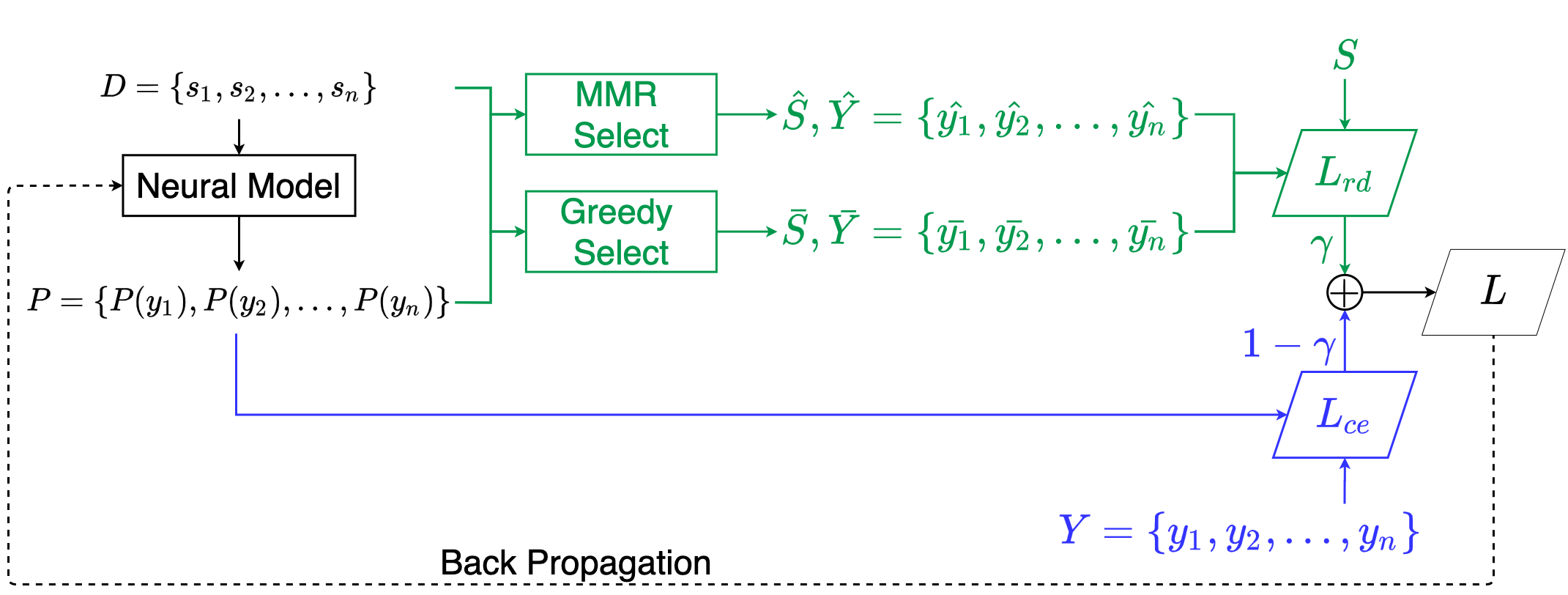
- They propose three new methods: (1) a modified decoder for sentence scoring that incorporates redundancy awareness, (2) a custom loss function that penalizes redundant sentence selections, and (3) a sentence selection algorithm that uses a dynamic threshold based on sentence similarity.
- The methods are designed to be general and flexible, allowing integration into various neural extractive summarization frameworks.
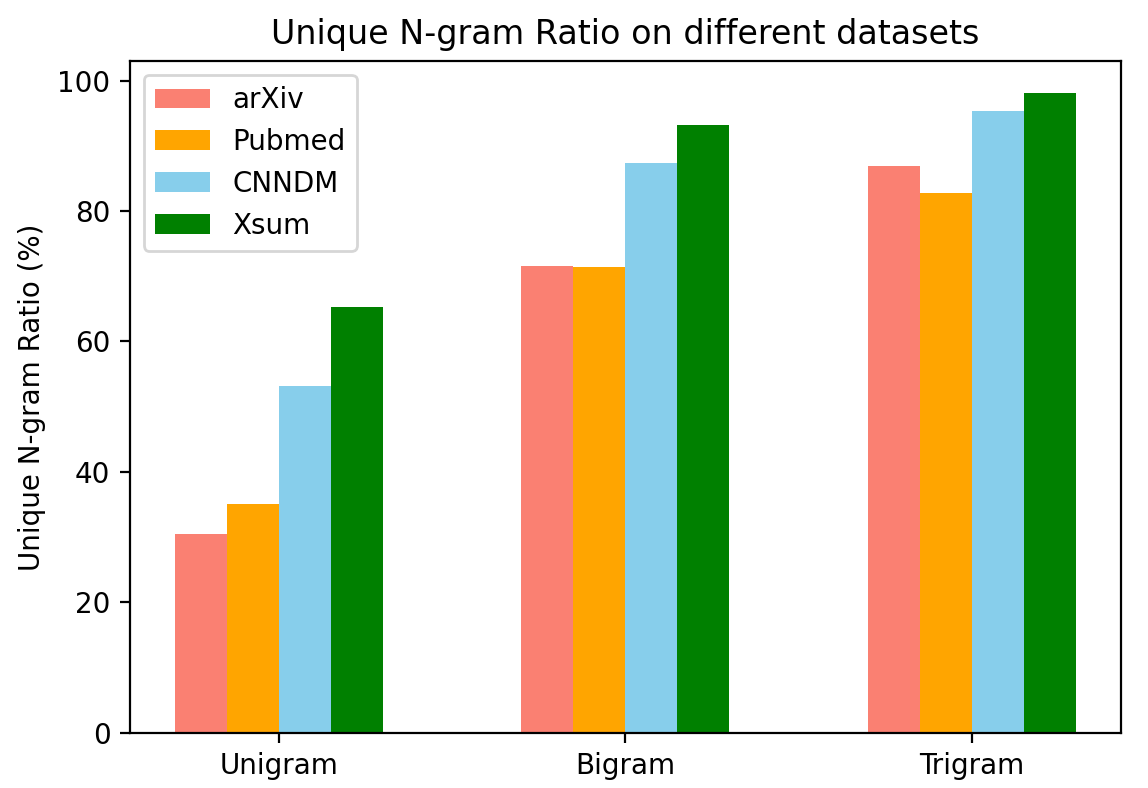
- Redundancy is measured using unique n-gram ratios and cosine similarity between sentence embeddings.
- The models are trained and evaluated on two long-document datasets: Pubmed and arXiv, with ROUGE scores and redundancy metrics used as evaluation metrics.
- The proposed methods are evaluated under varying conditions, including document length and redundancy levels, to assess robustness and generalization.
Experimental results
Research questions
- RQ1How does redundancy vary between long documents (e.g., scientific papers) and short documents (e.g., news)?
- RQ2Which redundancy reduction strategies—applied during scoring or selection—yield better performance in long-document summarization?
- RQ3Can explicit, flexible, and general-purpose redundancy reduction methods improve both ROUGE scores and redundancy reduction in neural extractive summarization?
- RQ4How do different redundancy reduction techniques perform across varying document lengths and redundancy levels?
- RQ5Does the effectiveness of redundancy reduction methods depend on the summary length or the inherent redundancy of the source document?
Key findings
- The proposed methods achieve state-of-the-art performance on ROUGE scores for both the Pubmed and arXiv datasets, outperforming existing neural and non-neural baselines.
- Redundancy is significantly higher in long scientific documents compared to short news articles, validating the need for dedicated redundancy reduction in long-document summarization.
- MMR-Select+ achieves the best balance between informativeness (ROUGE) and redundancy reduction, especially on highly redundant documents.
- Redundancy reduction during the sentence selection phase is more effective than during the scoring phase, as shown by the superior performance of selection-phase methods.
- The Trigram Blocking method reduces redundancy the most but harms informativeness the most, making it less suitable for long, redundant documents.
- The proposed methods maintain stable performance across different summary length limits, indicating robustness and generalization across varying output lengths.
Read this paper
Open the full text in the Nubint reader and ask about any passage as you read.
Read this paper on NubintThis review was generated by AI from the original paper. Please check the paper before citing it.