
[Paper Review] Table-GPT: Table-tuned GPT for Diverse Table Tasks
Table-GPT continues to train GPT-3.5/ChatGPT on diverse synthesized table tasks to improve table understanding and generalization to unseen table tasks.
Language models, such as GPT-3.5 and ChatGPT, demonstrate remarkable abilities to follow diverse human instructions and perform a wide range of tasks. However, when probing language models using a range of basic table-understanding tasks, we observe that today's language models are still sub-optimal in many table-related tasks, likely because they are pre-trained predominantly on \emph{one-dimensional} natural-language texts, whereas relational tables are \emph{two-dimensional} objects. In this work, we propose a new "\emph{table-tuning}" paradigm, where we continue to train/fine-tune language models like GPT-3.5 and ChatGPT, using diverse table-tasks synthesized from real tables as training data, with the goal of enhancing language models' ability to understand tables and perform table tasks. We show that our resulting Table-GPT models demonstrate (1) better \emph{table-understanding} capabilities, by consistently outperforming the vanilla GPT-3.5 and ChatGPT, on a wide-range of table tasks, including holdout unseen tasks, and (2) strong \emph{generalizability}, in its ability to respond to diverse human instructions to perform new table-tasks, in a manner similar to GPT-3.5 and ChatGPT.
Motivation & Objective
- Motivate the need for better table understanding, given that 2D relational tables differ from 1D natural language text.
- Propose a table-tuning paradigm to improve language models' abilities on table tasks by weight-tuning rather than task-specific prompts.
- Develop diverse table-tasks synthesized from real tables to train a table-tuned model.
- Demonstrate that Table-GPT outperforms vanilla GPT-3.5/ChatGPT on seen and unseen table tasks and generalizes to new instructions.
Proposed method
- Introduce a table-tuning paradigm analogous to instruction-tuning, training on (instruction, table, completion) triples.
- Synthesize diverse table-tasks from real tables to create a rich training corpus (synthesis-then-augment).
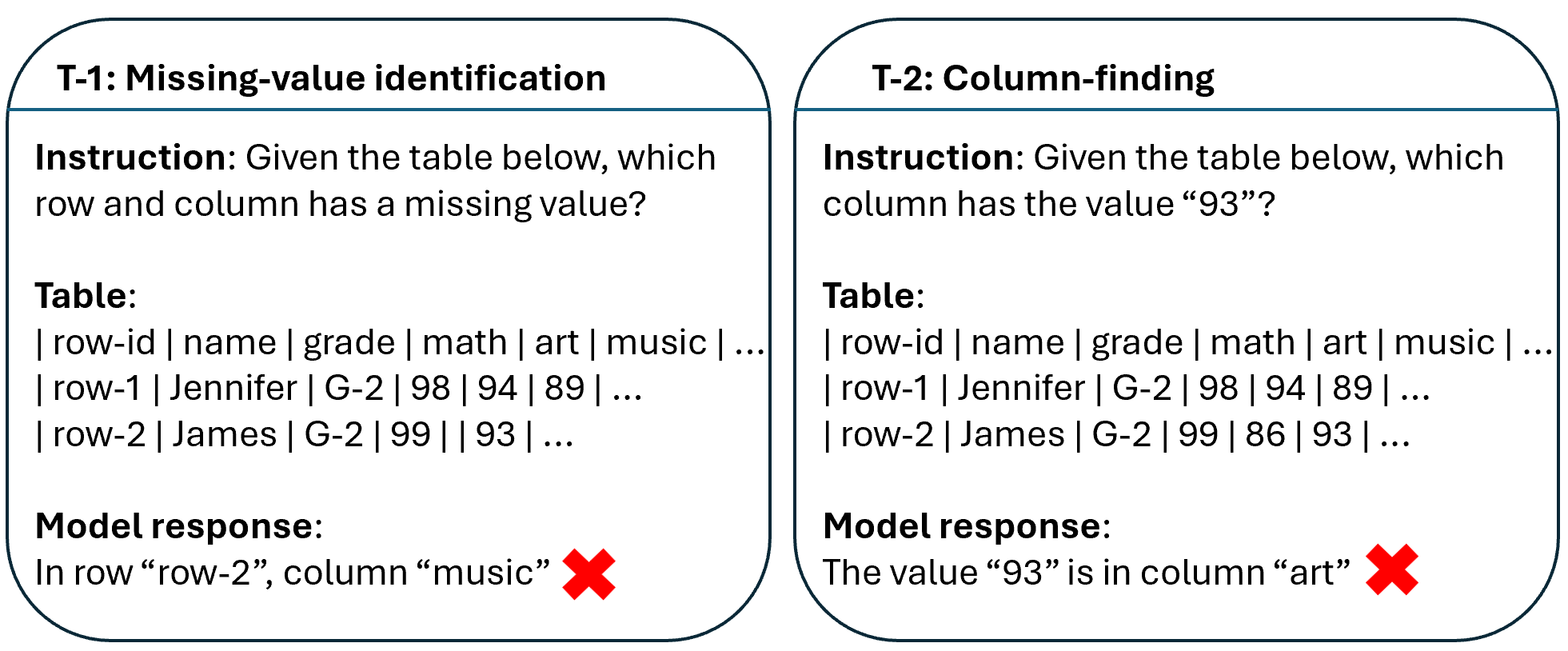
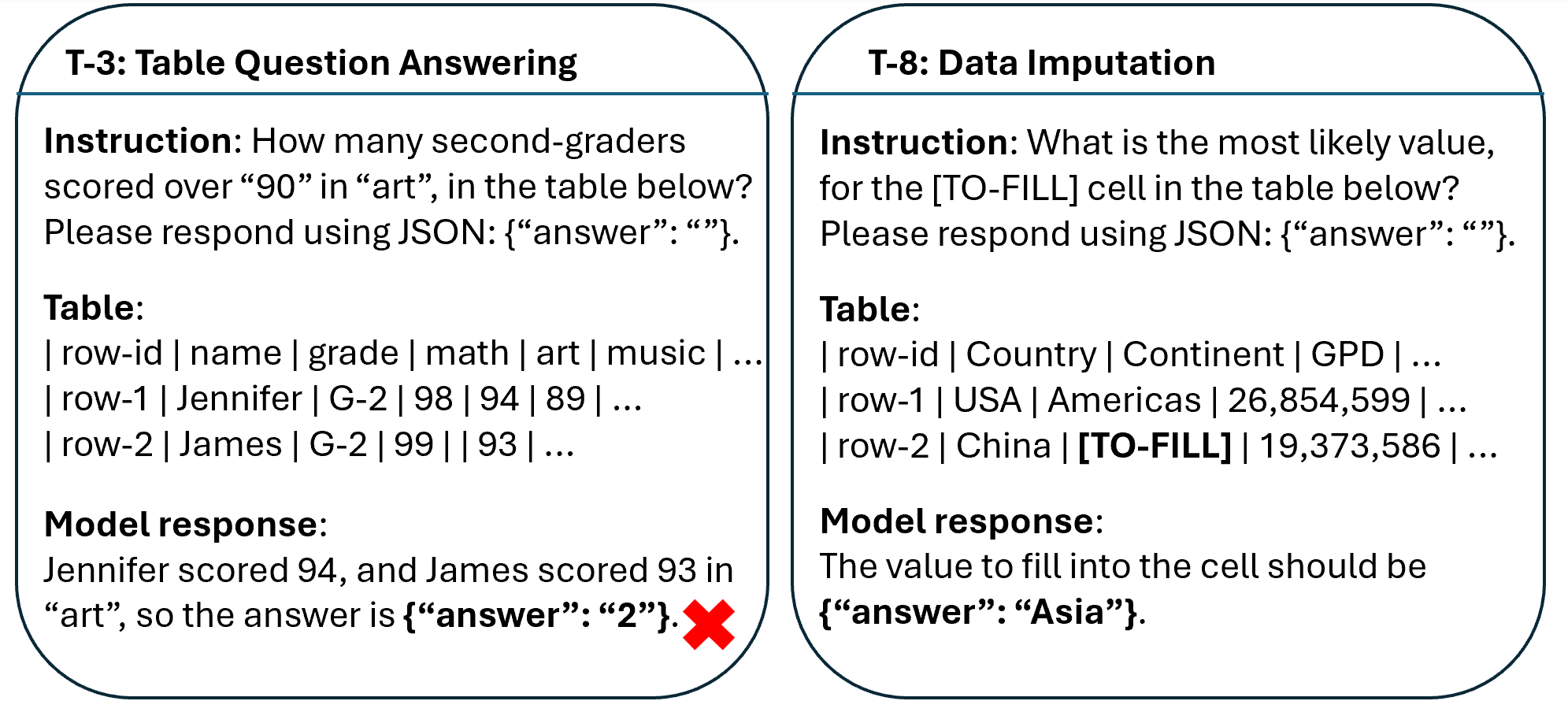
- Define a suite of 18 table-related tasks (T-1 to T-18) spanning table understanding, QA, matching, cleaning, and transformation.
- Apply task-, table-, instruction-, and completion-level data augmentation to prevent overfitting and improve generalization.
- Demonstrate that Table-GPT serves as a better starting point than vanilla GPT for downstream fine-tuning and prompt-engineering.
Experimental results
Research questions
- RQ1Can large language models reliably read and reason over two-dimensional tables, compared to natural language text?
- RQ2Does continuing to train on diverse table tasks (table-tuning) improve table understanding and task performance over vanilla GPT-3.5/ChatGPT?
- RQ3Do Table-GPT models generalize to unseen table tasks and follow new human instructions for table-related tasks?
- RQ4How does the synthesis-then-augment data pipeline impact generalization and robustness to table variations?
Key findings
- Table-GPT consistently outperforms vanilla GPT-3.5 and ChatGPT on a wide range of table tasks.
- Table-GPT shows strong generalizability, handling novel and unseen table tasks with instruction-following behavior similar to GPT-3.5/ChatGPT.
- The table-tuning approach is complementary to prompt-engineering, benefiting both vanilla and table-tuned models.
- The study highlights that current LMs struggle with 2D table structures and vertical reading, motivating table-tuning as a solution.
Read this paper
Open the full text in the Nubint reader and ask about any passage as you read.
Read this paper on NubintThis review was generated by AI from the original paper. Please check the paper before citing it.