
[Paper Review] Tactile-RL for Insertion: Generalization to Objects of Unknown Geometry
This paper proposes a tactile reinforcement learning (RL) policy for robotic peg-in-hole insertion that generalizes across objects of unknown geometry. By using curriculum learning and tactile flow representation, the policy achieves over 85% success rate on four novel objects within 3–4 attempts, outperforming supervised learning, F/T-based policies, and RGB-based tactile inputs in generalization.
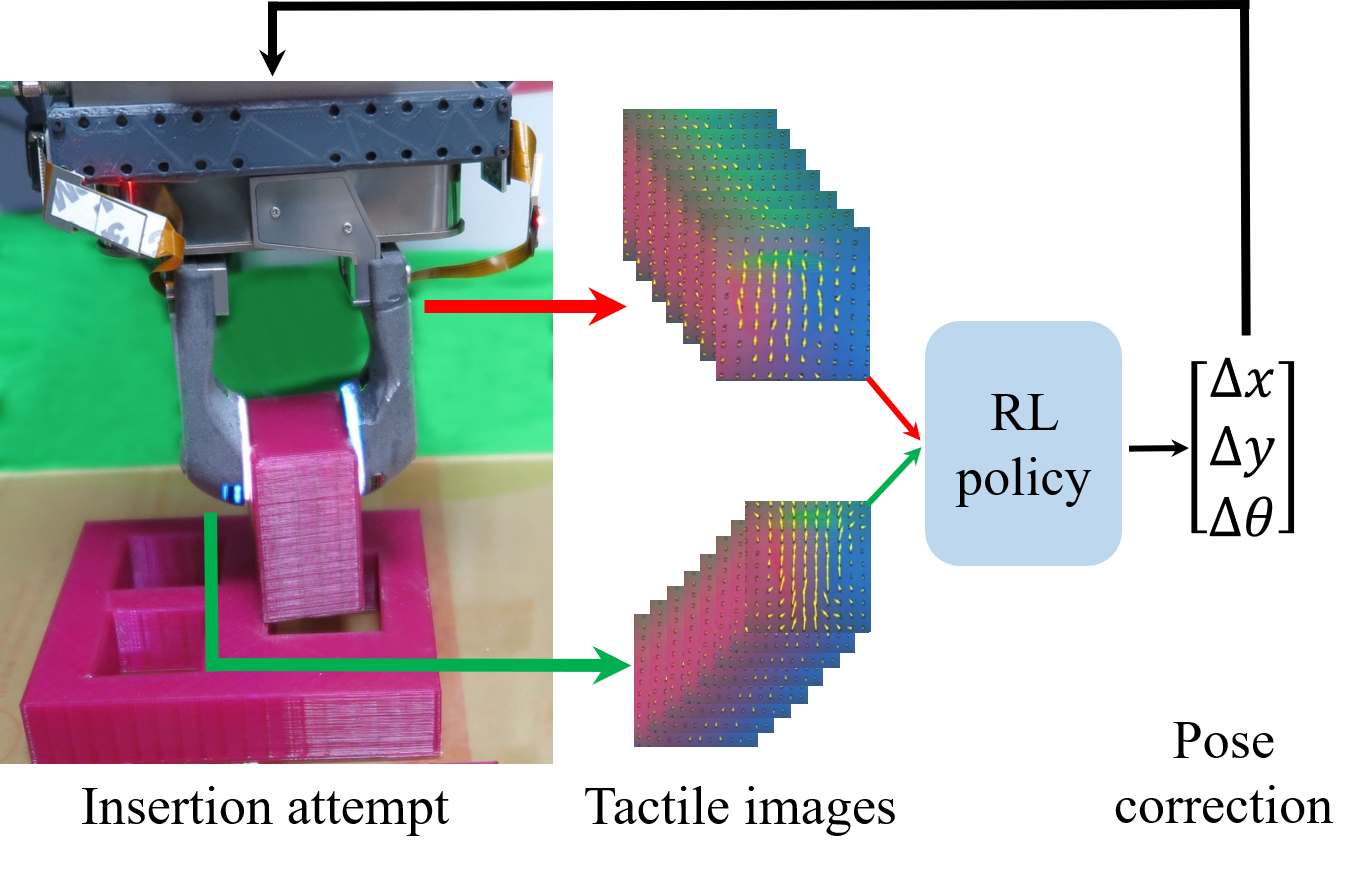
Object insertion is a classic contact-rich manipulation task. The task remains challenging, especially when considering general objects of unknown geometry, which significantly limits the ability to understand the contact configuration between the object and the environment. We study the problem of aligning the object and environment with a tactile-based feedback insertion policy. The insertion process is modeled as an episodic policy that iterates between insertion attempts followed by pose corrections. We explore different mechanisms to learn such a policy based on Reinforcement Learning. The key contribution of this paper is to demonstrate that it is possible to learn a tactile insertion policy that generalizes across different object geometries, and an ablation study of the key design choices for the learning agent: 1) the type of learning scheme: supervised vs. reinforcement learning; 2) the type of learning schedule: unguided vs. curriculum learning; 3) the type of sensing modality: force/torque (F/T) vs. tactile; and 4) the type of tactile representation: tactile RGB vs. tactile flow. We show that the optimal configuration of the learning agent (RL + curriculum + tactile flow) exposed to 4 training objects yields an insertion policy that inserts 4 novel objects with over 85.0% success rate and within 3~4 attempts. Comparisons between F/T and tactile sensing, shows that while an F/T-based policy learns more efficiently, a tactile-based policy provides better generalization.
Motivation & Objective
- Develop a general-purpose robotic insertion policy that works across diverse object geometries without prior geometric knowledge.
- Address the challenge of contact-rich manipulation where contact states are only partially observable from tactile or force/torque sensing.
- Improve generalization beyond training objects by leveraging appropriate sensory representations and learning strategies.
- Demonstrate that tactile-based RL outperforms F/T-based and supervised learning approaches in generalization to novel object shapes.
- Investigate the impact of key design choices—learning scheme, curriculum training, sensing modality, and tactile representation—on policy performance and data efficiency.
Proposed method
- Formulate the insertion task as an episodic RL problem with iterative insertion attempts and pose corrections.
- Use high-resolution GelSlim tactile sensors to capture contact dynamics at the gripper fingers, providing rich spatial and temporal feedback.
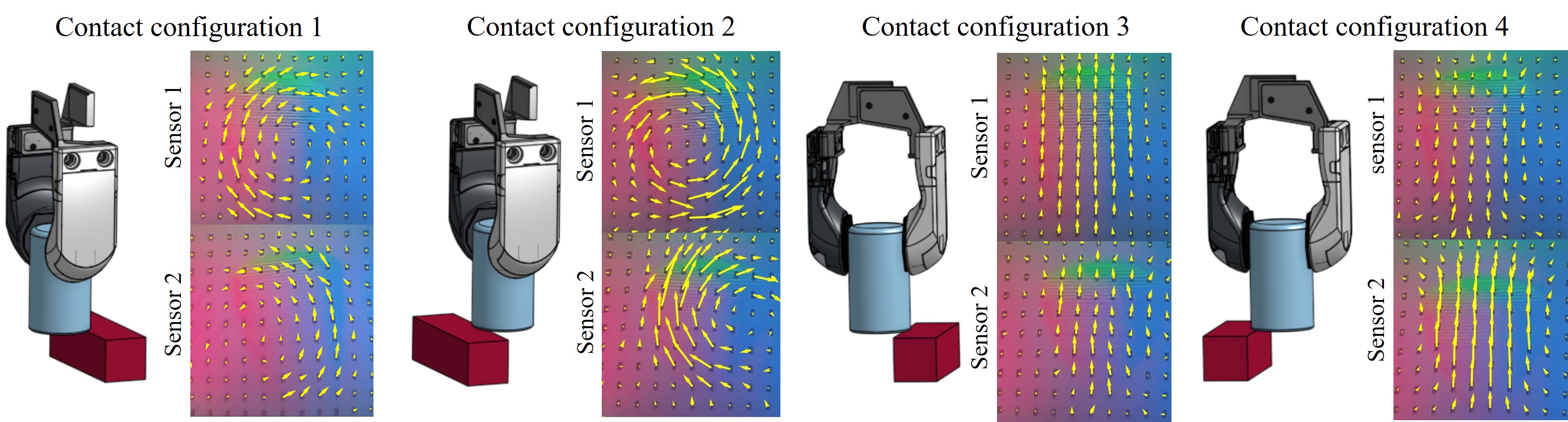
- Represent tactile data as tactile flow (motion of contact markers over time) to improve generalization and reduce overfitting to surface textures.
- Implement curriculum learning by progressively increasing task complexity: wall → corner → U-shape → hole, improving data efficiency and convergence.
- Train an end-to-end deep RL agent using Proximal Policy Optimization (PPO) with dense shaping rewards based on alignment error and insertion success.
- Bootstrap the RL policy with a supervised policy to improve initial exploration and stabilize training.
Experimental results
Research questions
- RQ1Can a tactile-based RL policy generalize to novel objects with unknown geometry in a contact-rich insertion task?
- RQ2How does curriculum learning improve data efficiency and convergence speed in tactile-RL for insertion?
- RQ3Does tactile flow representation lead to better generalization than raw RGB tactile images in RL-based insertion?
- RQ4How does tactile sensing compare to F/T sensing in terms of generalization performance across diverse object shapes?
- RQ5What is the relative impact of supervised learning versus reinforcement learning in handling partially observable contact states during insertion?
Key findings
- The optimal configuration—RL with curriculum learning and tactile flow—achieved over 85.0% success rate on four novel objects within 3–4 attempts.
- The RL policy with curriculum learning converged faster and achieved 80% success rate on training objects in half the number of attempts compared to non-curriculum RL.
- The tactile-RL policy generalized significantly better than the supervised learning baseline, which failed to insert cuboid and paper box objects during testing.
- The policy using raw RGB tactile images overfit to training objects, showing near-zero success rates on novel objects like the big bottle and paper box.
- The F/T-based RL policy achieved near 100% success on cylindrical objects but dropped to 55% on cuboid-shaped objects, indicating poor generalization to rotational errors.
- Tactile sensing provided better generalization than F/T sensing, as tactile flow captured motion dynamics during contact that F/T sensors could not distinguish.
Read this paper
Open the full text in the Nubint reader and ask about any passage as you read.
Read this paper on NubintThis review was generated by AI from the original paper. Please check the paper before citing it.