
[Paper Review] Terracorder: Sense Long and Prosper
Terracorder demonstrates an on-device reinforcement learning scheduler for a low-power biodiversity sensor, achieving higher event detection with substantially reduced activations and extending battery life, including collaborative network scheduling for robustness.
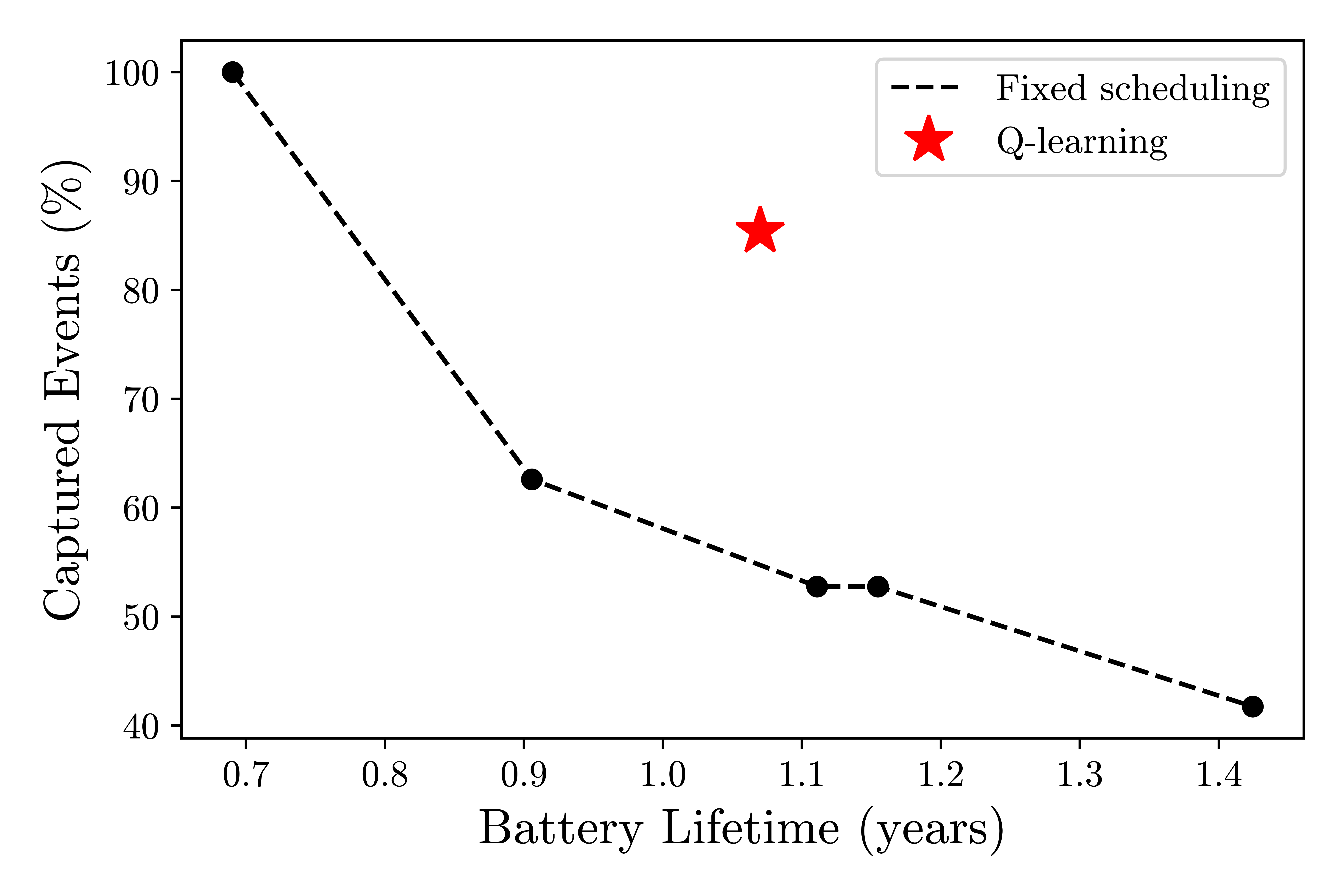
In-situ sensing devices need to be deployed in remote environments for long periods of time; minimizing their power consumption is vital for maximising both their operational lifetime and coverage. We introduce Terracorder -- a versatile multi-sensor device -- and showcase its exceptionally low power consumption using an on-device reinforcement learning scheduler. We prototype a unique device setup for biodiversity monitoring and compare its battery life using our scheduler against a number of fixed schedules; the scheduler captures more than 80% of events at less than 50% of the number of activations of the best-performing fixed schedule. We then explore how a collaborative scheduler can maximise the useful operation of a network of devices, improving overall network power consumption and robustness.
Motivation & Objective
- Develop a low-power, multi-sensor device for biodiversity monitoring with long deployment lifetimes.
- Introduce an on-device reinforcement learning scheduler to optimize event-driven sensor activations under power constraints.
- Evaluate isolated and collaborative scheduling to maximize useful active time and network robustness.
Proposed method
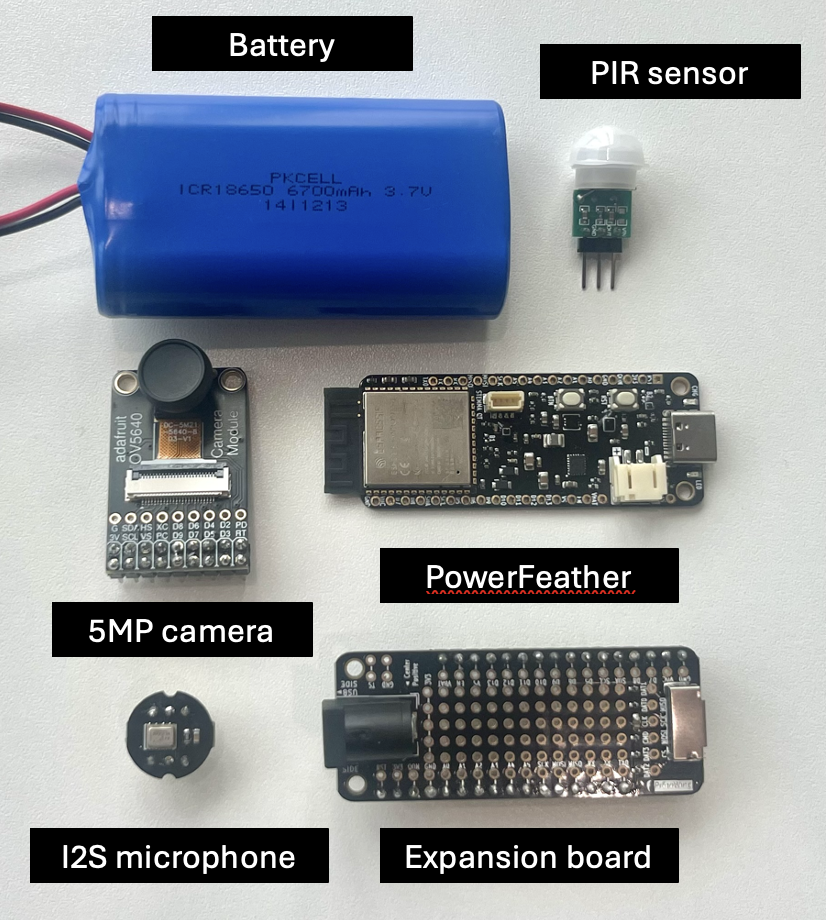
- Use ESP32s3-based PowerFeather hardware with deep-sleep and low-power I/O to build Terracorder.
- Implement an on-device Q-learning scheduler with a quantized action/state space to minimize activations while maximizing detections.
- Define a reward R_t = N_p_t - w1 * N_n_t to balance positive/negative activations for isolated scheduling.
- Extend the reward for network-wide collaboration to include overlaps and battery balance: R_t = N_p_t - w1*N_n_t - w2*sum_i(N_o_ti-1) - w3*B_sigma_t.
- Prototype with a 5MP camera, omnidirectional microphone, and PIR sensor; evaluate Goertzel filtering and a one-layer CNN on-device for event detection.
- Demonstrate practical on-device learning with a 24x7 Q-table (~3KB) and negligible overhead for Q-learning inference/update.
Experimental results
Research questions
- RQ1Can an on-device reinforcement learning scheduler optimize event-driven sensing to extend device lifetime under power constraints?
- RQ2How does a collaborative, network-aware scheduling strategy reduce redundant activations and improve overall network robustness and efficiency?
- RQ3What are the practical performance and energy trade-offs of Goertzel filtering versus on-device CNN-based event detection in this architecture?
Key findings
- Isolated scheduling with Q-learning detects 85.3% of events, extending battery life by 55.1% over a fixed 3s baseline.
- Q-learning inference uses ~30 μA and updates ~70 μA with <0.1 s latency; Goertzel ~33.3 mA and TFLite ~33.1 mA with similar latency.
- Battery life extends from 0.69 to 1.07 years with Goertzel, and to ~1.05 years with TFLite-based event detection.
- The device achieves a deep-sleep current of ~100 μA while maintaining attached sensors and RTC; WiFi remains the largest power consumer for transmissions.
- Collaborative scheduling introduces a network-wide reward to minimize overlaps and balance battery life, enabling distributed, low-overhead coordination across nearby devices.
- A 24x7 Q-table (~3 KB) supports scheduling across 7 activation frequencies across 24 hours.
Read this paper
Open the full text in the Nubint reader and ask about any passage as you read.
Read this paper on NubintThis review was generated by AI from the original paper. Please check the paper before citing it.