
[Paper Review] The 2022 high-energy outburst and radio disappearing act of the magnetar 1E 1547.0-5408
This study reports the 2022 outburst of the radio-loud magnetar 1E 1547.0−5408, observing a soft X-ray flux increase and a prior disappearance of persistent radio emission, followed by a spin-up glitch with a sustained rise in spin-down rate. The lack of hard X-ray spectral change suggests localized magnetic reconfiguration near the magnetic pole, possibly due to small-scale crustal fractures or transient particle winds, without global field reorganization.
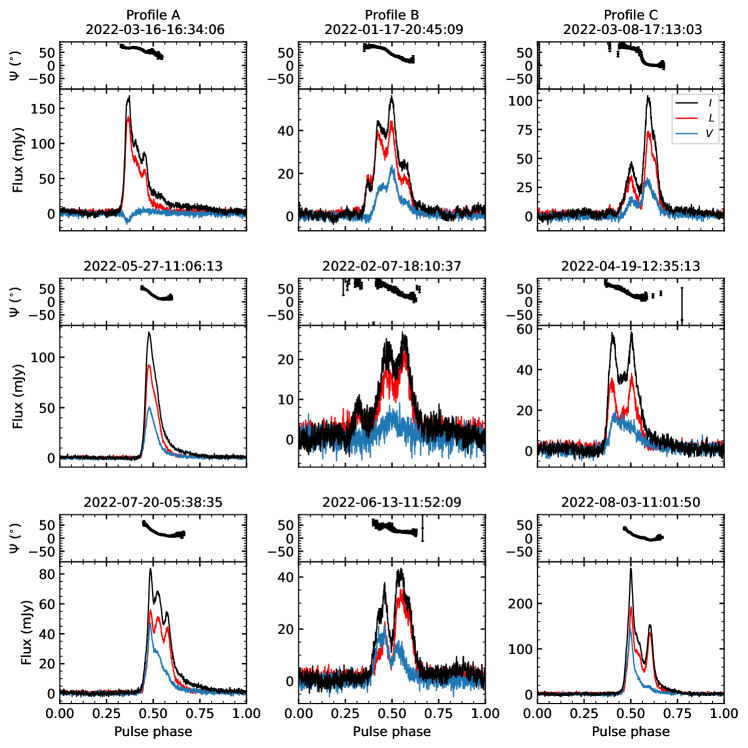
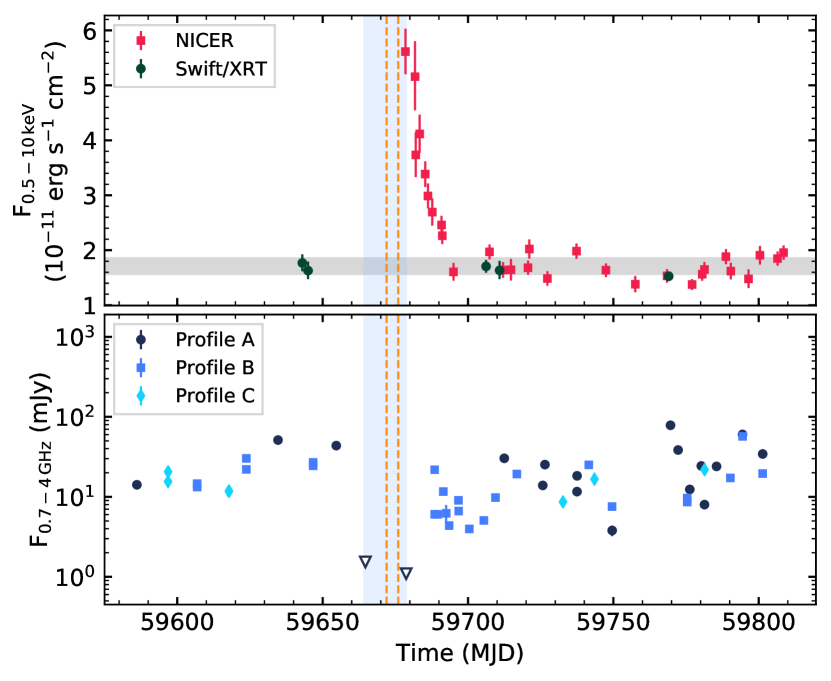
We report the radio and high-energy properties of a new outburst from the radio-loud magnetar 1E 1547.0$-$5408. Following the detection of a short burst from the source with Swift-BAT on 2022 April 7, observations by NICER detected an increased flux peaking at $(6.0 \pm 0.4) imes 10^{-11}$ erg s$^{-1}$ cm$^{-2}$ in the soft X-ray band, falling to the baseline level of $1.7 imes10^{-11}$ erg s$^{-1}$ cm$^{-2}$ over a 17-day period. Joint spectroscopic measurements by NICER and NuSTAR indicated no change in the hard non-thermal tail despite the prominent increase in soft X-rays. Observations at radio wavelengths with Murriyang, the 64-m Parkes radio telescope, revealed that the persistent radio emission from the magnetar disappeared at least 22 days prior to the initial Swift-BAT detection and was re-detected two weeks later. Such behavior is unprecedented in a radio-loud magnetar, and may point to an unnoticed slow rise in the high-energy activity prior to the detected short-bursts. Finally, our combined radio and X-ray timing revealed the outburst coincided with a spin-up glitch, where the spin-frequency and spin-down rate increased by $0.2 \pm 0.1$ $μ$Hz and $(-2.4 \pm 0.1) imes 10^{-12}$ s$^{-2}$ respectively. A linear increase in spin-down rate of $(-2.0 \pm 0.1) imes 10^{-19}$ s$^{-3}$ was also observed over 147 d of post-outburst timing. Our results suggest that the outburst may have been associated with a reconfiguration of the quasi-polar field lines, likely signalling a changing twist, accompanied by spatially broader heating of the surface and a brief quenching of the radio signal, yet without any measurable impact on the hard X-ray properties.
Motivation & Objective
- To characterize the high-energy and radio behavior of a new outburst in the radio-loud magnetar 1E 1547.0−5408.
- To investigate the timing evolution of the magnetar during and after the outburst, particularly the presence of glitches.
- To determine whether the radio emission disappearance preceded the high-energy activity, challenging standard outburst models.
- To assess the impact of the outburst on the hard X-ray non-thermal tail and magnetic field topology.
- To explore the physical mechanisms behind the observed radio quenching and spin-down rate evolution.
Proposed method
- Multi-wavelength monitoring using Swift-BAT for initial burst detection and NICER for soft X-ray light curves and spectroscopy.
- Joint X-ray spectroscopy with NICER and NuSTAR to measure the hard non-thermal tail and search for spectral changes.
- High-cadence radio observations with the Parkes telescope (Murriyang) to track the persistence and disappearance of pulsed radio emission.
- Timing analysis of radio and X-ray data using tempo2 and RMNest software to detect spin-up glitches and measure spin frequency and spin-down rate evolution.
- Modeling of spin-down rate evolution with a linear fit to extract the third derivative of spin frequency over time.
- Use of HEAsoft, XSPEC, and PSRCHIVE for data reduction and pulse profile analysis.
Experimental results
Research questions
- RQ1Did the radio emission from 1E 1547.0−5408 disappear before the onset of the high-energy outburst?
- RQ2What is the nature of the soft X-ray flux increase, and does it correlate with changes in the hard X-ray non-thermal component?
- RQ3What caused the observed spin-up glitch, and how does the sustained increase in spin-down rate relate to magnetic field reconfiguration?
- RQ4Why was the radio emission quenched without a detectable change in the hard X-ray spectrum?
- RQ5Could the outburst be part of a longer-term increase in activity, as suggested by similarities to the 2008 outburst?
Key findings
- The soft X-ray flux increased to (6.0±0.4)×10⁻¹¹ erg s⁻¹ cm⁻² over 17 days, peaking before returning to baseline (1.7×10⁻¹¹ erg s⁻¹ cm⁻²).
- The hard X-ray non-thermal tail showed no spectral change during the soft X-ray flare, indicating no global magnetic field reorganization.
- Persistent radio emission disappeared at least 22 days before the Swift-BAT burst detection, suggesting a hidden precursor phase of high-energy activity.
- Radio emission reappeared two weeks after the initial burst, recovering to pre-outburst levels within ~3 weeks.
- A spin-up glitch occurred with an instantaneous increase in spin frequency of 0.2±0.1 μHz and a spin-down rate increase of (−2.4±0.1)×10⁻¹² s⁻².
- A linear increase in spin-down rate of (−2.0±0.1)×10⁻¹⁹ s⁻³ was measured over 147 days post-outburst, indicating ongoing magnetic stress relaxation.
Read this paper
Open the full text in the Nubint reader and ask about any passage as you read.
Read this paper on NubintThis review was generated by AI from the original paper. Please check the paper before citing it.