
[Paper Review] The All-Seeing Project V2: Towards General Relation Comprehension of the Open World
This paper introduces the All-Seeing Project V2, proposing a novel Relation Conversation (ReC) task that unifies text generation, object localization, and relation comprehension in multimodal models. The authors present ASMv2, a model trained on the high-quality AS-V2 dataset and evaluated via the CRPE benchmark, achieving 52.04% overall accuracy—significantly outperforming LLaVA-1.5 (43.14%) in relation understanding.
We present the All-Seeing Project V2: a new model and dataset designed for understanding object relations in images. Specifically, we propose the All-Seeing Model V2 (ASMv2) that integrates the formulation of text generation, object localization, and relation comprehension into a relation conversation (ReC) task. Leveraging this unified task, our model excels not only in perceiving and recognizing all objects within the image but also in grasping the intricate relation graph between them, diminishing the relation hallucination often encountered by Multi-modal Large Language Models (MLLMs). To facilitate training and evaluation of MLLMs in relation understanding, we created the first high-quality ReC dataset ({AS-V2) which is aligned with the format of standard instruction tuning data. In addition, we design a new benchmark, termed Circular-based Relation Probing Evaluation (CRPE) for comprehensively evaluating the relation comprehension capabilities of MLLMs. Notably, our ASMv2 achieves an overall accuracy of 52.04 on this relation-aware benchmark, surpassing the 43.14 of LLaVA-1.5 by a large margin. We hope that our work can inspire more future research and contribute to the evolution towards artificial general intelligence. Our project is released at https://github.com/OpenGVLab/all-seeing.
Motivation & Objective
- Address the limitation of existing MLLMs in comprehending object relations within images, which often leads to hallucinations or reliance on language priors.
- Overcome the gap between holistic image understanding and fine-grained relation perception by unifying text generation, grounding, and relation reasoning.
- Develop a high-quality, instruction-tuning compatible dataset (AS-V2) with 127K relation conversation samples to support training and evaluation.
- Design a comprehensive benchmark, Circular-based Relation Probing Evaluation (CRPE), to quantitatively measure relation comprehension in MLLMs.
- Achieve state-of-the-art performance in open-ended scene graph generation and relation understanding while preserving general multimodal capabilities.
Proposed method
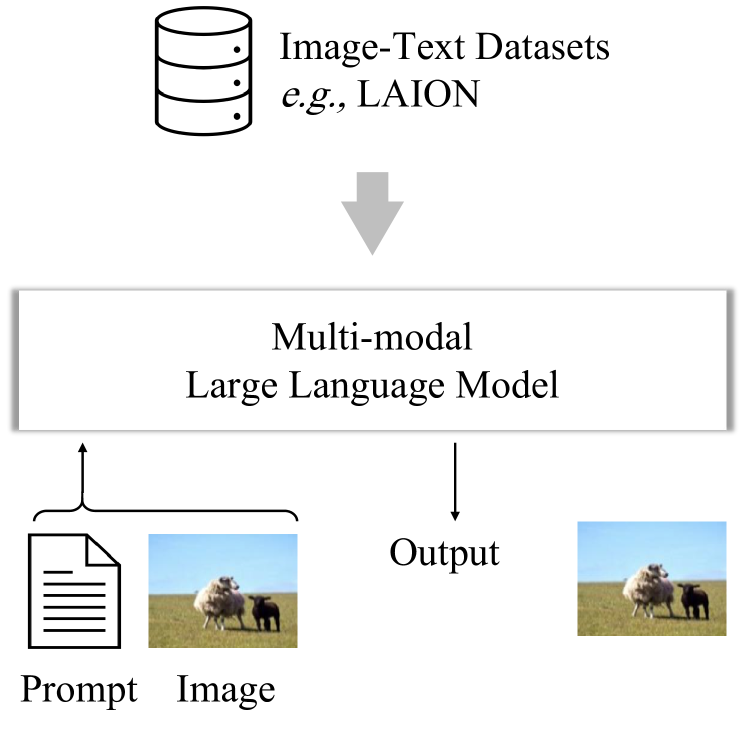
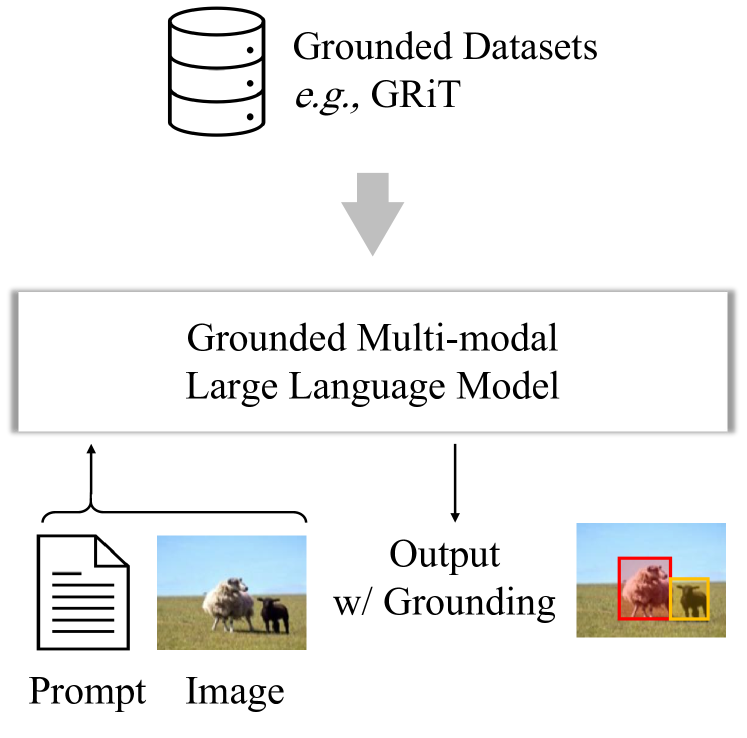
- Propose the Relation Conversation (ReC) task, requiring models to ground all objects and predicates (subject, predicate, object) in image regions while generating natural language responses.
- Construct the AS-V2 dataset by combining existing caption, localization, and relation annotations, resulting in 127K high-quality ReC samples aligned with standard instruction tuning formats.
- Train the All-Seeing Model v2 (ASMv2) using AS-V2 and other multimodal corpora, enabling end-to-end learning of text generation, object grounding, and relation comprehension.
- Design the CRPE benchmark with four splits—Existence, Subject, Predicate, and Object—to evaluate relation comprehension capabilities in a structured, probing manner.
- Adapt ASMv2 to three tasks: Relation Conversation, Open-ended Scene Graph Generation (OpenSGG), and Predicate Classification, demonstrating generalization across settings.
- Use IoU > 0.5 for bounding box matching and exact-match triplet recall for evaluation, with mRecall and #Tuples as key metrics in OpenSGG.
Experimental results
Research questions
- RQ1Can a unified task format like Relation Conversation (ReC) effectively train MLLMs to jointly understand object relations, localization, and text generation?
- RQ2To what extent does training on a high-quality, instruction-tuned ReC dataset (AS-V2) improve a model’s ability to avoid relation hallucinations compared to standard MLLMs?
- RQ3How well can a model generalize to open-ended scene graph generation (OpenSGG) when trained on ReC, and how does it compare to closed-set baselines?
- RQ4Can the CRPE benchmark effectively quantify and differentiate the relation comprehension abilities of various MLLMs?
- RQ5Does the proposed architecture and training paradigm enable superior performance on both relation-specific and general multimodal benchmarks?
Key findings
- ASMv2 achieves 52.04% overall accuracy on the CRPE benchmark, significantly outperforming LLaVA-1.5 (43.14%) and Qwen-VL (27.27%), demonstrating superior relation comprehension.
- On the OpenSGG task, ASMv2 achieves 14.2% triplet recall and 10.3% mRecall, outperforming TextPSG (4.8% recall) despite generating only 9.2 tuples on average—indicating higher sample efficiency and generalization.
- The model maintains strong performance across all CRPE splits, with 87.24% on Existence, 50.55% on Subject, 48.46% on Predicate, and 57.10% on Object, showing balanced and robust relation understanding.
- ASMv2's performance on Predicate and Object splits (48.46% and 57.10%) exceeds that of LLaVA-1.5 (43.68% and 47.89%), indicating improved reasoning over relations beyond object detection.
- The CRPE benchmark successfully reveals that existing MLLMs, including LLaVA-1.5, are significantly weaker in relation comprehension than in object recognition, highlighting the need for targeted evaluation.
- ASMv2’s ability to generate scene graphs in an open-ended manner while maintaining competitive recall suggests strong generalization to unseen predicate labels, a key step toward AGI-level vision-language understanding.
Read this paper
Open the full text in the Nubint reader and ask about any passage as you read.
Read this paper on NubintThis review was generated by AI from the original paper. Please check the paper before citing it.