
[Paper Review] The Automated Inspection of Opaque Liquid Vaccines
This paper proposes a deep learning-based automated inspection system for opaque liquid vaccines using 3D-ConvNets to detect particles in 20-frame video sequences. By leveraging Frame-Completion GANs to generate saliency maps and a novel self-training approach with multi-classifier voting, the method augments a small hand-labeled dataset, achieving 0.96 AUROC on both positive and negative samples—improving upon the initial 0.94 and 0.93 scores.
In the pharmaceutical industry the screening of opaque vaccines containing suspensions is currently a manual task carried out by trained human visual inspectors. We show that deep learning can be used to effectively automate this process. A moving contrast is required to distinguish anomalies from other particles, reflections and dust resting on a vial's surface. We train 3D-ConvNets to predict the likelihood of 20-frame video samples containing anomalies. Our unaugmented dataset consists of hand-labelled samples, recorded using vials provided by the HAL Allergy Group, a pharmaceutical company. We trained ten randomly initialized 3D-ConvNets to provide a benchmark, observing mean AUROC scores of 0.94 and 0.93 for positive samples (containing anomalies) and negative (anomaly-free) samples, respectively. Using Frame-Completion Generative Adversarial Networks we: (i) introduce an algorithm for computing saliency maps, which we use to verify that the 3D-ConvNets are indeed identifying anomalies; (ii) propose a novel self-training approach using the saliency maps to determine if multiple networks agree on the location of anomalies. Our self-training approach allows us to augment our data set by labelling 217,888 additional samples. 3D-ConvNets trained with our augmented dataset improve on the results we get when we train only on the unaugmented dataset.
Motivation & Objective
- To automate the manual visual inspection of opaque liquid vaccines containing suspensions, which is currently error-prone and labor-intensive.
- To develop a deep learning framework capable of detecting transient anomalies in moving contrast during vial rotation.
- To address data scarcity by introducing a self-training method that uses saliency maps from Frame-Completion GANs to automatically label 217,888 additional training samples.
- To verify model interpretability by using saliency maps to confirm that predictions are based on actual anomalies rather than artifacts or noise.
- To improve classification performance beyond human-labeled baselines through data augmentation and model fine-tuning.
Proposed method
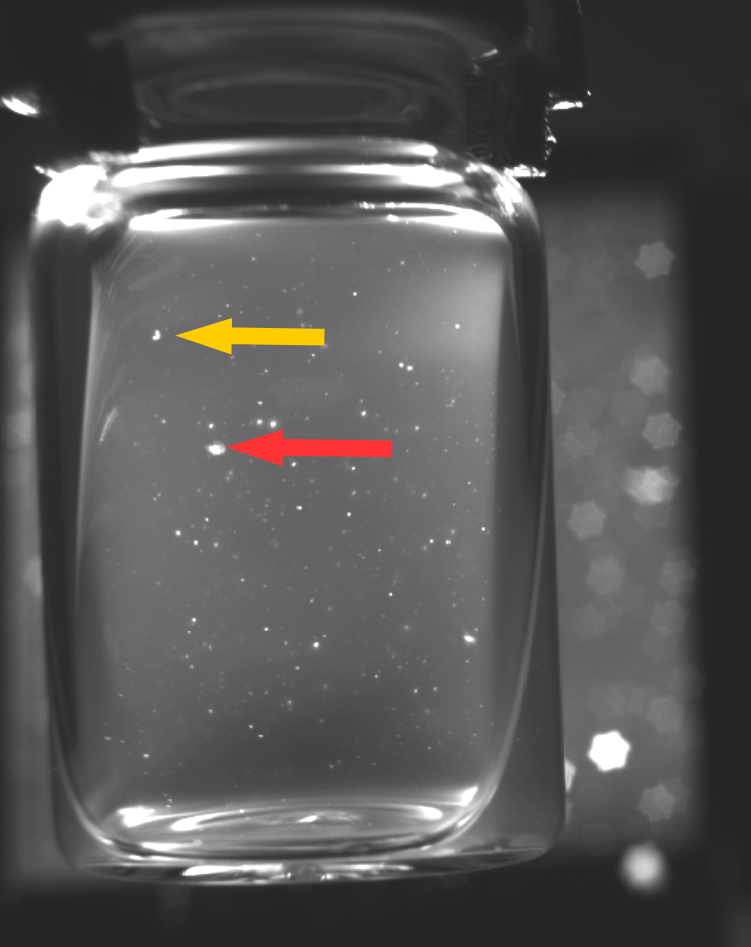
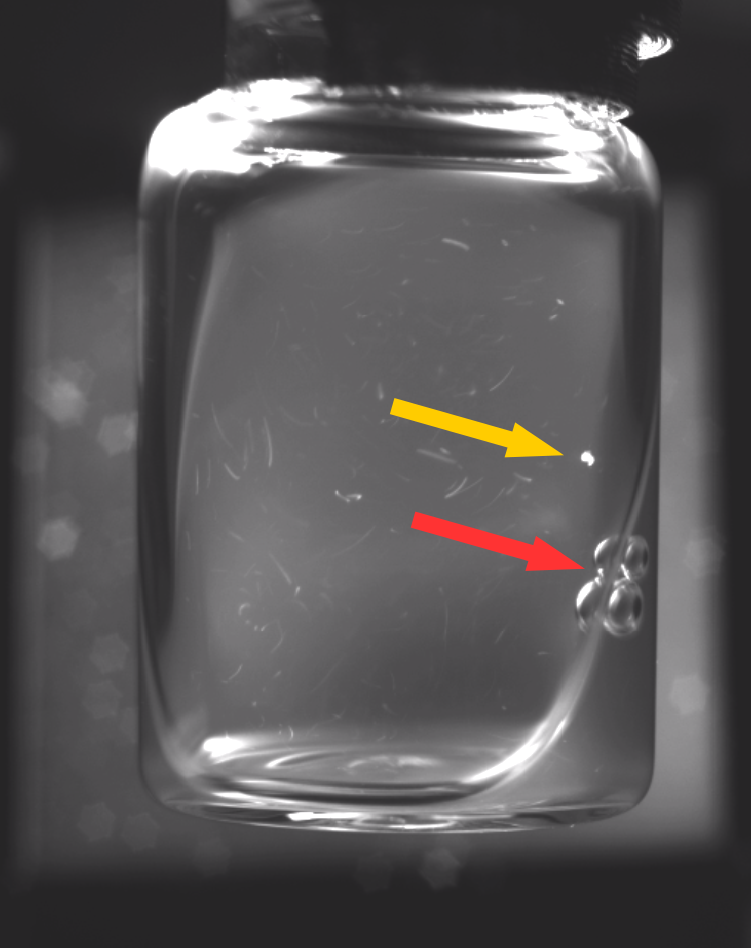
- A custom automated vial rotator (AVR) was built to standardize vial rotation and generate consistent video recordings of 20-frame sequences from 160 vials.
- A dataset of 14,000 training and 6,000 evaluation samples was constructed by manually labeling 20-frame video clips for the presence of anomalies.
- Ten randomly initialized 3D-ConvNets were trained on the unaugmented dataset to establish a benchmark with AUROC scores of 0.94 (positive) and 0.93 (negative).
- Frame-Completion Generative Adversarial Networks (FC-GANs) were used to compute saliency maps, identifying input regions that most influence model predictions.
- A self-training pipeline was developed that uses a multi-classifier voting system incorporating FC-GAN saliency maps to reduce noisy label propagation and identify reliable new training samples.
- The final model was trained on the original dataset augmented with 217,888 self-labeled samples, improving AUROC to 0.96 for both positive and negative classes.
Experimental results
Research questions
- RQ1Can 3D-ConvNets effectively detect transient anomalies in opaque liquid vaccine suspensions using short video sequences?
- RQ2Can Frame-Completion GANs be used to generate reliable saliency maps that verify model predictions are based on actual anomalies?
- RQ3Does self-training with saliency-guided labeling improve performance on a small, hand-labeled dataset of vaccine inspection videos?
- RQ4To what extent does excluding motion-blurred frames improve classification accuracy in automated vaccine inspection?
- RQ5Can a self-training pipeline using multi-classifier agreement on saliency maps reduce noise in synthetic labels and enhance model generalization?
Key findings
- The initial 3D-ConvNet benchmark achieved AUROC scores of 0.94 for positive samples (anomaly-containing) and 0.93 for negative samples (anomaly-free), demonstrating strong baseline performance.
- Excluding motion-blurred frames from training improved classification accuracy, indicating that motion blur negatively affects model learning.
- Saliency maps generated via Frame-Completion GANs confirmed that models focus on relevant regions, validating that predictions are based on actual anomalies rather than artifacts.
- The self-training approach successfully labeled 217,888 additional 20-frame video samples using a voting system informed by saliency maps, reducing the risk of noisy labels.
- 3D-ConvNets trained on the augmented dataset achieved improved AUROC scores of 0.96 for both positive and negative samples, outperforming the unaugmented baseline.
- The results suggest that automated inspection systems can match or exceed human inspection performance in consistency and scalability, particularly under high-production demand.
Read this paper
Open the full text in the Nubint reader and ask about any passage as you read.
Read this paper on NubintThis review was generated by AI from the original paper. Please check the paper before citing it.