
[Paper Review] The Brain Tumor Segmentation (BraTS) Challenge 2023: Focus on Pediatrics (CBTN-CONNECT-DIPGR-ASNR-MICCAI BraTS-PEDs)
This paper presents BraTS-PEDs 2023, the first BraTS pediatric brain tumor segmentation benchmark, detailing data collection, ground-truth annotation, preprocessing, and evaluation framework for multi-institutional mpMRI-based segmentation of pediatric high-grade gliomas. It outlines participation, baseline methods, and evaluation pipelines.
Pediatric tumors of the central nervous system are the most common cause of cancer-related death in children. The five-year survival rate for high-grade gliomas in children is less than 20\%. Due to their rarity, the diagnosis of these entities is often delayed, their treatment is mainly based on historic treatment concepts, and clinical trials require multi-institutional collaborations. The MICCAI Brain Tumor Segmentation (BraTS) Challenge is a landmark community benchmark event with a successful history of 12 years of resource creation for the segmentation and analysis of adult glioma. Here we present the CBTN-CONNECT-DIPGR-ASNR-MICCAI BraTS-PEDs 2023 challenge, which represents the first BraTS challenge focused on pediatric brain tumors with data acquired across multiple international consortia dedicated to pediatric neuro-oncology and clinical trials. The BraTS-PEDs 2023 challenge focuses on benchmarking the development of volumentric segmentation algorithms for pediatric brain glioma through standardized quantitative performance evaluation metrics utilized across the BraTS 2023 cluster of challenges. Models gaining knowledge from the BraTS-PEDs multi-parametric structural MRI (mpMRI) training data will be evaluated on separate validation and unseen test mpMRI dataof high-grade pediatric glioma. The CBTN-CONNECT-DIPGR-ASNR-MICCAI BraTS-PEDs 2023 challenge brings together clinicians and AI/imaging scientists to lead to faster development of automated segmentation techniques that could benefit clinical trials, and ultimately the care of children with brain tumors.
Motivation & Objective
- Provide a retrospective multi-institutional pediatric mpMRI dataset of high-grade gliomas (astrocytoma and DMG/DIPG).
- Benchmark volumetric segmentation algorithms for pediatric brain tumors using standardized metrics.
- Enable fair comparison by restricting training data to BraTS-PEDs 2023 data and containerized submissions evaluated on unseen data.
- Facilitate rapid development of automated segmentation tools to support pediatric clinical trials and treatment planning.
Proposed method
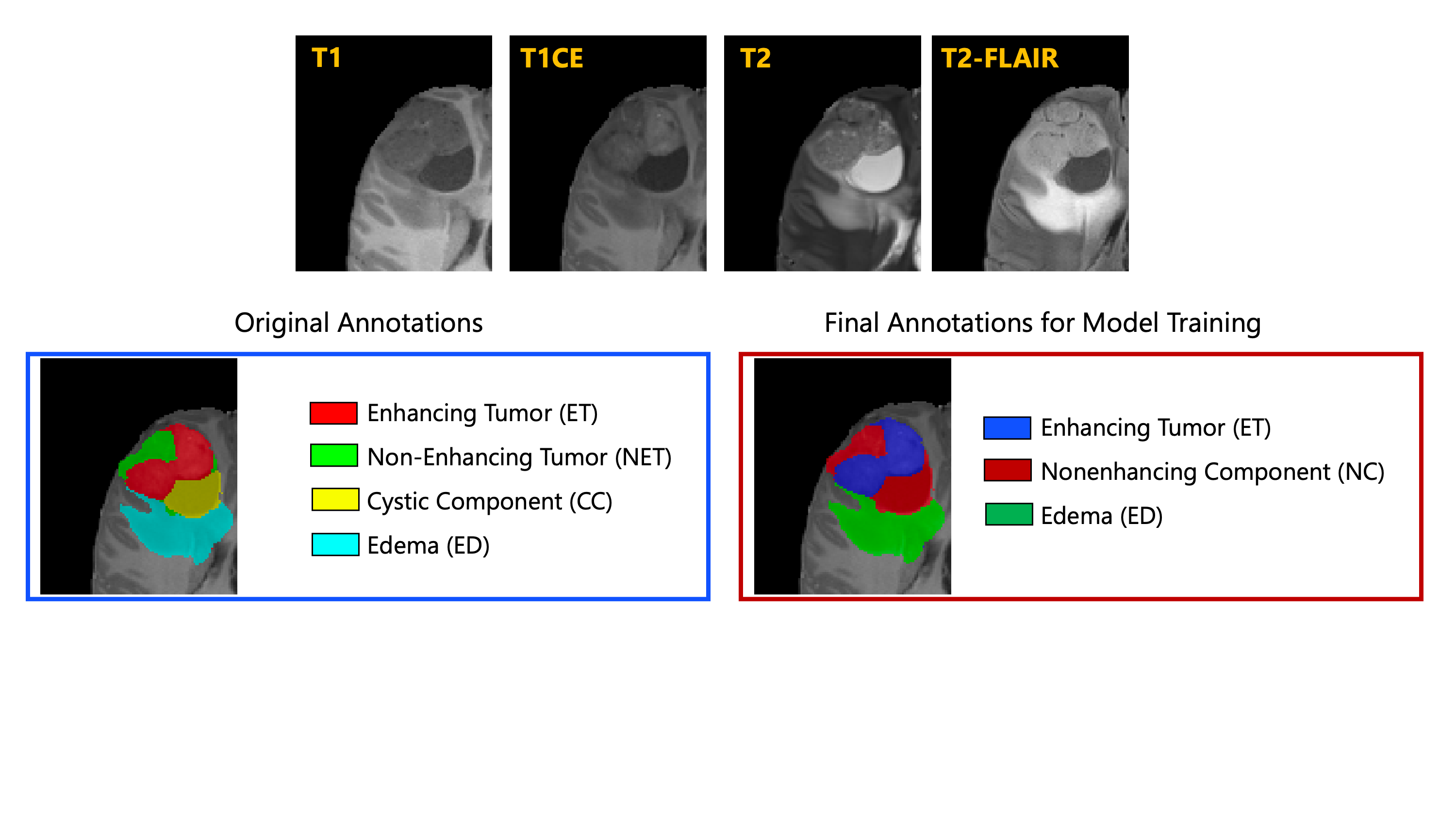
- Assemble a retrospective multi-institutional dataset of pediatric high-grade gliomas with four mpMRI sequences (T1, T1CE, T2, T2-FLAIR).
- Pre-process images with DICOM-to-NIfTI conversion, co-registration to SRI24, and isotropic resampling (1 mm^3).
- Provide ground-truth tumor subregion labels (ET, NET/NC, CC, ED) refined by neuroradiology experts and attending radiologists.
- Offer three labeling targets for participants (ET, NC, ED) and a fourth subregion (CC) not used for scoring to aid training.
- Use GaNDLF as a baseline framework for participants and enable containerized submissions via MLCube and MedPerf Synapse platform.
Experimental results
Research questions
- RQ1Can pediatric brain tumor subregions be reliably segmented volumetrically using multi-parametric MRI in a multi-institutional dataset?
- RQ2How well do pediatric tumor segmentation models trained on BraTS-PEDs generalize to unseen pediatric data across centers?
- RQ3What is the impact of using pediatric-annotated ground truth versus adult-focused annotations on segmentation performance?
- RQ4Does restricting training data to BraTS-PEDs data enable fair, reproducible benchmarking across participants?
Key findings
- BraTS-PEDs 2023 establishes the first pediatric-focused BraTS benchmark with multi-consortium data and ground-truth annotations.
- The dataset includes 228 pediatric high-grade glioma cases with four mpMRI sequences and standardized preprocessing.
- Participants are evaluated on enhancing tumor (ET), NC (enhancing/cystic/necrotic) and whole tumor (WT) regions on unseen data.
- The evaluation relies on containerized methods submitted via the MedPerf platform and CaPTk/FeTS tools during training and validation.
Read this paper
Open the full text in the Nubint reader and ask about any passage as you read.
Read this paper on NubintThis review was generated by AI from the original paper. Please check the paper before citing it.