
[Paper Review] The Brain Tumor Segmentation in Pediatrics (BraTS-PEDs) Challenge: Focus on Pediatrics (CBTN-CONNECT-DIPGR-ASNR-MICCAI BraTS-PEDs)
This paper describes the BraTS-PEDs challenge focused on pediatric brain tumor segmentation, detailing data, processing pipeline, annotation workflow, evaluation, and participation timeline across international consortia.
Pediatric tumors of the central nervous system are the most common cause of cancer-related death in children. The five-year survival rate for high-grade gliomas in children is less than 20%. Due to their rarity, the diagnosis of these entities is often delayed, their treatment is mainly based on historic treatment concepts, and clinical trials require multi-institutional collaborations. Here we present the CBTN-CONNECT-DIPGR-ASNR-MICCAI BraTS-PEDs challenge, focused on pediatric brain tumors with data acquired across multiple international consortia dedicated to pediatric neuro-oncology and clinical trials. The CBTN-CONNECT-DIPGR-ASNR-MICCAI BraTS-PEDs challenge brings together clinicians and AI/imaging scientists to lead to faster development of automated segmentation techniques that could benefit clinical trials, and ultimately the care of children with brain tumors.
Motivation & Objective
- Benchmark pediatric brain tumor segmentation methods using a retrospective multi-institutional mpMRI dataset.
- Provide ground-truth annotations for pediatric tumor subregions to enable standardized evaluation.
- Foster collaboration between clinicians and AI researchers to accelerate automated segmentation tools for pediatric neuro-oncology.
Proposed method
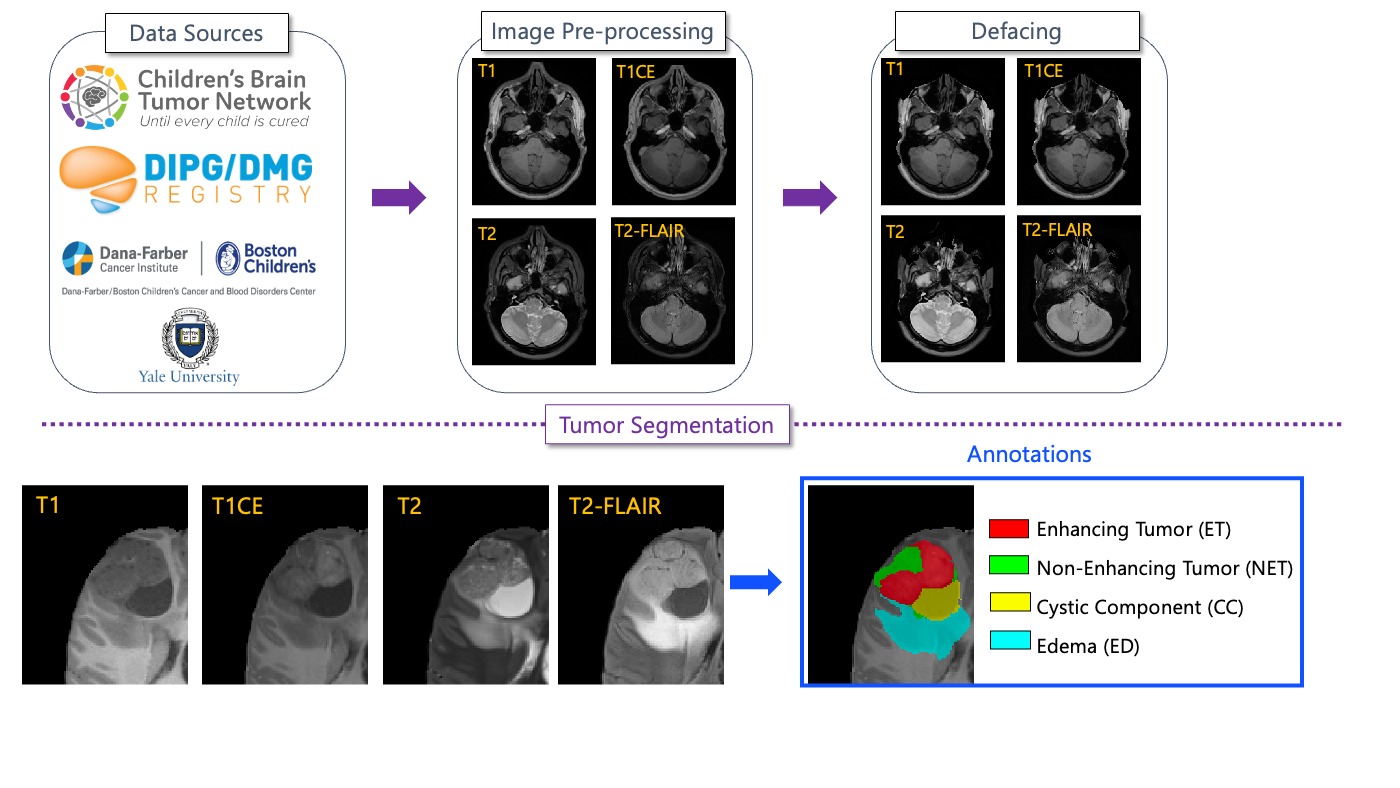
- Data aggregation from multiple international consortia (CBTN, CONNECT, DIPG Registry, ASNR) to form a 464-patient pediatric dataset.
- MRI sequences include T1, T1CE, T2, and T2-FLAIR with treatment-naive imaging.
- Ground-truth annotations segment tumors into four subregions: Enhancing Tumor (ET), Nonenhancing Tumor (NET), Cystic Component (CC), and Edema (ED).
- A pediatric autosegmentation tool provides preliminary segmentation refined by volunteer neuroradiology experts and adjudicated by attending neuroradiologists.
- Pre-processing uses the BraTS Pipeline and CaPTk/FeTS tools; defacing and anonymization are performed for privacy.
- Evaluation focuses on ET, NC (ET/CC/necrosis), and Whole Tumor (WT); submissions are containerized and evaluated on Synapse powered by MedPerf.
Experimental results
Research questions
- RQ1Can multi-institutional pediatric mpMRI data support robust automated segmentation of pediatric brain tumors?
- RQ2How do pediatric tumor subregions (ET, NET, CC, ED) affect segmentation performance and treatment monitoring?
- RQ3What is the impact of standardized preprocessing and expert-validated ground truth on reproducibility across institutions?
Key findings
- A retrospective multi-institutional dataset of 464 pediatric high-grade gliomas was assembled for BraTS-PEDs.
- The dataset includes four mpMRI sequences (T1, T1CE, T2, T2-FLAIR) and four tumor subregions for annotation.
- Automated segmentations are refined by neuroradiology experts and reviewed by board-certified neuroradiologists before public release.
- The challenge uses containerized submissions evaluated on unseen testing data via the Synapse/MedPerf platform.
- The study outlines common errors in automated pediatric brain tumor segmentation and provides guidelines for evaluation.
- The challenge design enables reproducibility and comparison with prior BraTS iterations, with data processing through CaPTk/FeTS pipelines.
Read this paper
Open the full text in the Nubint reader and ask about any passage as you read.
Read this paper on NubintThis review was generated by AI from the original paper. Please check the paper before citing it.