
[Paper Review] The clustering of galaxies in the completed SDSS-IV extended Baryon Oscillation Spectroscopic Survey: Primordial non-Gaussianity in Fourier Space
This study measures primordial non-Gaussianity using the clustering of 343,708 quasars from the completed eBOSS survey in Fourier space, employing a novel neural network for systematics correction and redshift-weighting techniques to optimize sensitivity. It reports $f_{\mathrm{NL}}^\mathrm{local} = -12 \pm 21$ at 68% confidence, representing one of the tightest constraints from large-scale structure to date, demonstrating the robustness of advanced systematics mitigation for future cosmological surveys.
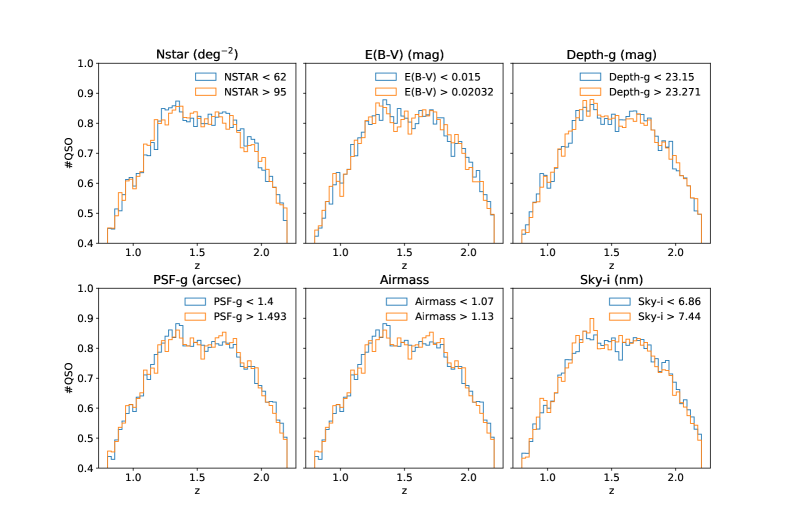
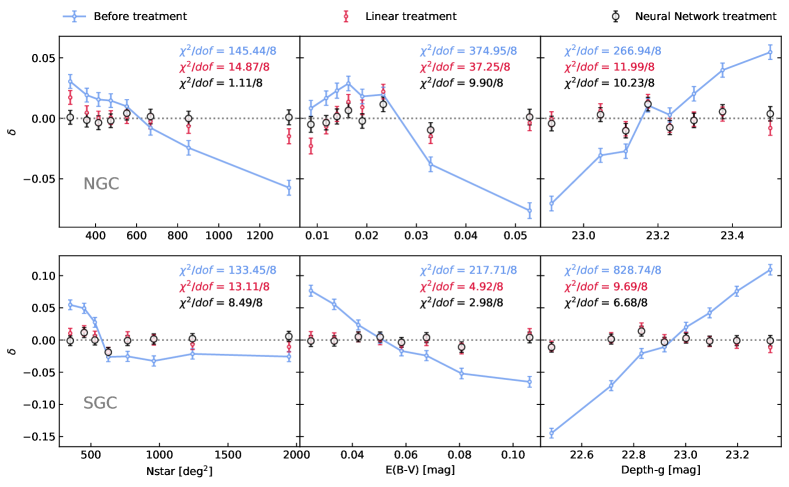
We present measurements of the local primordial non-Gaussianity parameter \fNLloc from the clustering of 343,708 quasars with redshifts 0.8 < z < 2.2 distributed over 4808 square degrees from the final data release (DR16) of the extended Baryon acoustic Oscillation Spectroscopic Survey (eBOSS), the largest volume spectroscopic survey up to date. Our analysis is performed in Fourier space, using the power spectrum monopole at very large scales to constrain the scale dependent halo bias. We carefully assess the impact of systematics on our measurement and test multiple contamination removal methods. We demonstrate the robustness of our analysis pipeline with EZ-mock catalogues that simulate the eBOSS DR16 target selection. We find $f_\mathrm{NL}=-12\pm 21$ (68\% confidence) for the main clustering sample including quasars with redshifts between 0.8 and 2.2, after exploiting a novel neural network scheme for cleaning the DR16 sample and in particular after applying redshift weighting techniques, designed for non-Gaussianity measurement from large scales structure, to optimize our analysis, which improve our results by 37\%.
Motivation & Objective
- To constrain the local primordial non-Gaussianity parameter $f_{\mathrm{NL}}^\mathrm{local}$ using large-scale structure clustering from the largest-volume spectroscopic survey to date.
- To improve constraints on inflationary models by leveraging the scale-dependent halo bias induced by primordial non-Gaussianity in quasar clustering.
- To develop and validate a robust analysis pipeline that mitigates observational systematics, particularly on large scales where PNG signals are most sensitive.
- To demonstrate the superiority of advanced systematics correction—specifically a neural network approach—over standard linear regression techniques in the context of PNG measurements.
- To enable future large-scale structure surveys to surpass cosmic microwave background constraints on $f_{\mathrm{NL}}$ by optimizing systematics control and weighting schemes.
Proposed method
- Analyzes the power spectrum monopole of quasar clustering in Fourier space to extract scale-dependent halo bias from large-scale structure.
- Applies redshift-dependent weights optimized for PNG sensitivity to maximize signal-to-noise across the redshift range 0.8 < z < 2.2.
- Employs a novel neural network-based contamination cleaning method to correct for observational systematics such as stellar density and extinction, as detailed in Rezaie et al. (2021).
- Validates the pipeline using EZ-mock catalogues that replicate the eBOSS DR16 target selection and observational systematics.
- Compares results from the neural network method with standard linear regression techniques to assess robustness and contamination levels.
- Performs extensive systematics testing, including redshift weighting and contamination removal, to ensure the $f_{\mathrm{NL}}$ measurement is not biased by observational effects.
Experimental results
Research questions
- RQ1What is the constraint on the local primordial non-Gaussianity parameter $f_{\mathrm{NL}}^\mathrm{local}$ derived from quasar clustering in the eBOSS DR16 survey?
- RQ2How do different systematics mitigation techniques—particularly neural networks versus linear regression—affect the robustness of $f_{\mathrm{NL}}$ measurements?
- RQ3To what extent do redshift-weighting techniques improve the sensitivity of $f_{\mathrm{NL}}$ constraints in large-scale structure surveys?
- RQ4Can the power spectrum monopole in Fourier space provide a robust and precise measurement of $f_{\mathrm{NL}}^\mathrm{local}$ in the presence of observational systematics?
- RQ5How does the performance of the analysis pipeline compare to previous LSS-based PNG measurements in terms of statistical uncertainty and systematics control?
Key findings
- The measurement yields $f_{\mathrm{NL}}^\mathrm{local} = -12 \pm 21$ at 68% confidence, representing a significant improvement in precision due to optimized systematics mitigation.
- The neural network-based systematics correction method produces robust results, whereas standard linear regression techniques fail to control contaminants, indicating uncorrected systematics in the data.
- The application of redshift-weighting techniques improves the final $f_{\mathrm{NL}}$ constraint by 37% compared to unweighted analysis, demonstrating their critical role in enhancing sensitivity.
- The analysis pipeline, validated with EZ-mock catalogues, shows high robustness against observational systematics, particularly on the largest scales where PNG signals are most prominent.
- The study confirms that large-scale structure surveys like eBOSS can achieve competitive constraints on $f_{\mathrm{NL}}^\mathrm{local}$, with potential to surpass CMB-based limits in the future.
- The results underscore the importance of advanced systematics mitigation—especially machine learning-based approaches—for next-generation surveys aiming for $\Delta f_{\mathrm{NL}} \sim 1$ precision.
Read this paper
Open the full text in the Nubint reader and ask about any passage as you read.
Read this paper on NubintThis review was generated by AI from the original paper. Please check the paper before citing it.