
[Paper Review] The Cosmos in its Infancy: JADES Galaxy Candidates at z > 8 in GOODS-S and GOODS-N
The paper presents a catalog of 717 galaxy candidates at z > 8 selected from 125 square arcminutes of JWST/NIRCam imaging as part of JADES, with extensive photometric redshift analysis and spectroscopic validation.
The JADES dataset of z > 8 galaxies (from the JADES-Deep public region) and galaxy candidates accompanying the paper "The Cosmos in its Infancy: JADES Galaxy Candidates at z > 8 in GOODS-S and GOODS-N" (Hainline et al.). We also include the EAZY template set used for these fits. Please see the README files for descriptions of the datasets. The full dataset, which will be released on paper acceptance, can be found at this link.
Motivation & Objective
- Motivate study of the earliest galaxy formation during the first billion years after the Big Bang.
- Construct a robust sample of z>8 galaxy candidates using deep multi-filter JWST and ancillary HST data.
- Assess reliability of photometric redshifts with spectroscopic confirmations and evaluate potential low-mass star contamination.
- Highlight notable high-z sources and understand selection effects, depths, and template choices in high-redshift galaxy identification.
Proposed method
- Combine JWST/NIRCam imaging from JADES with data from JEMS and FRESCO, plus deep HST/ACS imaging to build a 15-filter JWST + 5-filter HST photometric set.
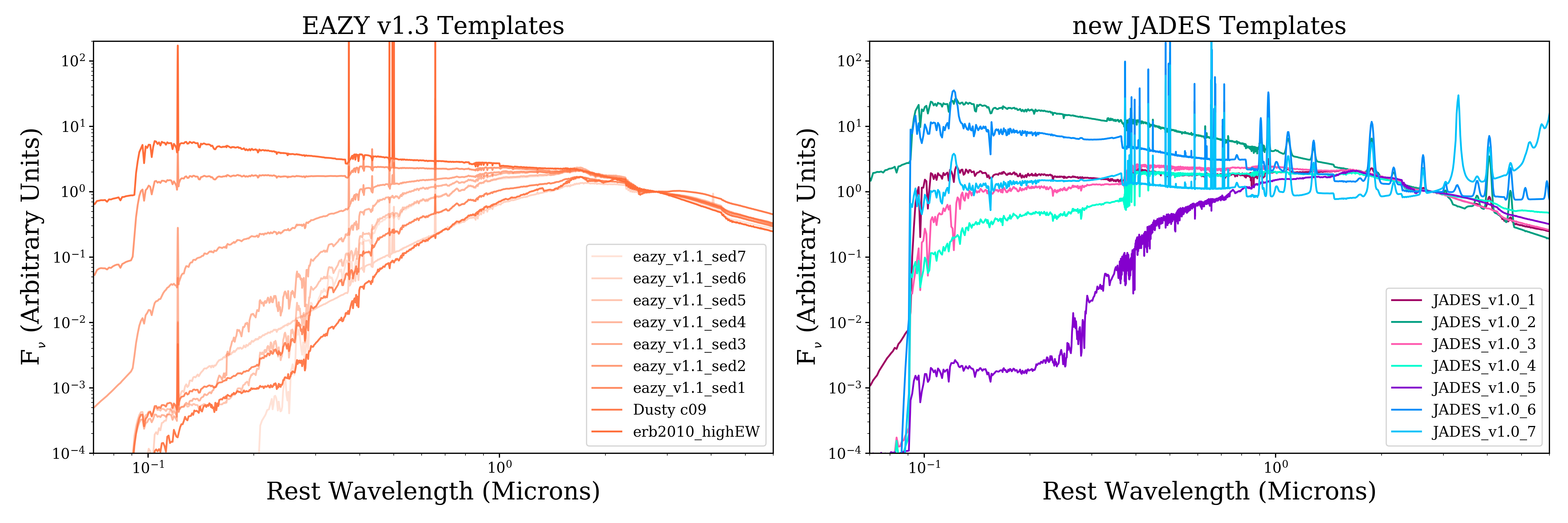
- Perform template fitting with EAZY to estimate photometric redshifts across z = 0.01–22, incorporating nebular emission templates and IGM attenuation.
- Use an error floor of 5% on photometry and a template error file to account for calibration and template uncertainties.
- Apply forced photometry on 0.2 arcsecond diameter apertures to measure fluxes and derive photometric redshifts.
- Cross-match with FRESCO and NIRSpec spectroscopy to validate redshift estimates and assess contamination.
Experimental results
Research questions
- RQ1How many credible galaxy candidates exist at z>8 in GOODS-S and GOODS-N when combining JADES, JEMS, FRESCO, and deep HST data?
- RQ2How accurate are photometric redshifts for z>8 galaxies when validated against spectroscopic redshifts from NIRSpec and FRESCO?
- RQ3What is the level of contamination by low-mass stars or other interlopers in the z>8 candidate sample?
- RQ4What is the distribution of high-z galaxies across z=8–10, z=10–12, and z>12, and what are their notable properties?
- RQ5How do different template sets affect the derived photometric redshifts and candidate selection?
Key findings
- Catalog identifies 717 candidate galaxies at z>8 over 125 square arcminutes of NIRCam imaging.
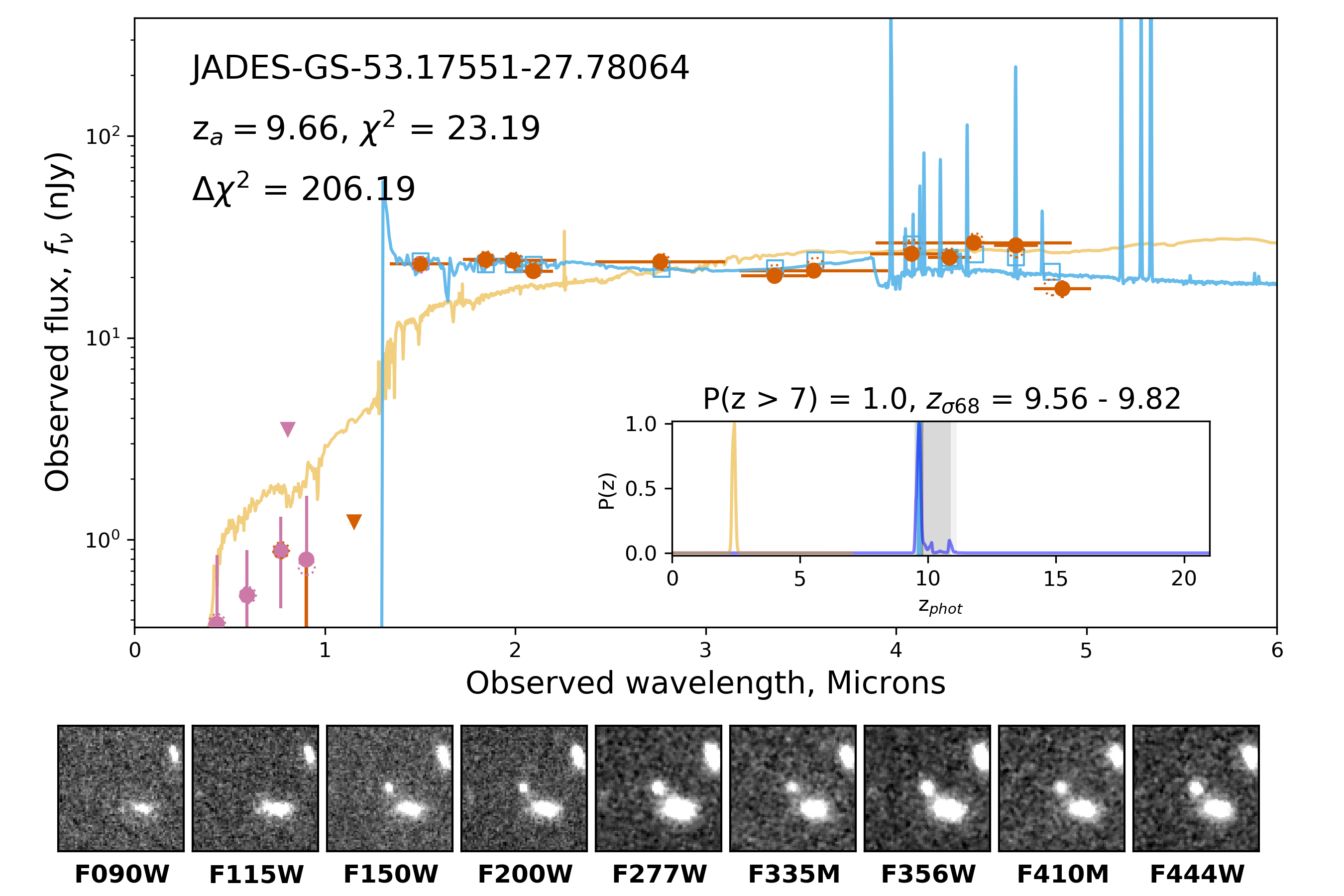
- Over 93% of sources are newly identified from deep JADES imaging, including 31 new galaxy candidates at z_phot > 12.
- Highest photometric redshifts extend to z_phot ~ 18 among the candidates.
- Using 42 sources with spectroscopic redshifts (NIRSpec and FRESCO), photometric redshifts show excellent agreement with no catastrophic outliers and an average Δz = z_phot − z_spec = 0.26.
- Candidates include analyses of resolved or extended sources and very red long-wavelength slopes, with robust sampling enabled by the deep multi-filter data.
- Sample provides a robust dataset for probing the early buildup of galaxies within the first few hundred million years of the Universe.
Read this paper
Open the full text in the Nubint reader and ask about any passage as you read.
Read this paper on NubintThis review was generated by AI from the original paper. Please check the paper before citing it.