
[Paper Review] The dust enrichment of early galaxies in the JWST and ALMA era
The study uses the delphi semi-analytic model with two redshift- and mass-independent parameters to predict UV and FIR properties of high-z galaxies up to z~20, highlighting dust effects, UV visibility, and FIR evolution.
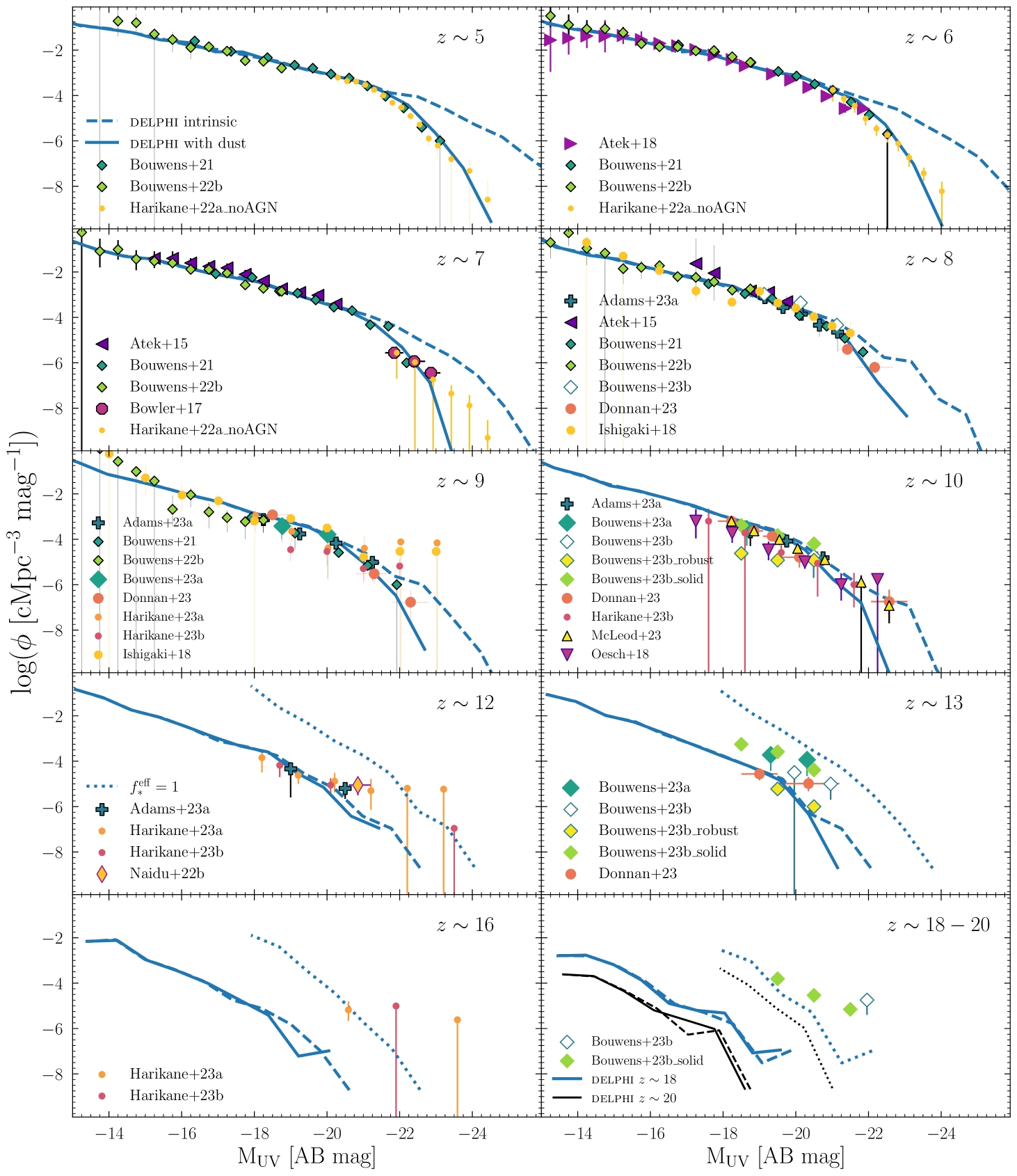
Recent observations with the James Webb Space Telescope are yielding tantalizing hints of an early population of massive, bright galaxies at $z > 10$, with Atacama Large Millimeter Array (ALMA) observations indicating significant dust masses as early as $z\sim 7$. To understand the implications of these observations, we use the DELPHI semi-analytic model that jointly tracks the assembly of dark matter halos and their baryons, including the key processes of dust enrichment. Our model employs only two redshift- and mass-independent free parameters (the maximum star-formation efficiency and the fraction of supernova energy that couples to gas) that are tuned against all available galaxy data at $z \sim 5-9$ before it is used to make predictions up to $z \sim 20$. Our key results are: (i) the model under-predicts the observed ultraviolet luminosity function (UV LF) at $z > 12$; observations at $z>16$ lie close to, or even above, a "maximal" model where all available gas is turned into stars; (ii) UV selection would miss 34\% of the star formation rate density at $z \sim 5$, decreasing to 17\% by $z \sim 10$ for bright galaxies with $ m{M_{UV}} < -19$; (iii) the dust mass ($M_d$) evolves with the stellar mass ($M_*$) and redshift as $\log(M_d) = 1.194\log(M_*) + 0.0975z - 5.433$; (iv) the dust temperature increases with stellar mass, ranging between $30-33$ K for $M_* \sim 10^{9-11}M_\odot$ galaxies at $z \sim 7$. Finally, we predict the far infrared LF at $z \sim 5-20$, testable with ALMA observations, and caution that spectroscopic redshifts and dust masses must be pinned down before invoking unphysical extrema in galaxy formation models.
Motivation & Objective
- Motivate understanding of dust enrichment and its impact on early galaxy observables in the JWST and ALMA era.
- Predict UV and FIR luminosities and how dust attenuates UV light in high-redshift galaxies.
- Link dust mass and temperature to stellar mass and redshift, informing FIR luminosity functions.
- Test model predictions against UV luminosity functions, stellar mass functions, and cosmic SFR density up to z~20.
Proposed method
- Employ the delphi semi-analytic model tracking dark matter halo assembly and baryons with dust enrichment.
- Use two redshift- and mass-independent free parameters: maximum star-formation efficiency f_* and SN energy coupling fraction f_w, calibrated to z~5-9 data.
- Compute gas accretion, star formation, SN feedback, and dust evolution through coupled differential equations for metals and dust (including growth and destruction).
- Generate intrinsic UV luminosities via BPASS stellar populations and apply dust attenuation using a slab geometry with a dust optical depth tied to M_d and r_d.
- Enforce energy balance to derive FIR luminosities and estimate dust temperatures from L_FIR and M_d, including CMB considerations at high z.
Experimental results
Research questions
- RQ1How does dust enrichment influence the UV luminosity function and UV visibility of high-redshift galaxies up to z~20?
- RQ2What are the relationships between dust mass, stellar mass, star formation, and redshift in early galaxies, and how do these affect FIR emission?
- RQ3Can the model reproduce observed UV and stellar mass functions from z~5 to z~9 and predict FIR luminosity functions for z~5-20?
- RQ4What fraction of star formation is missed by UV selection due to dust attenuation, especially for bright galaxies?
- RQ5How do dust temperature and UV escape fraction evolve with galaxy mass and redshift?
Key findings
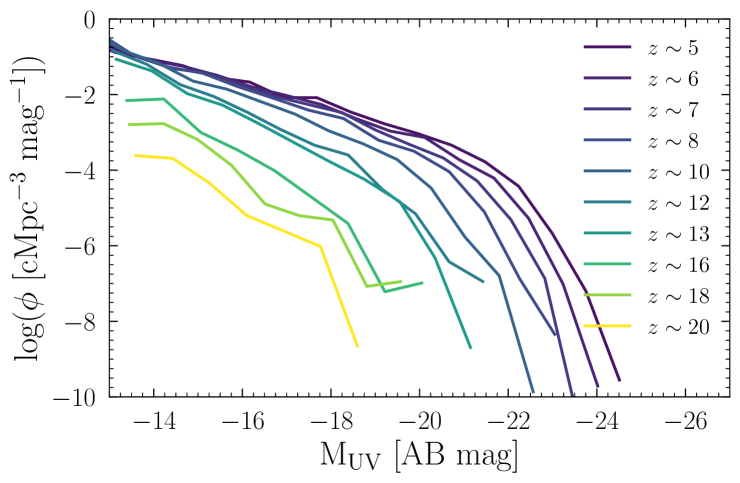
- The model under-predicts the UV LF at z>12; at z>16 observations approach a maximal model with high star formation efficiency.
- UV selection misses 34% of SFR density at z~5 for bright galaxies (M_UV<-19), decreasing to 17% by z~10.
- Dust mass scales with stellar mass and redshift as log(M_d)=1.194 log(M_*)+0.0975 z-5.433.
- Dust temperature ranges ~30-33 K for M_* ~10^9-10^11 M_sun at z~7 and increases with stellar mass.
- The model predicts FIR luminosities and can constrain the far-infrared LF at z~5-20, with caution about spectroscopic redshifts and dust mass determinations.
- The UV LF evolution shows dust impacts become relevant at z~5-10 for faint/moderate Luminosities and are negligible at z>12 for the brightest systems.
Read this paper
Open the full text in the Nubint reader and ask about any passage as you read.
Read this paper on NubintThis review was generated by AI from the original paper. Please check the paper before citing it.