
[Paper Review] The Effect of Domain and Diacritics in Yorùbá-English Neural Machine Translation
This paper introduces MENYO-20k, a high-quality, multi-domain English–Yorùbá parallel corpus with standardized train-test splits, and evaluates its impact on neural machine translation. By incorporating proper diacritics and domain-specific data, the authors demonstrate that fine-tuned models outperform massive multilingual models like Google and Facebook M2M by +8.7 and +9.1 BLEU respectively in Yorùbá–English translation.
Massively multilingual machine translation (MT) has shown impressive capabilities, including zero and few-shot translation between low-resource language pairs. However, these models are often evaluated on high-resource languages with the assumption that they generalize to low-resource ones. The difficulty of evaluating MT models on low-resource pairs is often due to lack of standardized evaluation datasets. In this paper, we present MENYO-20k, the first multi-domain parallel corpus with a special focus on clean orthography for Yorùbá--English with standardized train-test splits for benchmarking. We provide several neural MT benchmarks and compare them to the performance of popular pre-trained (massively multilingual) MT models both for the heterogeneous test set and its subdomains. Since these pre-trained models use huge amounts of data with uncertain quality, we also analyze the effect of diacritics, a major characteristic of Yorùbá, in the training data. We investigate how and when this training condition affects the final quality and intelligibility of a translation. Our models outperform massively multilingual models such as Google ($+8.7$ BLEU) and Facebook M2M ($+9.1$ BLEU) when translating to Yorùbá, setting a high quality benchmark for future research.
Motivation & Objective
- To address the lack of standardized, high-quality parallel corpora for low-resource Yorùbá–English machine translation.
- To investigate the impact of domain diversity and diacritic accuracy in training data on translation quality.
- To establish a benchmark for Yorùbá–English neural machine translation using a curated, multi-domain dataset.
- To evaluate the performance of supervised, semi-supervised, and fine-tuned models on low-resource Yorùbá–English translation.
- To analyze how diacritics affect translation quality, especially in the en–yo direction, and assess the benefits of diacritic restoration.
Proposed method
- Constructed MENYO-20k, a 20k-sentence parallel corpus spanning news, TED talks, radio, science/tech, and conversational texts, curated with professional translators.
- Defined a standardized train-dev-test split to enable reproducible benchmarking for Yorùbá–English NMT.
- Trained multiple supervised, semi-supervised, and fine-tuned NMT models on MENYO-20k combined with JW300 and Bible datasets.
- Evaluated models using automatic metrics (BLEU) and human evaluation for fluency and intelligibility.
- Compared performance against massive multilingual models like Google's MNMT and Facebook's M2M-100.
- Analyzed the effect of diacritics by training models on both diacritic-rich and diacritic-poor versions of the data.
Experimental results
Research questions
- RQ1How does domain diversity in training data affect the generalization of NMT models on low-resource Yorùbá–English translation?
- RQ2To what extent does proper diacritization in training data improve translation quality, particularly in the en–yo direction?
- RQ3Can fine-tuned models trained on MENYO-20k outperform massive multilingual models like Google MNMT and Facebook M2M on Yorùbá–English translation?
- RQ4How does the presence of diacritics in the training data affect fluency and intelligibility in human evaluation?
- RQ5What is the impact of domain mismatch between training and test data on translation quality when diacritics are inconsistent?
Key findings
- Models fine-tuned on MENYO-20k outperformed Google's multilingual model by +8.7 BLEU and Facebook's M2M model by +9.1 BLEU in Yorùbá–English translation.
- The human evaluation revealed that models trained on low-quality, non-diacriticized data (e.g., Google MNMT) were less fluent despite being intelligible.
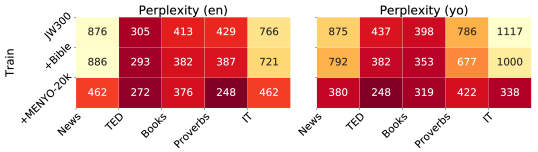
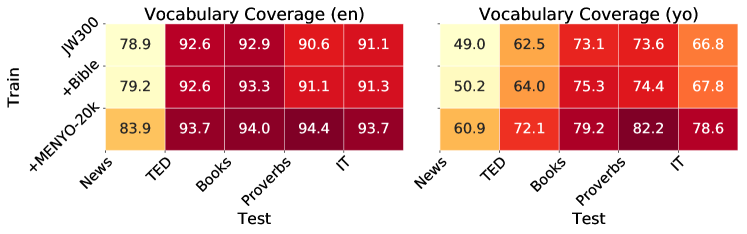
- Proper diacritization in training data significantly improved translation quality in the en–yo direction, especially when there was a domain mismatch.
- Even with only 10k parallel sentences, MENYO-20k combined with JW300 and Bible improved translation performance across all domains.
- The study demonstrated that high-quality, language-specific data with correct diacritics outperforms massive, noisy multilingual corpora in low-resource settings.
- Automatic diacritic restoration was shown to be beneficial in mitigating the negative effects of noisy or missing diacritics in training data.
Read this paper
Open the full text in the Nubint reader and ask about any passage as you read.
Read this paper on NubintThis review was generated by AI from the original paper. Please check the paper before citing it.