
[Paper Review] The field theoretical ABC of epidemic dynamics
This paper introduces a unified field-theoretical framework to model epidemic dynamics by linking percolation models, compartmental SIR-type models, and renormalization group (eRG) approaches through the symmetry of time-dilation invariance. It demonstrates that criticality, self-similarity under time rescaling, and multi-wave dynamics emerge naturally in this formalism, offering a powerful, symmetric description of disease spread applicable to real-world pandemics like COVID-19.
Infectious diseases are a threat for human health with tremendous impact on our society at large. The recent COVID-19 pandemic, caused by the SARS-CoV-2, is the latest example of a highly infectious disease ravaging the world, since late 2019. It is therefore imperative to develop efficient mathematical models, able to substantially curb the damages of a pandemic by unveiling disease spreading dynamics and symmetries. This will help inform (non)-pharmaceutical prevention strategies. For the reasons above we wrote this report that goes at the heart of mathematical modelling of infectious disease diffusion by simultaneously investigating the underlying microscopic dynamics in terms of percolation models, effective description via compartmental models and the employment of temporal symmetries naturally encoded in the mathematical language of critical phenomena. Our report reviews these approaches and determines their common denominators, relevant for theoretical epidemiology and its link to important concepts in theoretical physics. We show that the different frameworks exhibit common features such as criticality and self-similarity under time rescaling. These features are naturally encoded within the unifying field theoretical approach. The latter leads to an efficient description of the time evolution of the disease via a framework in which (near) time-dilation invariance is explicitly realised. As important test of the relevance of symmetries we show how to mathematically account for observed phenomena such as multi-wave dynamics. The models presented here are of immediate relevance for different realms of scientific enquiry from medical applications to the understanding of human behaviour. Our review offers novel perspectives on how to model, capture, organise and understand epidemiological data and disease dynamics for modelling real-world phenomena.
Motivation & Objective
- To unify disparate mathematical models of epidemic spread—percolation, compartmental (SIR), and renormalization group approaches—under a common field-theoretical framework.
- To identify and exploit time-dilation invariance as a fundamental symmetry underlying epidemic dynamics, particularly near critical points.
- To demonstrate how this symmetry explains observed phenomena such as multi-wave pandemics and linear growth phases.
- To provide a systematic, physics-inspired framework for modeling real-world epidemic data with predictive and policy-relevant insights.
- To extend the applicability of these models beyond human infectious diseases to broader complex systems, including information spread and network dynamics.
Proposed method
- Formulates a master action in field theory that encodes the dynamics of disease spread from microscopic percolation processes.
- Derives effective compartmental models (e.g., SIR) from lattice percolation via coarse-graining and mean-field approximations.
- Reinterprets SIR models as a system of renormalization group (RG) equations with a beta-function governing time evolution.
- Introduces the Epidemic Renormalization Group (eRG) framework, where fixed points represent disease-free or endemic states, and flow between them describes epidemic progression.
- Uses time-rescaling symmetries to identify self-similar solutions and critical behavior near phase transitions.
- Applies the formalism to model multi-wave dynamics by extending the eRG with complex fixed points and non-trivial flow trajectories.
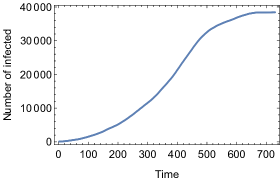
Experimental results
Research questions
- RQ1How can field theory provide a unifying description of diverse epidemic modeling approaches, including percolation and compartmental models?
- RQ2What role does time-dilation invariance play in organizing the dynamics of disease spread, and how is it reflected in critical behavior and self-similarity?
- RQ3Can the epidemic renormalization group (eRG) framework explain multi-wave pandemic patterns observed in real data, such as those in the COVID-19 pandemic?
- RQ4How do time-rescaling symmetries and fixed points in the eRG formalism relate to observable epidemiological features like linear growth or sustained transmission?
- RQ5To what extent can this field-theoretic framework be generalized to model non-pharmaceutical interventions, vaccination, and pathogen evolution?
Key findings
- The field-theoretical approach reveals that criticality and self-similarity under time rescaling are universal features of epidemic dynamics, emerging naturally from the underlying symmetries.
- Compartmental models like SIR can be derived from microscopic percolation models via coarse-graining and mean-field averaging, establishing a bridge between microscopic and macroscopic descriptions.
- The SIR model is shown to be equivalent to a system of renormalization group equations with a well-defined beta-function, enabling a dynamical systems interpretation.
- The eRG framework successfully models multi-wave dynamics by introducing complex fixed points and non-trivial flow trajectories between them, consistent with observed pandemic waves.
- The formalism accounts for time-rescaling invariance in the linear growth phase, where the number of active infections remains approximately constant, and the system exhibits near-scale invariance.
- The framework is validated on real-world data from the COVID-19 pandemic, showing that non-pharmaceutical interventions and mobility patterns can be effectively modeled through time-dependent parameters in the eRG approach.
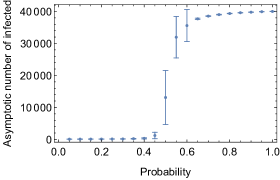
Read this paper
Open the full text in the Nubint reader and ask about any passage as you read.
Read this paper on NubintThis review was generated by AI from the original paper. Please check the paper before citing it.