
[Paper Review] The galaxy UV luminosity function at $\mathbf{z \simeq 11}$ from a suite of public JWST ERS, ERO and Cycle-1 programs
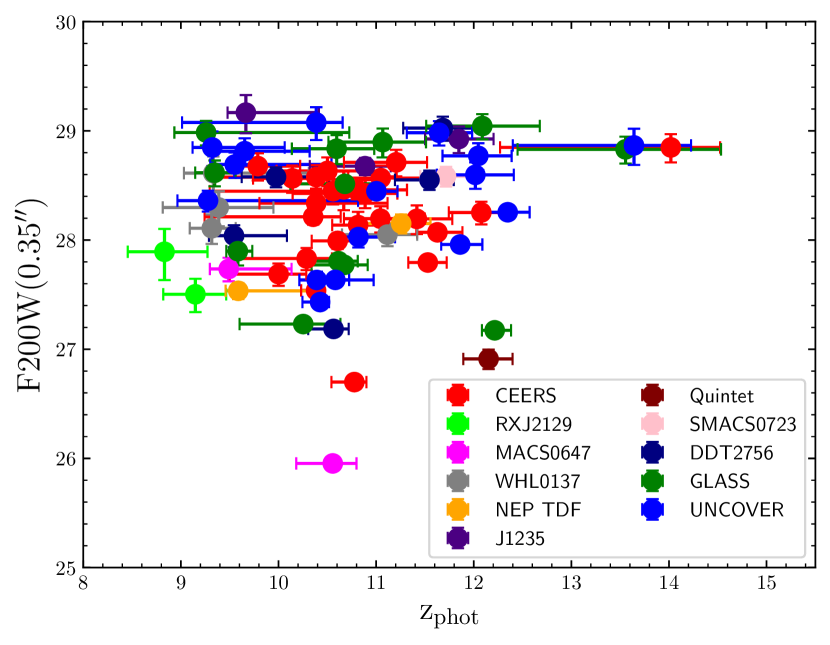
The paper presents a wide-area JWST NIRCam search (∼260 arcmin²) yielding 61 robust z>9.5 galaxy candidates to constrain the evolving UV luminosity function from z≈9.5 to 12.5, favoring a double power-law form and a steep faint-end slope.
We present a new determination of the evolving galaxy UV luminosity function (LF) over the redshift range $9.5250$ arcmin$^2$) data set of JWST NIRCam near-infrared imaging assembled from thirteen public JWST surveys. Our relatively large-area search allows us to uncover a sample of 61 robust $z>9.5$ candidates detected at $\geq 8σ$, and hence place new constraints on the intermediate-to-bright end of the UV LF. When combined with our previous JWST+UltraVISTA results, this allows us to measure the form of the LF over a luminosity range corresponding to four magnitudes ($M_{1500}$). At these early times we find that the galaxy UV LF is best described by a double power-law function, consistent with results obtained from recent ground-based and early JWST studies at similar redshifts. Our measurements provide further evidence for a relative lack of evolution at the bright-end of the UV LF at $z=9-11$, but do favour a steep faint-end slope ($α\leq-2$). The luminosity-weighted integral of our evolving UV LF provides further evidence for a gradual, smooth (exponential) decline in co-moving star-formation rate density ($ρ_{\mathrm{SFR}}$) at least out to $z\simeq12$, with our determination of $ρ_{\mathrm{SFR}}(z=11)$ lying significantly above the predictions of many theoretical models of galaxy evolution.
Motivation & Objective
- Chart the evolution of the rest-frame UV galaxy luminosity function (LF) at z≈9.5–12.5 using a wide-area JWST NIRCam data set from public surveys.
- Measure the bright-to-intermediate end of the UV LF over four magnitudes in M1500 and assess its functional form.
- Combine new wide-area results with previous JWST+UltraVISTA constraints to derive the evolution of ρ_SFR up to z≈12.
- Assess the abundance of bright z>9.5 galaxies and compare with theoretical models of galaxy evolution.
Proposed method
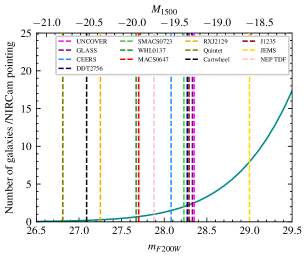
- Compile a multi-survey JWST NIRCam catalog (over 13 public surveys) totaling ~260 arcmin² after masking clusters/lensing where applicable.
- Perform PSF homogenization and 0.35″ diameter aperture photometry with flux corrections to total using FLUX_AUTO with an additional 10% light outside the Kron aperture.
- Use LePhare for SED fitting with BC03 templates, a Chabrier IMF, Calzetti dust law, and Madau IGM attenuation to derive photometric redshifts and M1500.
- Apply robust z>9.5 selection with zphot≥8.5, Δχ²≥4 between primary/secondary solutions, ≥8σ detection in at least one key band, and non-detection in bands shortward of the Lyman break.
- Account for lensing and effective survey areas in cluster fields (e.g., SMACS 0723) and use published lensing models to derive delensed areas and magnifications.
Experimental results
Research questions
- RQ1What is the form of the UV luminosity function at z≈9.5–12.5 across a four-magnitude luminosity range?
- RQ2Does the UV LF at these redshifts favor a double power-law over a Schechter function at the bright end?
- RQ3What is the evolution of the luminosity density and the implied star-formation rate density (ρ_SFR) out to z≈12?
- RQ4How do JWST-derived LF measurements at z>9.5 compare with existing theoretical models of early galaxy evolution?
Key findings
- The UV luminosity function at z≈9.5–12.5 is best described by a double power-law, consistent with recent ground-based and early JWST studies.
- There is evidence for a relative lack of evolution at the bright end of the UV LF at z=9–11.
- The faint-end slope is steep (α ≤ −2) based on the combined data.
- The luminosity-weighted integral of the evolving UV LF indicates a gradual exponential decline in the co-moving star-formation rate density up to z≈12.
- The derived ρ_SFR(z=11) lies significantly above many theoretical model predictions, indicating higher star-formation activity in the early universe than some models anticipate.
Read this paper
Open the full text in the Nubint reader and ask about any passage as you read.
Read this paper on NubintThis review was generated by AI from the original paper. Please check the paper before citing it.