
[論文レビュー] The GALEX Ultraviolet Virgo Cluster Survey (GUViCS). IV: The role of the cluster environment on galaxy evolution
本研究では、UVから電波にわたる波長域における868個の銀河を対象としたGUViCS調査を用いて、バービオ銀河団環境が銀河進化に与える影響を調査する。質量の大きな銀河は初期の主要合体によって形成された(ゆっくり回転する銀河)、一方、低質量の星形成を示す矮星銀河は、降着時に断続的圧力剥ぎ取りによって急速に停止し、運動学的構造を損なわずに静止状態の赤い矮星に変容する。このことにより、バービオ団中心部に密集する赤いシーケンスの成り立ちが説明できる。
We study the role of the environment on galaxy evolution using a sample of 868 galaxies in the Virgo cluster and in its surrounding regions selected from the GUViCS Survey with the purpose of understanding the origin of the red sequence in dense environments. We collected multifrequency data covering the whole electromagnetic spectrum for most of the galaxies. We identify the different dynamical substructures composing the Virgo cluster and we calculate the local density of galaxies using different methods. We then study the distribution of galaxies belonging to the red sequence, the green valley, and the blue cloud within the different cluster substructures. Our analysis indicates that all the most massive galaxies are slow rotators and are the dominant galaxies of the different cluster substructures generally associated with a diffuse X-ray emission. They are probably the result of major merging events that occurred at early epochs. Slow rotators of lower stellar mass are also preferentially located within the different high-density substructures of the cluster. They are virialised within the cluster, thus Virgo members since its formation. They have been shaped by gravitational perturbations occurring within the infalling groups that later formed the cluster. On the contrary, low-mass star-forming systems are extremely rare in the inner regions of the Virgo cluster A, where the density of the intergalactic medium is at its maximum. Our ram pressure stripping models consistently indicate that these star-forming systems can be rapidly deprived of their interstellar medium during their interaction with the intergalactic medium. The lack of gas quenches their star formation activity transforming them into quiescent dwarf ellipticals. This mild transformation does not perturb the kinematic properties of these galaxies which still have rotation curves typical of star-forming systems.
研究の動機と目的
- バービオ銀河団における環境的要因が銀河進化に与える影響を理解すること、特に高密度環境における赤いシーケンスの起源を解明すること。
- 銀河団内での銀河の消滅が、主に断続的圧力剥ぎ取り、スターヴェーション、それとも降着するグループでの事前処理によるものであるかを特定すること。
- 初期型銀河の形成メカニズムを区別すること:質量の大きな系では主要合体、低質量系では環境的消滅。
- 動的構造と局所的銀河密度が色-等級図における銀河分布に与える影響を評価すること。
- 特に消滅した矮星において、運動学的性質(例:回転曲線)が環境変化中に保持されるかどうかを調査すること。
提案手法
- GALEX(UV)、光学、中赤外・遠赤外、光学/HI分光計測データを用いて、バービオ銀河団に属する868個の銀河の多波長データを分析した。
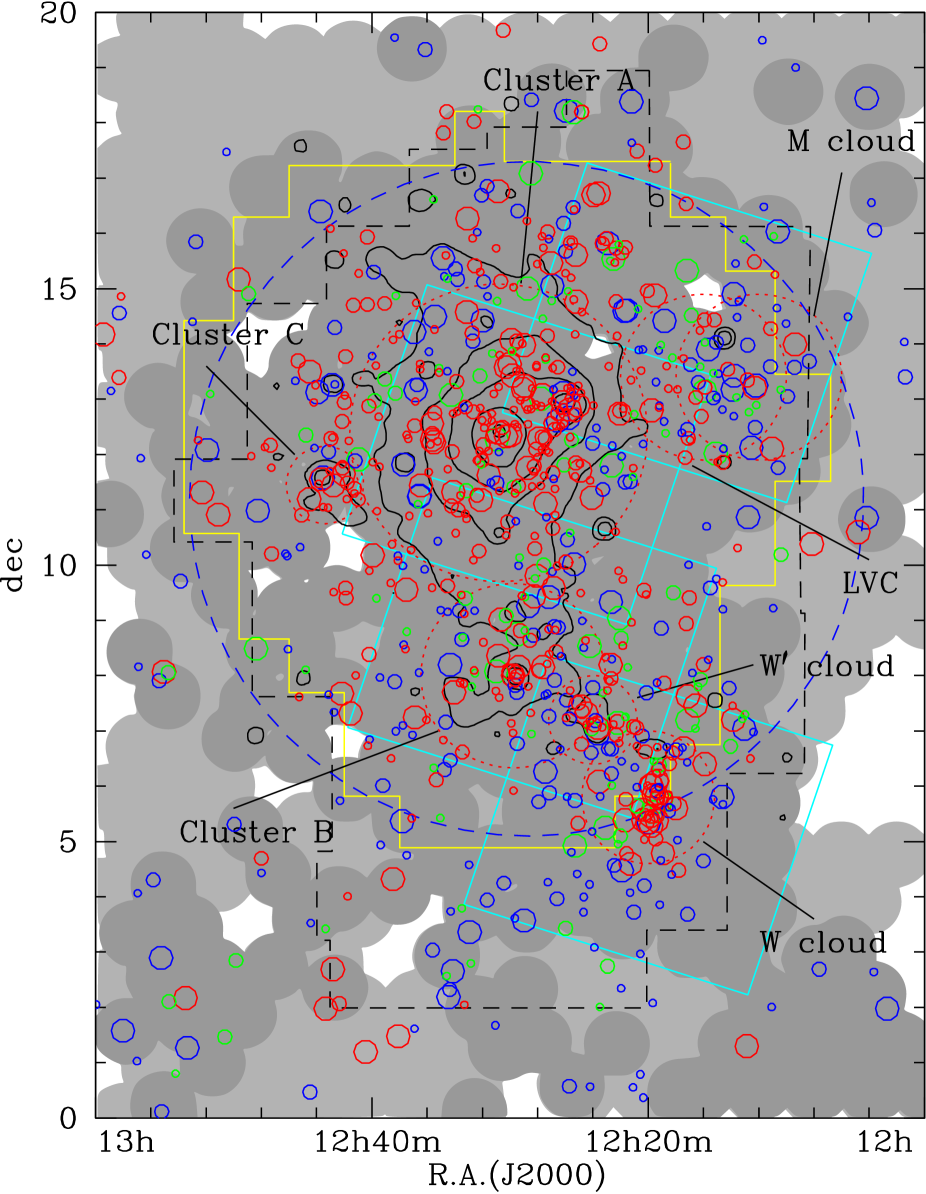
- 速度分布と空間的分布を用いて、バービオ団内の動的構造を同定し、複数の手法を用いて局所的銀河密度を定量化した。
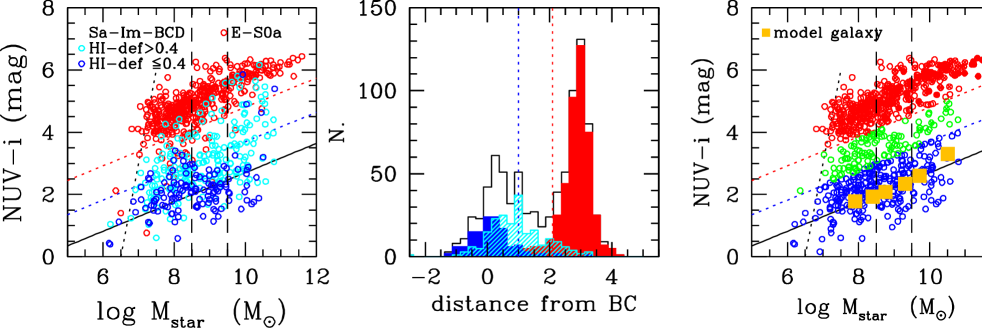
- UV-光学色-等級図に基づき、銀河を赤いシーケンス、緑い谷、青いクラウドに分類した。
- 流体力学的シミュレーションを用いて断続的圧力剥ぎ取りをモデル化し、星形成を示す矮星におけるガス除去に要する時間スケールを推定した。
- 回転曲線、速度分散といった運動学的データを用いて、銀河をゆっくり回転する銀河(合体の残骸)と速い回転銀河(ディスク型)に分類した。
- ガス供給の停止が約100億年前に始まったと仮定し、スターヴェーションと断続的圧力剥ぎ取りが消滅時間スケールに与える影響を比較した。
実験結果
リサーチクエスチョン
- RQ1バービオ団コア部における低質量銀河の星形成の消滅を引き起こす主なメカニズムは何か?
- RQ2消滅した矮星銀河の運動学的性質は、星形成を示す同様の対象と比較してどう異なるか。これは、変容過程で回転構造が保持されているかどうかを示唆する。
- RQ3主要合体と降着するグループ内での事前処理は、バービオ団における質量の大きな初期型銀河形成にどの程度寄与しているか?
- RQ4赤い銀河、緑い谷、青い銀河の観測分布は、局所的密度および構造的サブグループへの所属関係とどの程度相関しているか?
- RQ5スターヴェーションだけが、観測された銀河団内の消滅を説明できるのか、それとも断続的圧力剥ぎ取りがより効果的なメカニズムであるのか?
主な発見
- すべての質量が $M_{\star} \gtrsim 10^{11} M_\odot$ の銀河はゆっくり回転する銀河であり、初期に主要合体が起こったことを示している。
- 低質量の星形成銀河は、バービオAのコア部では極めてまれであり、これは環境的要因による急速な消滅を示している。
- 断続的圧力剥ぎ取りのモデルでは、ガスが約10億年で矮星から剥がれることが示され、これは銀河が周縁部からコア部へ移動する時間スケール(約1000 km s$^{-1}$)と一致する。
- 星形成を示す矮星が断続的圧力剥ぎ取りによって静止状態の赤い矮星に変容する過程で、回転曲線が保持されている。これは運動学的構造の破壊が最小限に抑えられていることを示している。
- スターヴェーションモデルでは、ガス供給の停止が100億年前に始まったとしても、ほとんど消滅効果が得られず、したがってバービオ団の観測された赤いシーケンスを説明することはできない。
- 赤いシーケンスのきわめて明るくない部分は、長期間にわたるスターヴェーションや事前処理ではなく、最近変容した矮星が支配的であると考えられる。
より良い研究を、今すぐ始めましょう
論文設計から論文執筆まで、研究時間を劇的に削減しましょう。
クレジットカード登録不要
このレビューはAIが作成し、人間の編集者が確認しました。