
[Paper Review] The Gas-Phase Mass--Metallicity Relation for Massive Galaxies at $z\sim0.7$ with the LEGA-C Survey
This study extends the gas-phase mass–metallicity relation (MZR) for massive galaxies to log(M⋆/M☉) ≈ 11.1 at z ≈ 0.7 using deep VLT/VIMOS spectra from the LEGA-C survey. It reveals a flattened MZR at high masses, contradicting simulation predictions and providing a critical observational constraint for AGN feedback models in galaxy evolution.
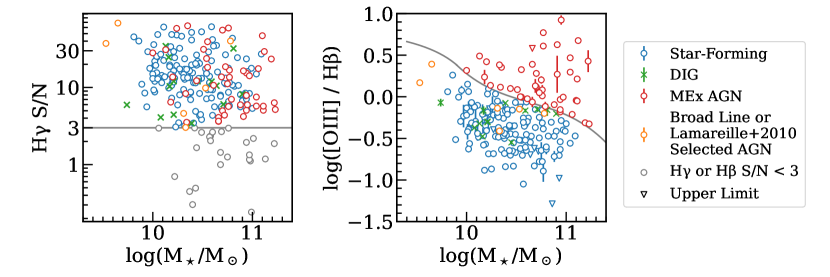
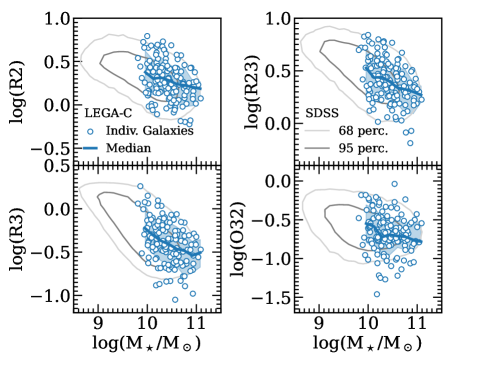
The massive end of the gas-phase mass--metallicity relation (MZR) is a sensitive probe of active galactic nuclei (AGN) feedback that is a crucial but highly uncertain component of galaxy evolution models. In this paper, we extend the $z\sim0.7$ MZR by $\sim$0.5 dex up to log$(M_\star/ extrm{M}_\odot)\sim11.1$. We use extremely deep VLT VIMOS spectra from the Large Early Galaxy Astrophysics Census (LEGA-C) survey to measure metallicities for 145 galaxies. The LEGA-C MZR matches the normalization of the $z\sim0.8$ DEEP2 MZR where they overlap, so we combine the two to create an MZR spanning from 9.3 to 11.1 log$(M_\star/ extrm{M}_\odot)$. The LEGA-C+DEEP2 MZR at $z\sim0.7$ is offset to slightly lower metallicities (0.05-0.13 dex) than the $z\sim0$ MZR, but it otherwise mirrors the established power law rise at low/intermediate stellar masses and asymptotic flattening at high stellar masses. We compare the LEGA-C+DEEP2 MZR to the MZR from two cosmological simulations (IllustrisTNG and SIMBA), which predict qualitatively different metallicity trends for high-mass galaxies. This comparison highlights that our extended MZR provides a crucial observational constraint for galaxy evolution models in a mass regime where the MZR is very sensitive to choices about the implementation of AGN feedback.
Motivation & Objective
- To measure the gas-phase metallicity of massive galaxies at z ≈ 0.7 to probe the high-mass end of the mass–metallicity relation (MZR).
- To extend the existing MZR beyond the previously measured range by ~0.5 dex in stellar mass, reaching log(M⋆/M☉) ≈ 11.1.
- To compare the observed MZR with predictions from cosmological simulations (IllustrisTNG and SIMBA) to constrain the role of AGN feedback in galaxy evolution.
- To provide a high-precision observational benchmark for calibrating AGN feedback prescriptions in galaxy formation models.
Proposed method
- Acquired extremely deep VLT VIMOS spectra for 145 massive galaxies from the LEGA-C survey in the redshift range 0.6 < z < 1.0.
- Measured gas-phase oxygen abundances (12 + log(O/H)) using strong emission lines (e.g., [O III] λ5007, Hβ, [O II] λ3727) with spectral fitting and aperture corrections.
- Combined LEGA-C data with the z ≈ 0.8 DEEP2 MZR to create a continuous MZR from log(M⋆/M☉) = 9.3 to 11.1.
- Normalized the MZR from simulations (IllustrisTNG and SIMBA) to match the LEGA-C+DEEP2 MZR at log(M⋆/M☉) = 10.4 for direct comparison.
- Used statistical fitting (LMFIT, emcee) to derive metallicities and uncertainties, accounting for dust extinction and aperture effects.
- Applied SFR-weighted and mass-weighted metallicity estimators to assess sensitivity to selection effects in simulations.
Experimental results
Research questions
- RQ1How does the high-mass end of the gas-phase MZR evolve at z ≈ 0.7, and does it show a flattening or downturn at log(M⋆/M☉) ≈ 11.1?
- RQ2How do the predictions of the IllustrisTNG and SIMBA cosmological simulations compare to the observed MZR at high stellar masses?
- RQ3To what extent does the observed MZR constrain the implementation of AGN feedback in galaxy evolution models?
- RQ4Is the observed MZR consistent with thermal or radio-mode AGN feedback mechanisms, given the simulated trends?
- RQ5How does the normalization and shape of the MZR at z ≈ 0.7 compare to the local (z ≈ 0) MZR?
Key findings
- The LEGA-C MZR extends the high-mass end of the MZR to log(M⋆/M☉) ≈ 11.1, increasing the dynamic range by ~0.5 dex compared to prior measurements.
- The LEGA-C+DEEP2 MZR at z ≈ 0.7 is offset by 0.05–0.13 dex to lower metallicities compared to the local z ≈ 0 MZR, consistent with cosmic metallicity evolution.
- The observed MZR flattens at high masses (log(M⋆/M☉) > 10.6), with metallicities asymptoting to ~12 + log(O/H) ≈ 8.75, contrary to the simulated downturn in IllustrisTNG.
- IllustrisTNG predicts a metallicity downturn at log(M⋆/M☉) ≈ 10.6 due to ejective AGN feedback removing metal-rich gas, which is inconsistent with observations.
- SIMBA predicts a continued rise in metallicity up to log(M⋆/M☉) = 11, but still lies above the observed MZR at high masses, suggesting overproduction of metals or insufficient wind metal-loading.
- The observed MZR provides a critical constraint for calibrating AGN feedback in simulations, favoring models with suppressed metal ejection or closed-box-like evolution.
Read this paper
Open the full text in the Nubint reader and ask about any passage as you read.
Read this paper on NubintThis review was generated by AI from the original paper. Please check the paper before citing it.