
[Paper Review] The Ground-state Inter-plane Superconducting Coherence Length of La$_{1.875}$Sr$_{0.125}$CuO$_4$ Measured by a "Xiometer"
This paper introduces the 'Xiometer,' a novel experimental method using a long excitation coil to induce persistent currents in superconducting rings, enabling direct measurement of the ground-state inter-plane coherence length ξc in cuprates. Applied to La1.875Sr0.125CuO4, it yields ξc = 1.3 ± 0.1 nm at T → 0 K, indicating three-dimensional Cooper pairs, consistent with prior Hc2 extrapolations but challenging previous assumptions of highly anisotropic, quasi-2D pairing.
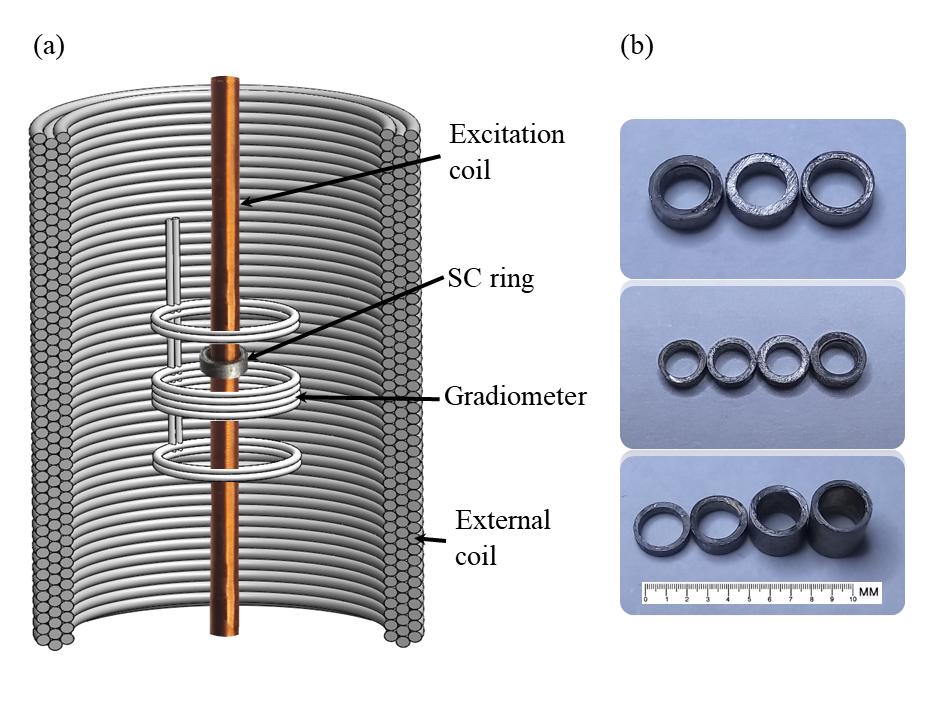
A long excitation coil piercing a superconducting (SC) ring is used to generate ever increasing persistent current in the ring, until the current destroys the order parameter. Given that the penetration depth $λ$ is known, this experiment measures, hypothetically, the coherence length $ξ$, hence the name "Xiometer". We examine various aspects of this theoretically driven hypothesis by testing niobium rings with different dimensions, and by comparing the results to the known values of $ξ$. We then apply the method to two La$_{1.875}$Sr$_{0.125}$CuO$_4$ rings at $T ightarrow 0$. In one, the current flows in the CuO$_2$ planes hence it is set by $ξ_{ab}$. In the other, the current must cross planes and is determined by $ξ_{c}$. We find that $ξ_{c}=1.3 \pm 0.1$~nm, and $ξ_{ab}<2.3~$nm indicating that at low temperatures the Cooper pairs are three dimensional.
Motivation & Objective
- To develop and validate a new experimental method for measuring the superconducting coherence length ξ in bulk superconductors, particularly in the c-direction where measurements are challenging.
- To test the theoretical framework of the 'Xiometer' using niobium rings with known ξ and λ to verify its accuracy.
- To apply the Xiometer to measure ξc and ξab in the highly anisotropic cuprate La1.875Sr0.125CuO4 at low temperatures (T = 1.6 K).
- To determine whether Cooper pairs in LSCO-1/8 are three-dimensional or highly anisotropic, resolving a key open question in cuprate superconductivity.
- To provide a direct, experimentally validated measurement of ξc at T → 0 K, avoiding the uncertainties of Hc2 extrapolation methods.
Proposed method
- The Xiometer uses a long superconducting excitation coil (EC) piercing a superconducting ring to generate a tunable magnetic flux, inducing persistent currents.
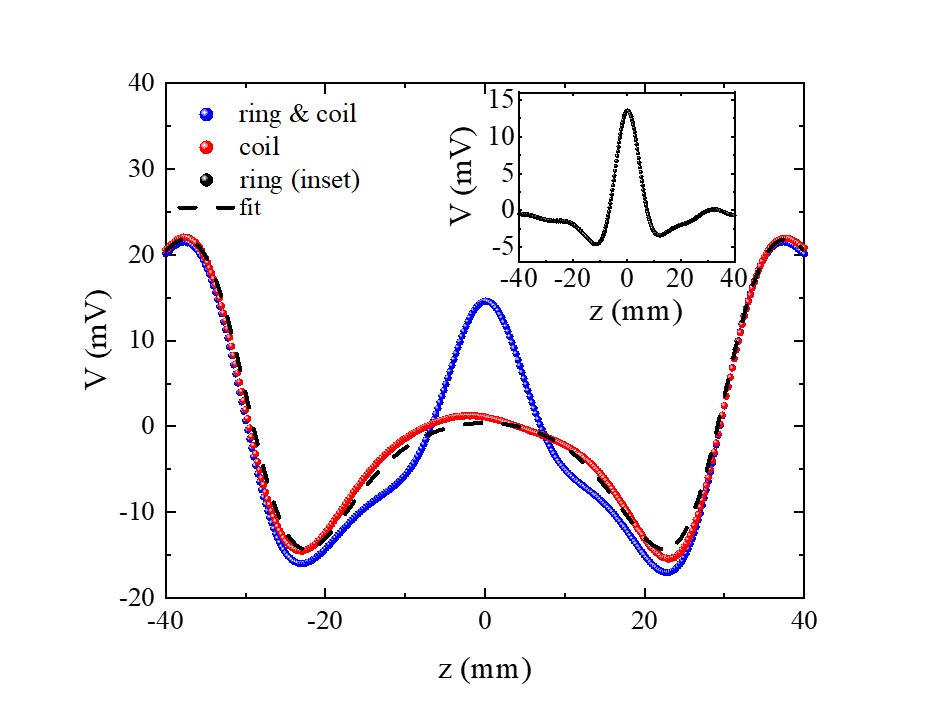
- The critical current Ic at which the superconducting order parameter is destroyed is measured via a SQUID gradiometer, detecting the ring's magnetic moment as a function of EC current.
- The critical flux Φc is determined by the point where the magnetic moment deviates from linearity, signaling vortex entry and order parameter suppression.
- The method relies on the relation Φc ∝ (λξ) r_out², derived from the Ginzburg-Landau theory, where λ is the penetration depth and ξ is the coherence length.
- For rings with height h ≥ r_out, the outer radius r_out dominates the critical flux, simplifying the analysis to depend only on r_out and the λξ product.
- The method is first validated on niobium rings with known λ = 38 nm and ξ = 39 nm, showing good agreement with theory and literature values.
Experimental results
Research questions
- RQ1Can the Xiometer method reliably measure the ground-state coherence length ξ in superconductors with known λ and ξ?
- RQ2What is the inter-plane coherence length ξc of La1.875Sr0.125CuO4 at T → 0 K, and how does it compare to ξab?
- RQ3Are Cooper pairs in LSCO-1/8 three-dimensional or highly anisotropic, as suggested by the ratio ξc/ξab?
- RQ4Does the Xiometer yield results consistent with Hc2 extrapolations for ξc, particularly the controversial 0.86 nm value from flux compression?
- RQ5Can the Xiometer resolve the fundamental question of Cooper pair dimensionality in cuprates without relying on high-temperature extrapolations?
Key findings
- The Xiometer method was validated on niobium rings, yielding a measured λξ = 1267 ± 32.5 nm², close to the literature value of 1482 nm², confirming its reliability.
- For the a-ring of LSCO-1/8, where current flows primarily in the c-direction, a critical current of 2.2 A was observed, indicating a break in supercurrent flow.
- Using λc = 4500 nm and the critical flux from the a-ring, the inter-plane coherence length was determined as ξc = 1.3 ± 0.1 nm at T = 1.6 K.
- An upper bound of ξab < 2.3 nm was established using λab = 350 nm and the same method, indicating that ab-plane pairing is also short-ranged.
- The measured ξc = 1.3 ± 0.1 nm is in good agreement with the previously reported Hc2 = 250 T extrapolation (ξc ≈ 1.3 nm), supporting its validity.
- The results imply that Cooper pairs in LSCO-1/8 are more three-dimensional than previously thought, with ξc ≈ ξab, challenging the conventional view of highly anisotropic, quasi-2D pairing.
Read this paper
Open the full text in the Nubint reader and ask about any passage as you read.
Read this paper on NubintThis review was generated by AI from the original paper. Please check the paper before citing it.