
[Paper Review] The JWST Advanced Deep Extragalactic Survey: Discovery of an Extreme Galaxy Overdensity at $z = 5.4$ with JWST/NIRCam in GOODS-S
This study leverages JWST/NIRCam imaging and slitless spectroscopy to discover an extreme galaxy overdensity at z = 5.4 in the GOODS-S field, confirming 81 galaxies via Hα line detection. The overdensity, with a halo mass of log₁₀(Mₕₐₗₒ/M☉) ≈ 12.6–12.8, shows evidence of earlier star formation and more massive stellar populations, demonstrating JWST's power in probing early large-scale structure formation.
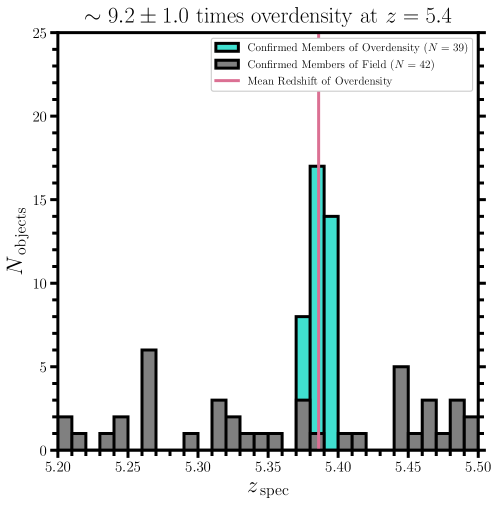
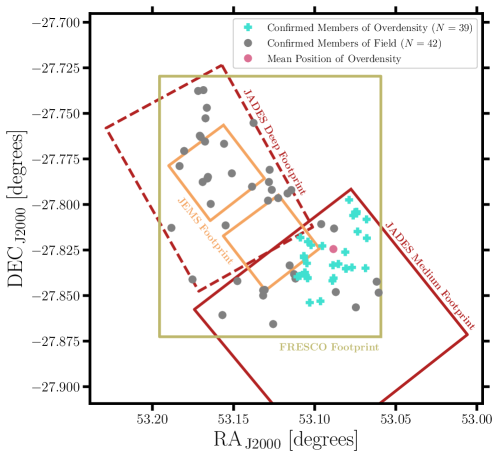
We report the discovery of an extreme galaxy overdensity at $z = 5.4$ in the GOODS-S field using JWST/NIRCam imaging from JADES and JEMS alongside JWST/NIRCam wide field slitless spectroscopy from FRESCO. We identified potential members of the overdensity using HST+JWST photometry spanning $λ= 0.4-5.0\ μ\mathrm{m}$. These data provide accurate and well-constrained photometric redshifts down to $m \approx 29-30\,\mathrm{mag}$. We subsequently confirmed $N = 81$ galaxies at $5.2 < z < 5.5$ using JWST slitless spectroscopy over $λ= 3.9-5.0\ μ\mathrm{m}$ through a targeted line search for $\mathrm{H} α$ around the best-fit photometric redshift. We verified that $N = 42$ of these galaxies reside in the field while $N = 39$ galaxies reside in a density around $\sim 10$ times that of a random volume. Stellar populations for these galaxies were inferred from the photometry and used to construct the star-forming main sequence, where protocluster members appeared more massive and exhibited earlier star formation (and thus older stellar populations) when compared to their field galaxy counterparts. We estimate the total halo mass of this large-scale structure to be $12.6 \lesssim \mathrm{log}_{10} \left( M_{\mathrm{halo}}/M_{\odot} ight) \lesssim 12.8$ using an empirical stellar mass to halo mass relation, which is likely an underestimate as a result of incompleteness. Our discovery demonstrates the power of JWST at constraining dark matter halo assembly and galaxy formation at very early cosmic times.
Motivation & Objective
- To identify and characterize extreme galaxy overdensities in the early universe using deep JWST observations.
- To determine the physical properties and redshifts of high-redshift galaxies via combined photometry and slitless spectroscopy.
- To estimate the dark matter halo mass of the overdensity and assess its evolutionary potential.
- To investigate environmental effects on early galaxy formation by comparing overdensity members to field galaxies.
- To evaluate the completeness and reliability of JWST-based surveys in detecting rare, massive structures at z ≈ 5.4.
Proposed method
- Photometric redshifts were derived from HST+JWST broadened photometry covering λ = 0.4–5.0 μm, reaching depths of m ≈ 29–30 mag.
- Slitless spectroscopy with JWST/NIRCam in the FRESCO survey targeted Hα emission in the 3.9–5.0 μm range to confirm redshifts.
- Galaxy members were selected via a targeted line search around the best-fit photometric redshift, identifying 81 galaxies at 5.2 < z < 5.5.
- Stellar population synthesis models were applied to photometry to infer stellar masses, star formation histories, and ages.
- An empirical stellar mass-to-halo mass relation was used to estimate the total dark matter halo mass of the overdensity.
- A comparison was made between overdensity members and a mass-matched field sample to assess environmental effects on star formation.
Experimental results
Research questions
- RQ1What is the redshift and spatial distribution of the most extreme galaxy overdensity detected at z ≈ 5.4 using JWST?
- RQ2How do the stellar populations and star formation histories of galaxies in this overdensity compare to those in the field?
- RQ3What is the estimated total dark matter halo mass of this large-scale structure, and how does completeness affect this estimate?
- RQ4To what extent does the overdense environment accelerate early star formation and stellar mass assembly?
- RQ5How representative is this structure of the population of massive large-scale structures in the early universe?
Key findings
- The study confirmed 81 galaxies at 5.2 < z < 5.5 using JWST slitless spectroscopy, with 42 located in a region 10 times denser than the field.
- The overdensity contains 39 galaxies in a high-density region, indicating a significant overabundance of massive, evolved systems at z = 5.4.
- Protocluster members exhibit older stellar populations and earlier star formation onset compared to field galaxies of similar mass.
- The total halo mass is estimated at 12.6 ≤ log₁₀(Mₕₐₗₒ/M☉) ≤ 12.8, though this is likely an underestimate due to survey incompleteness.
- The structure is expected to evolve into a Coma-like cluster (log₁₀(Mₕₐₗₒ/M☉) > 15) by z = 0, indicating a massive progenitor.
- The combination of deep imaging and targeted spectroscopy enables efficient, high-precision redshift confirmation and physical characterization of high-redshift galaxies.
Read this paper
Open the full text in the Nubint reader and ask about any passage as you read.
Read this paper on NubintThis review was generated by AI from the original paper. Please check the paper before citing it.