
[論文レビュー] The JWST EXCELS survey: Too much, too young, too fast? Ultra-massive quiescent galaxies at 3 < z < 5
この論文は JWST EXCELS 調査を紹介し、3 < z < 5 における4つの超大質量の静止銀河の深い NIRSpec 分光を提示し、星形成履歴を分析し、Lambda-CDM との適合性を評価する。
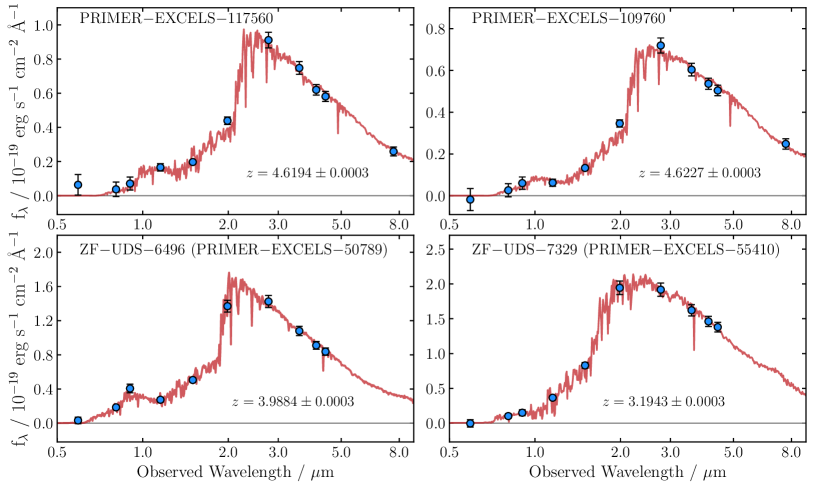
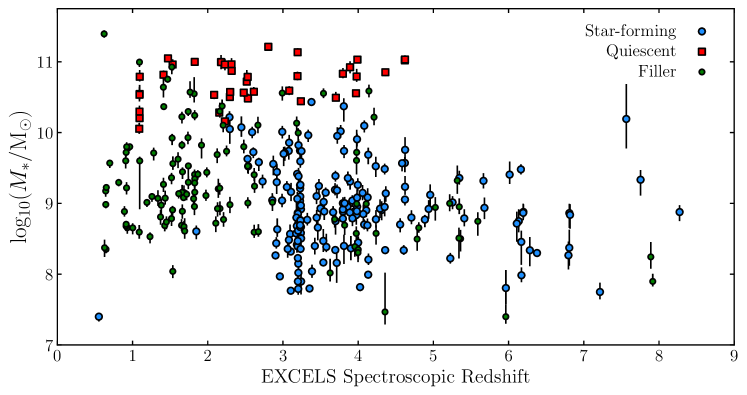
We report ultra-deep, medium-resolution spectroscopic observations for 4 quiescent galaxies with log$_{10}(M_*/\mathrm{M_\odot})>11$ at $3 < z < 5$. These data were obtained with JWST NIRSpec as part of the Early eXtragalactic Continuum and Emission Line Science (EXCELS) survey, which we introduce in this work. The first two galaxies are newly selected from PRIMER UDS imaging, both at $z=4.62$ and separated by $860$ pkpc on the sky, within a larger structure for which we confirm several other members. Both formed at $z\simeq8-10$. These systems could plausibly merge by the present day to produce a local massive elliptical galaxy. The other two ultra-massive quiescent galaxies are previously known at $z=3.99$ and $3.19$, with the latter (ZF-UDS-7329) having been the subject of debate as potentially too old and too massive to be accommodated by the $Λ$-CDM halo-mass function. Both exhibit high stellar metallicities, and for ZF-UDS-7329 we are able to measure the $α-$enhancement, obtaining [Mg/Fe] = $0.42^{+0.19}_{-0.17}$. We finally evaluate whether these 4 galaxies are consistent with the $Λ$-CDM halo-mass function using an extreme value statistics approach. We find that the $z=4.62$ objects and the $z=3.19$ object are unlikely within our area under the assumption of standard stellar fractions ($f_*\simeq0.1-0.2$). However, these objects roughly align with the most massive galaxies expected under the assumption of 100 per cent conversion of baryons to stars ($f_*$=1). Our results suggest extreme galaxy formation physics during the first billion years, but no conflict with $Λ$-CDM cosmology.
研究の動機と目的
- 3 < z < 5 の質量の大きな静止銀河の高SNR・中分解能分光の設計と観測戦略を EXCELS 調査で紹介する。
- 4つの超巨大な静止銀河 (M* > 10^11 Msun) を提示し、全スペクトル適合から恒星年齢・金属量・SFHを導出する。
- 観測された銀河が極値統計を用いて Lambda-CDM のハローマス分布関数と整合するか評価する。
- 最初の十億年における初期銀河形成物理と消滅機構(クエンチング機構)の含意を論じる。
提案手法
- Deft JWST NIRSpec observations with four pointings covering 1-5 microns at R ~ 1000 across three gratings (G140M, G235M, G395M).
- Photometric pre-selection from PRIMER UDS imaging and VANDELS-based catalogs to identify high-mass quiescent candidates (log M*/Msun > 11) at 3 < z < 5.
- Full spectral fitting of spectra using Bagpipes with a double-power-law SFH, BC03/MILES models, and Cloudy-emission lines to derive ages, metallicities, and sSFR.
- Inclusion of dust attenuation, IGM attenuation, and a 2D joint posterior analysis for redshift and sSFR to select a robust quiescent sample.
- Comparison with Lambda-CDM via extreme value statistics to evaluate whether observed hyper-massive systems are plausible within standard baryon conversion efficiencies.
実験結果
リサーチクエスチョン
- RQ1What are the stellar ages, metallicities, and SFHs of ultra-massive quiescent galaxies at 3 < z < 5 as revealed by JWST EXCELS spectra?
- RQ2Are the observed ultra-massive quiescent galaxies consistent with the Lambda-CDM halo-mass function under standard stellar-to-baryon conversion efficiencies?
- RQ3Do the four detected z > 3 quiescent galaxies reveal diverse formation pathways or similar quenching mechanisms in the early Universe?
- RQ4What do the high metallicities and alpha-enhancement (where measured) imply about star-formation timescales and AGN feedback in early massive galaxies?
主な発見
- Four ultra-massive quiescent galaxies (M* > 10^11 Msun) are spectroscopically confirmed at 3 < z < 5, including a newly discovered pair at z = 4.62.
- Two z = 4.62 galaxies reside in close proximity (860 pkpc) within a larger structure and show differing stellar metallicities, suggesting diverse formation paths.
- One z = 3.99 PSB and one z = 3.19 galaxy (ZF-UDS-7329) exhibit high metallicities, with ZF-UDS-7329 yielding [Mg/Fe] = 0.42 +0.19/-0.17.
- Extreme value statistics indicate the z = 4.62 objects and the z = 3.19 object are unlikely under standard f* ~ 0.1–0.2, but compatible with f* = 1; overall no conflict with Lambda-CDM.
- Results imply extreme galaxy formation physics in the first billion years, without ruling out Lambda-CDM cosmology.
より良い研究を、今すぐ始めましょう
論文設計から論文執筆まで、研究時間を劇的に削減しましょう。
クレジットカード登録不要
このレビューはAIが作成し、人間の編集者が確認しました。