
[Paper Review] The Landscape and Challenges of HPC Research and LLMs
This paper surveys how large language models (LLMs) can be adapted for high-performance computing (HPC), outlines challenges, and discusses pathways, code representations, multimodal approaches, and potential case studies.
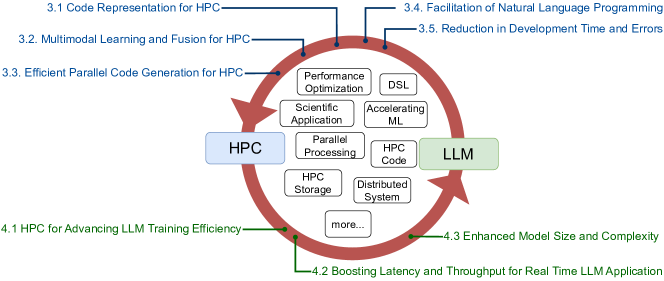
Recently, language models (LMs), especially large language models (LLMs), have revolutionized the field of deep learning. Both encoder-decoder models and prompt-based techniques have shown immense potential for natural language processing and code-based tasks. Over the past several years, many research labs and institutions have invested heavily in high-performance computing, approaching or breaching exascale performance levels. In this paper, we posit that adapting and utilizing such language model-based techniques for tasks in high-performance computing (HPC) would be very beneficial. This study presents our reasoning behind the aforementioned position and highlights how existing ideas can be improved and adapted for HPC tasks.
Motivation & Objective
- Motivate applying LLMs to HPC tasks by highlighting potential mutual benefits between LLMs and HPC.
- Identify domain-specific challenges in bringing LLMs to HPC, including data representation, tooling access, and evaluation metrics.
- Propose architectural and methodological directions for HPC-ready LLMs, including code representations, multimodal learning, and parallel code generation.
- Illustrate through a case study how tailored designs can enable mutual advantages between LLMs and HPC.
Proposed method
- Review existing work on LLMs for programming and HPC contexts to identify gaps.
- Discuss code representations for HPC, including source text and LLVM IR, and their impact on LLM tasks.
- Explore multimodal learning to fuse code features with system runtime data for performance optimization.
- Analyze parallel code generation with LLMs and outline challenges such as data availability and evaluation metrics.
- Describe NL-to-PL and PL-to-NL aspects for HPC-focused natural language programming.
- Summarize state-of-the-art HPC-specific code LLMs and how domain focus can reduce training needs.
Experimental results
Research questions
- RQ1What are the core opportunities for applying LLMs to HPC tasks and what mutual benefits arise for HPC and LLM research?
- RQ2What unique HPC challenges must be addressed to effectively utilize LLMs (data representation, tooling, evaluation, etc.)?
- RQ3How can code representations (e.g., LLVM IR) and multimodal fusion improve LLM effectiveness in HPC?
- RQ4What is the current state of code LLMs tailored to HPC, and what gaps remain in parallel code generation and optimization tasks?
Key findings
- LLMs have potential to aid HPC tasks such as parallel code generation, but challenges include robustness and correctness across parallel configurations.
- Code representations like LLVM IR can expose semantic features important for HPC, sometimes outperforming raw source text representations for certain tasks.
- Multimodal approaches combining code features with performance counters and system information may enhance HPC optimization tasks.
- State-of-the-art HPC-focused LLMs (e.g., Code LLMs and HPC-tuned models) show promise but remain limited by data availability and evaluation metrics for parallel code.
- NL-to-PL and PL-to-NL paradigms are proposed for HPC, emphasizing HPC-specific knowledge in both directions to improve usability and understanding.
- A future pipeline integrating HPC resources for LLM training and data preprocessing could improve efficiency and scalability.
Read this paper
Open the full text in the Nubint reader and ask about any passage as you read.
Read this paper on NubintThis review was generated by AI from the original paper. Please check the paper before citing it.