
[Paper Review] The nature of dynamic local order in CH$_3$NH$_3$PbI$_3$ and CH$_3$NH$_3$PbBr$_3$
This study reveals that dynamic local order in CH₃NH₃PbI₃ and CH₃NH₃PbBr₃ perovskites arises from two-dimensional, circular pancake-like regions of dynamically tilting PbX₆ octahedra, which induce long-range correlations in the methylammonium sublattice. These collective dynamics create transient ferroelectric or antiferroelectric domains that enhance charge carrier lifetimes and strongly influence halide migration, resolving long-standing questions about structure-function relationships in hybrid perovskites through combined X-ray and neutron diffuse scattering, inelastic spectroscopy, and molecular dynamics simulations.
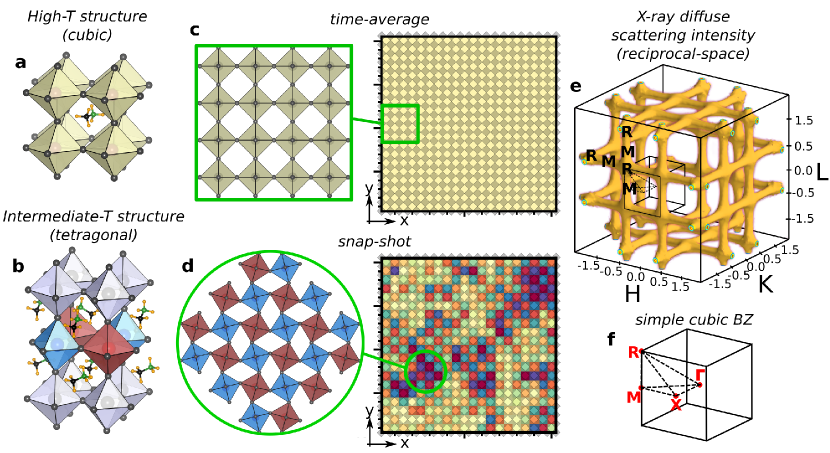
Hybrid lead halide perovskites (LHPs) are a class of semiconductor with novel properties that are distinctively governed by structural fluctuations. Diffraction experiments sensitive to average, long-range order reveal a cubic structure in the device-relevant, high-temperature phase. Local probes find additional short-range order with lower symmetry that may govern the structure-function relationships of LHPs. However, the dimensionality, participating atoms, and dynamics of this short-range order are unresolved, impeding our understanding of technologically relevant properties including long carrier lifetimes and facile halide migration. Here, we determine the true structure of two prototypical hybrid LHPs, CH$_3$NH$_3$PbI$_3$ and CH$_3$NH$_3$PbBr$_3$, using a combination of single-crystal X-ray and neutron diffuse scattering, neutron inelastic spectroscopy, and molecular dynamics simulations. The remarkable collective dynamics we found are not suggested by previous studies and consist of a network of local two-dimensional, circular pancake-like regions of dynamically tilting lead halide octahedra (lower symmetry) that induce longer range intermolecular correlations within the CH$_3$NH$_3^+$ sublattice. The dynamic local structure can introduce transient ferroelectric or antiferroelectric domains that increase charge carrier lifetimes, and strongly affect the halide migration, a poorly understood degradation mechanism. Our approach of co-analyzing single-crystal X-ray and neutron diffuse scattering data with MD simulations will provide unparalleled insights into the structure of hybrid materials and materials with engineered disorder.
Motivation & Objective
- To resolve the nature of dynamic local order in hybrid lead halide perovskites, which governs key optoelectronic properties but remains poorly understood.
- To determine the dimensionality, atomic participation, and dynamics of short-range structural fluctuations that deviate from the average cubic symmetry observed in long-range diffraction.
- To link local structural dynamics to technologically critical phenomena such as long carrier lifetimes and halide ion migration.
- To develop a co-analysis framework combining single-crystal X-ray and neutron diffuse scattering with molecular dynamics simulations for disordered materials.
Proposed method
- Combined single-crystal X-ray and neutron diffuse scattering experiments to probe short-range structural correlations in CH₃NH₃PbI₃ and CH₃NH₃PbBr₃.
- Performed neutron inelastic scattering (INS) to measure dynamic response and extract the dynamical structure factor S(Q,E).
- Conducted molecular dynamics (MD) simulations using the LAMMPS package with a polarizable potential for MAPbX₃ (ref. mattoni2015methylammonium) at 300 K.
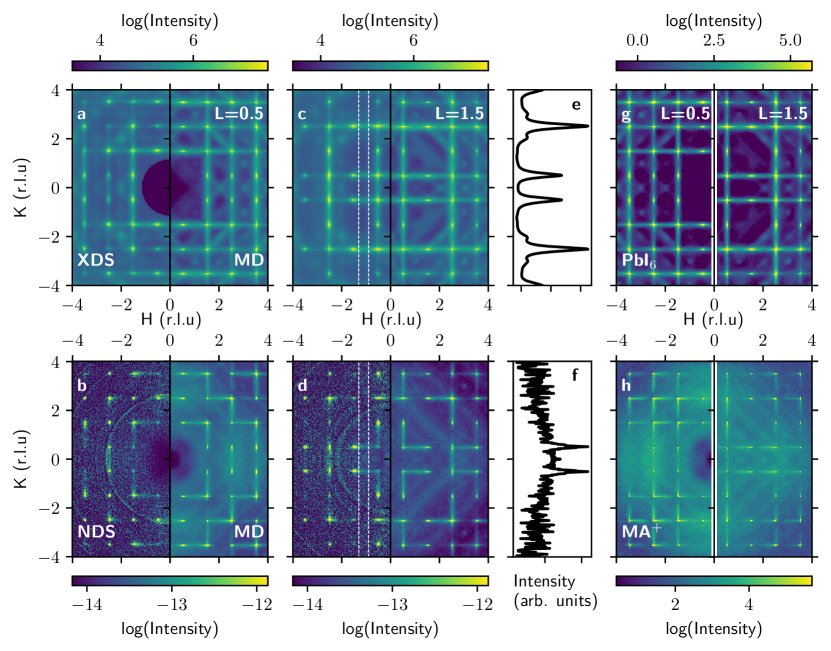
- Calculated theoretical S(Q,E) from MD trajectories using a custom Python code, weighted by atomic form factors (X-rays) or scattering lengths (neutrons).
- Integrated theoretical S(Q,E) over energy windows matching experimental resolution (±0.5 meV for NDS, ±2 meV for XDS, ±1 meV for INS) for direct comparison.
- Analyzed only the last nanosecond of MD trajectories (split into 20 non-consecutive 50 ps blocks) to ensure thermal equilibrium and avoid transient artifacts.
Experimental results
Research questions
- RQ1What is the true nature of dynamic local order in CH₃NH₃PbI₃ and CH₃NH₃PbBr₃ beyond the average cubic structure?
- RQ2What is the dimensionality and spatial arrangement of the dynamically tilting PbX₆ octahedra responsible for short-range order?
- RQ3How do these local structural fluctuations influence long-range correlations in the methylammonium cation sublattice?
- RQ4To what extent do these dynamic local structures contribute to long carrier lifetimes and halide ion migration?
- RQ5Can a combined approach of diffuse scattering, INS, and MD simulations resolve the structure-function relationship in disordered perovskites?
Key findings
- The dynamic local order consists of two-dimensional, circular pancake-like regions of dynamically tilting PbX₆ octahedra, which are not captured by conventional long-range diffraction.
- These dynamic octahedral regions induce long-range intermolecular correlations within the CH₃NH₃⁺ sublattice, extending beyond the local region.
- The collective dynamics generate transient ferroelectric or antiferroelectric domains that are predicted to enhance charge carrier lifetimes.
- The dynamic local structure strongly influences halide migration, providing a mechanistic explanation for this poorly understood degradation pathway.
- The theoretical S(Q,E) calculated from MD simulations shows excellent agreement with experimental neutron inelastic scattering data, validating the simulation model.
- The study demonstrates that co-analysis of X-ray and neutron diffuse scattering with MD simulations provides unparalleled insight into the local structure of complex, disordered materials.
Read this paper
Open the full text in the Nubint reader and ask about any passage as you read.
Read this paper on NubintThis review was generated by AI from the original paper. Please check the paper before citing it.