
[Paper Review] The Participatory Turn in AI Design: Theoretical Foundations and the Current State of Practice
The paper builds a framework to evaluate participatory AI and shows current practice is largely consultative, with stakeholders often limited to input on UI rather than core design decisions, highlighting tensions between empowerment and practical constraints.
Despite the growing consensus that stakeholders affected by AI systems should participate in their design, enormous variation and implicit disagreements exist among current approaches. For researchers and practitioners who are interested in taking a participatory approach to AI design and development, it remains challenging to assess the extent to which any participatory approach grants substantive agency to stakeholders. This article thus aims to ground what we dub the "participatory turn" in AI design by synthesizing existing theoretical literature on participation and through empirical investigation and critique of its current practices. Specifically, we derive a conceptual framework through synthesis of literature across technology design, political theory, and the social sciences that researchers and practitioners can leverage to evaluate approaches to participation in AI design. Additionally, we articulate empirical findings concerning the current state of participatory practice in AI design based on an analysis of recently published research and semi-structured interviews with 12 AI researchers and practitioners. We use these empirical findings to understand the current state of participatory practice and subsequently provide guidance to better align participatory goals and methods in a way that accounts for practical constraints.
Motivation & Objective
- Synthesize theories of participation across technology design, political theory, and social sciences to create an evaluative framework for participatory AI.
- Empirically map the current landscape of participatory AI by analyzing a corpus of 80 papers and conducting 12 interviews with researchers/practitioners.
- Identify motivations, challenges, and tensions in participatory AI practice.
- Provide empirically grounded opportunities to improve alignment between participatory goals and methods in AI design.
Proposed method
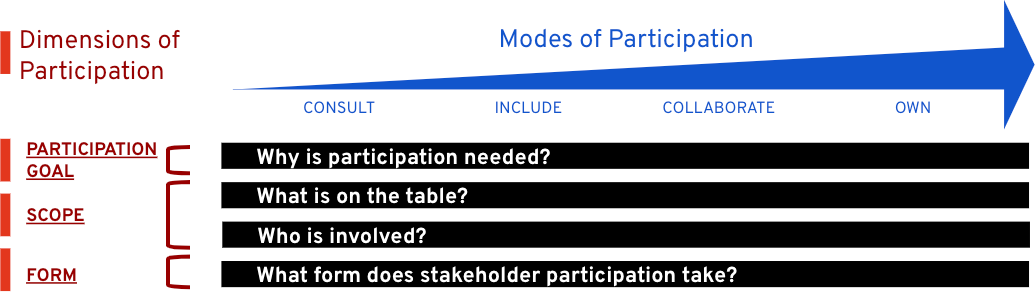
- Synthesize literature across nine participatory traditions to derive the Parameters of Participation framework.
- Code a corpus of 80 AI studies that claim to use participatory methods against the framework’s dimensions and modes of participation.
- Conduct 12 semi-structured interviews with authors of corpus papers to triangulate motivations, challenges, and aspirations.
- Use affinity diagramming and thematic analysis to derive findings about current practice and tensions.
Experimental results
Research questions
- RQ1What conceptual framework can reliably evaluate how participation is enacted in AI design and what agency it actually affords stakeholders?
- RQ2To what extent do current participatory AI practices empower stakeholders versus serving consultation needs?
- RQ3What are the main tensions and constraints shaping participatory AI implementations, and how might practice be improved?
- RQ4What empirical opportunities exist to better align participatory goals with methods in AI design?
Key findings
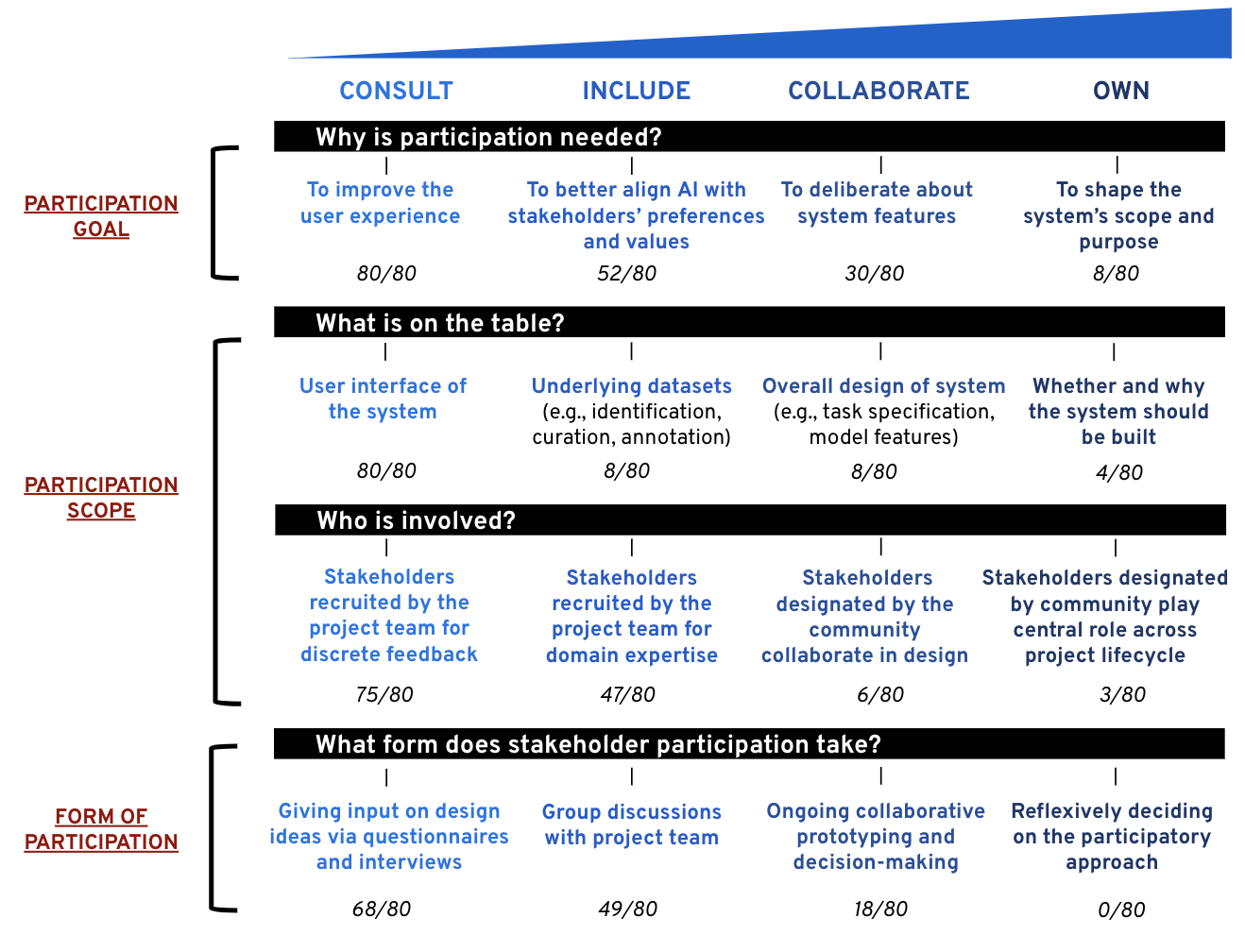
- Most participatory AI projects (80/80) aim to improve user experience, and 52/80 seek alignment with stakeholder preferences and values.
- A small share (8/80, 10%) involve stakeholders in shaping the system’s scope and purpose.
- Participation is predominantly consultative, with UI-focused involvement rather than participation in core model design.
- Practitioners rely on proxies (human or algorithmic) to represent stakeholder input when direct participation is limited.
- Tensions arise between empowerment aspirations and practical constraints like resources and timelines.
- The study identifies pathways to reconfigure participation contexts to enhance stakeholder agency in AI design.
Read this paper
Open the full text in the Nubint reader and ask about any passage as you read.
Read this paper on NubintThis review was generated by AI from the original paper. Please check the paper before citing it.