
[論文レビュー] The Physics of (good) LDPC Codes I. Gauging and dualities
本稿は、非ユークリッド幾何におけるゲージ理論と双対性を用い、チェーン複体を数学的基盤として、良好な古典的および量子LDPC符号の理解を統一的な物理的枠組みで確立する。すべての既知の良好な量子LDPC符号が局所的にテスト可能な古典的符号のゲージ化から生じることを示し、一般化された双対性変換を用いてクラスターハミルトニアンを構成し、SPT相およびチェーン複体上の脱コンfinement的 $Χ_2$ ゲージ理論との関係を明らかにする。
Low-depth parity check (LDPC) codes are a paradigm of error correction that allow for spatially non-local interactions between (qu)bits, while still enforcing that each (qu)bit interacts only with finitely many others. On expander graphs, they can give rise to ``good codes'' that combine a finite encoding rate with an optimal scaling of the code distance, which governs the code's robustness against noise. Such codes have garnered much recent attention due to two breakthrough developments: the construction of good quantum LDPC codes and good locally testable classical LDPC codes, using similar methods. Here we explore these developments from a physics lens, establishing connections between LDPC codes and ordered phases of matter defined for systems with non-local interactions and on non-Euclidean geometries. We generalize the physical notions of Kramers-Wannier (KW) dualities and gauge theories to this context, using the notion of chain complexes as an organizing principle. We discuss gauge theories based on generic classical LDPC codes and make a distinction between two classes, based on whether their excitations are point-like or extended. For the former, we describe KW dualities, analogous to the 1D Ising model and describe the role played by ``boundary conditions''. For the latter we generalize Wegner's duality to obtain generic quantum LDPC codes within the deconfined phase of a Z_2 gauge theory. We show that all known examples of good quantum LDPC codes are obtained by gauging locally testable classical codes. We also construct cluster Hamiltonians from arbitrary classical codes, related to the Higgs phase of the gauge theory, and formulate generalizations of the Kennedy-Tasaki duality transformation. We use the chain complex language to discuss edge modes and non-local order parameters for these models, initiating the study of SPT phases in non-Euclidean geometries.
研究の動機と目的
- 凝縮系物理学およびゲージ理論の観点から、良好な古典的および量子LDPC符号の理解を統一すること。
- チェーン複体を用いて、クライマー=ヴァンナーおよびウェグナー双対性を非局所的・非ユークリッド的設定に一般化すること。
- 局所的にテスト可能な古典的符号のゲージ化によって生じることを示すことにより、良好な量子LDPC符号の物理的起源を明確にすること。
- 一般化されたケネディ=タキシス双対性を用いて、任意の古典的符号からクラスターハミルトニアンを構成すること。
- チェーン複体形式を用いて、非ユークリッド幾何における対称性保護的トポロジカル相の研究を開始すること。
提案手法
- チェーン複体を用いて、古典的および量子LDPC符号を記述する統一的な数学的言語とし、チェック構造および安定化子構造を符号する写像 $\delta_1$, $\tilde{\delta}_1$, $\delta_2$, $\tilde{\delta}_2$ を使用する。
- 横磁場における古典的符号にゲージ化手順を適用し、$\mathbb{Z}_2$ ゲージ構造を持つ量子ハミルトニアンを生成する。
- ハミルトニアン項 $H_{\text{CSS}} = -J_x \sum_i \prod_{a \in \delta_1^T(i)} \tau_a^x - J_z \sum_p \prod_{a \in \tilde{\delta}_2(p)} \tau_a^z - K_z \sum_q \prod_{a \in \delta_2(q)} \tau_a^z - K_x \sum_j \prod_{a \in \tilde{\delta}_1^T(j)} \tau_a^x$ を持つ結合ゲージ理論フレームワークを導入する。
- 強い結合極限 $\lambda \to \infty$ を用いて、$\tilde{\tau}_a^x = \tau_a^z$ および $\tilde{\tau}_a^z = \tau_a^x$ を満たす部分空間に射影し、CSSハミルトニアンを回復する。
- 一般化されたケネディ=タキシス双対性を適用し、古典的符号とクラスターハミルトニアンを関連づけ、トポロジカル秩序を持つモデルの構成を可能にする。
実験結果
リサーチクエスチョン
- RQ1良好な量子LDPC符号の構成が、古典的符号の物理的ゲージ化手順としてどのように理解できるか?
- RQ2非局所的相互作用および非ユークリッド幾何を持つ系において、クライマー=ヴァンナー双対性が果たす役割は何か?
- RQ3LDPC符号内の励起(点状と拡張型)は、双対性および相構造の性質をどのように決定するか?
- RQ4一般化された双対性を用いて、任意の古典的LDPC符号からクラスターハミルトニアンを体系的に構成できるか?
- RQ5チェーン複体によって記述される非ユークリッド幾何における、対称性保護的トポロジカル秩序の物理的意味は何か?
主な発見
- すべての既知の良好な量子LDPC符号は、局所的にテスト可能な古典的LDPC符号のゲージ化によって得られ、その存在に物理的起源を確立する。
- 本稿は、一般化されたケネディ=タキシス双対性を用いて、任意の古典的符号からクラスターハミルトニアンを構成し、古典的符号とトポロジカル秩序を持つ量子モデルを結びつける。
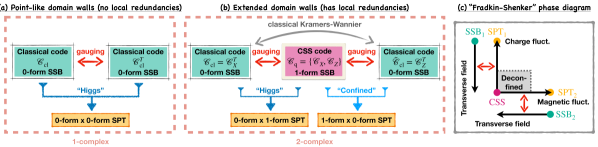
- LDPC符号内の励起は2つのクラスに分類される:点状(1次元イジング模型に類似)および拡張型($\mathbb{Z}_2$ ゲージ理論の脱コンfinement相に類似)、それぞれ異なる双対性構造を持つ。
- クライマー=ヴァンナー双対性は非局所的設定に一般化され、境界条件が点状励起と拡張型励起を区別する上で重要な役割を果たす。
- ウェグナー双対性はチェーン複体に拡張され、$\mathbb{Z}_2$ ゲージ理論の脱コンfinement相における一般な量子LDPC符号のフレームワークを提供する。
- 結合ゲージ理論モデルの相図により、古典的符号と量子符号の間で連続的なチューニングが可能であり、強い結合極限 $\lambda \to \infty$ でCSSハミルトニアンが回復される。
より良い研究を、今すぐ始めましょう
論文の読解から最終レビューまで、研究時間を劇的に削減しましょう。
クレジットカード登録不要
このレビューはAIが作成し、人間の編集者が確認しました。