
[論文レビュー] The $γ$-ray emitting region in low synchrotron peak blazars. Testing self-synchrotron Compton and external Compton scenarios
本研究は、104個の電波選択 LSP ブラザールの完全サンプルを用いて、自己シンクロtron コンプトン(SSC)モデルと外部コンプトン(EC)モデルをテストすることで、低シンクロtronピーク(LSP)ブラザールにおけるGeV γ線放射の起源を調査した。SSCモデルだけでは観測されたスペクトルエネルギー分布(SED)を説明できないことが判明し、代わりに赤外線外部光子場が支配するECシナリオが支持される。これは、γ線放射領域がブラックホールから0.1 pc以上離れていることを示しており、急速な変動を支持するに十分な狭いジェット構造と整合的である。
From the early days in gamma-ray astronomy, locating the origin of GeV emission within the core of an active galactic nucleus (AGN) persisted as an open question; the problem is to discern between near- and far-site scenarios with respect to the distance from the super massive central engine. We investigate this question under the light of a complete sample of low synchrotron peak (LSP) blazars which is fully characterized along many decades in the electromagnetic spectrum, from radio up to tens of GeV. We consider the high-energy emission from bright radio blazars and test for synchrotron self-Compton (SSC) and external Compton (EC) scenarios in the framework of localizing the $γ$-ray emission sites. Given that the inverse Compton (IC) process under the EC regime is driven by the abundance of external seed photons, these photons could be mainly ultraviolet (UV) to X-rays coming from the accretion disk region and the broad-line region (BLR), therefore close to the jet launch base; or infrared (IR) seed photons from the dust torus and molecular cloud spine-sheath, therefore far from jet launch base. We use enhanced SED information from recent works (including new $γ$-ray detections) to refine the study of Syn to IC peak correlations, which points to a particular $γ$-ray emission site. We show that SSC alone is not enough to account for the observed SEDs. Our analysis favors an EC scenario under the Thomson scattering regime, with a dominant IR external photon field. Therefore, the far-site (i.e., far from the jet launch) is probably the most reasonable scenario to account for the population properties of bright LSP blazars in cases modeled with a pure leptonic component. We calculate the photon energy density associated with the external field at the jet comoving frame to be $ m U'_{ext}=1.69 imes 10^{-2}$ erg/cm$^3$, finding good agreement to other correlated works.
研究の動機と目的
- 低シンクロtronピーク(LSP)ブラザールにおけるγ線放射領域の位置を特定し、近接領域(SSC)と遠方領域(EC)のシナリオを区別すること。
- LSP ブラザールの全波長 SED が、シンクロtron自己コンプトン(SSC)または外部コンプトン(EC)メカニズムによってどのように説明できるかを評価すること。
- LSP ブラザールにおける EC プロセスを駆動する主要な外部光子場(BLR からの紫外線または-dust torus からの赤外線)を特定すること。
- 多波長 SED モデリングを用いて、ローレンツ因子、ドップラー補正、外部光子エネルギー密度などのジェットの物理的パラメータを制約すること。
- スペクトルパラメータ(例:ピーク周波数、スペクトル指数)と放射度の相関関係を探索し、背後にあるジェット物理学を推察すること。
提案手法
- 37 GHz の電波放射度が 1 Jy 以上の 104 個の LSP ブラザールの完全サンプルを分析し、電波から GeV γ線にまで及ぶ SED を用いた。
- 単一ゾーンのレプトン系ジェットモデルを仮定し、SSC モデルと EC モデルの両方を用いて全バンド SED を構築およびフィットした。
- UV をシード光子とする BLR からの外部コンプトン(EC)と、赤外線をシード光子とするダストトルスおよび分子雲からの EC の 2 つのシナリオをテストした。
- 外部光子エネルギー密度の共動フレームでの計算値 $ U^{ ext{'} }_{\text{ext}} $ を求め、外部場の優位性を評価した。
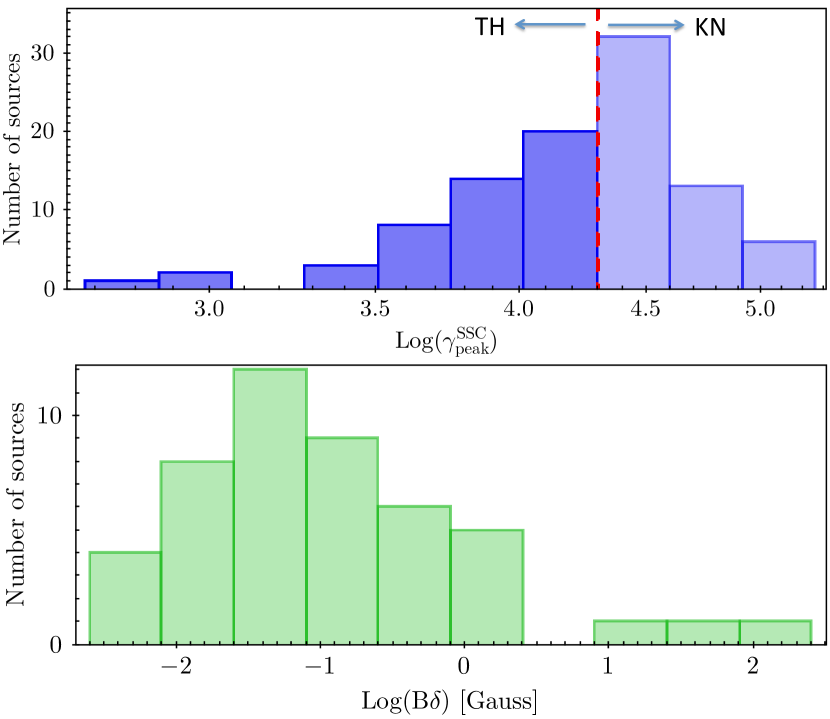
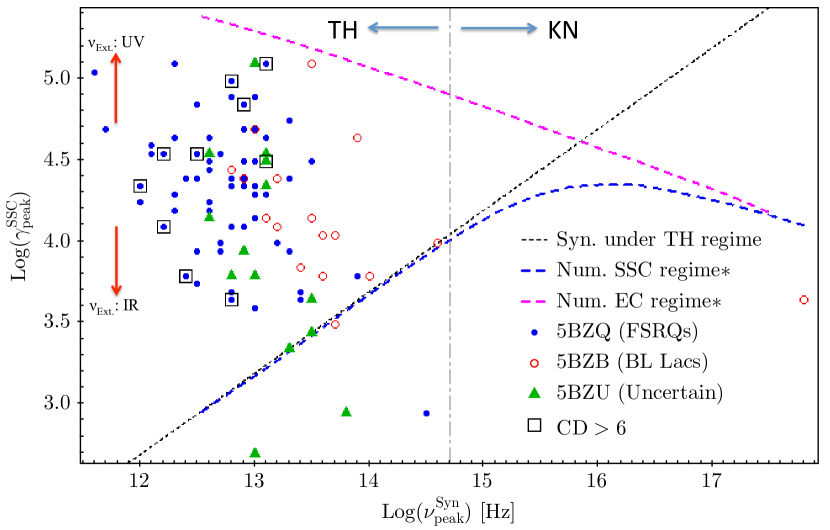
- EC が SSC よりも優位な領域を特定するため、$ \log(\gamma^{\text{EC}}_{\text{peak}}) $ 対 $ \log(\nu^{\text{Syn}}_{\text{peak}}) $ 平面へのマッピングを行った。
- 7 時間のオーダーにわたる IC とシンクロtron放射度の相関関係を調査するため、$ \log(L_{\text{IC}}) $ 対 $ \log(L_{\text{Syn}}) $ の放射度平面をプロットした。
実験結果
リサーチクエスチョン
- RQ1シンクロtron自己コンプトン(SSC)モデルは、LSP ブラザールの観測された SED を説明するのに十分か?
- RQ2LSP ブラザールにおける観測された γ 線放射と整合性の高い外部光子場は、BLR からの紫外線か、ダストトルスからの赤外線か?
- RQ3EC モデルと観測された SED を根拠に、γ 線放射領域が中心ブラックホールからどの程度離れていると推定されるか?
- RQ4スペクトルパラメータ(例:$ \nu^{\text{Syn}}_{\text{peak}} $、$ \nu^{\text{IC}}_{\text{peak}} $、$ \Gamma $)は、放射度やピーク周波数とどのように相関するか?
- RQ5LSP ブラザールにおける観測された IC 放射を生成するために必要な共動フレームでの外部光子エネルギー密度はどの程度か?
主な発見
- SSC モデルだけでは、LSP ブラザールの観測された SED を説明できない。多くの源が、支配的 SSC モードとは整合しないパラメータ空間の領域にある。
- 赤外線(IR)外部光子場を仮定した外部コンプトン(EC)モデルが、SED に対してより良いフィットを示し、γ 線放射領域がブラックホールから 0.1 pc 以上離れていることを示唆している。
- 共動フレームでの外部光子エネルギー密度は $ U^{ ext{'} }_{\text{ext}} = 1.69 \times 10^{-2} $ erg/cm³ と計算され、独立した研究と良好に一致している。
- 平均値 $ \langle \log(B\delta) \rangle \approx 0.99 $ および $ \langle \log(\gamma^{\text{EC}}_{\text{peak}}) \rangle \approx 2.80 $ は、先行研究の予測と整合的であり、高い整列ローレンツ因子と強いドップラー補正を示すジェット構造を支持している。
- 放射度平面 $ \log(L_{\text{IC}}) $ 対 $ \log(L_{\text{Syn}}) $ において、1 よりわずかに大きな勾配のきつい相関関係が確認され、ジェット内での粒子加速とエネルギー損失のバランスが取れていることを示唆している。
- γ 線スペクトル指数 $ \Gamma $ は、$ \nu^{\text{Syn}}_{\text{peak}} $ および $ \nu^{\text{IC}}_{\text{peak}} $ が高くなるにつれて硬くなる。また、LSP ブラザールは 0.1–500 GeV のエネルギー領域で急峻なスペクトルを示しており、Fermi-LAT による検出が困難である。
より良い研究を、今すぐ始めましょう
論文の読解から最終レビューまで、研究時間を劇的に削減しましょう。
クレジットカード登録不要
このレビューはAIが作成し、人間の編集者が確認しました。