
[Paper Review] The SRG/eROSITA all-sky survey: Hard X-ray selected Active Galactic Nuclei
This paper presents the first all-sky imaging survey in the hard X-ray band (2.3–5 keV) using eROSITA on the SRG satellite, identifying 5,466 hard X-ray selected Active Galactic Nuclei (AGN), including a significant sample of heavily obscured AGN detected only in the hard band. The survey reveals enhanced sensitivity to Compton-thick sources with column densities >10^24 cm⁻², significantly expanding the census of obscured AGN beyond previous surveys like Swift-BAT.
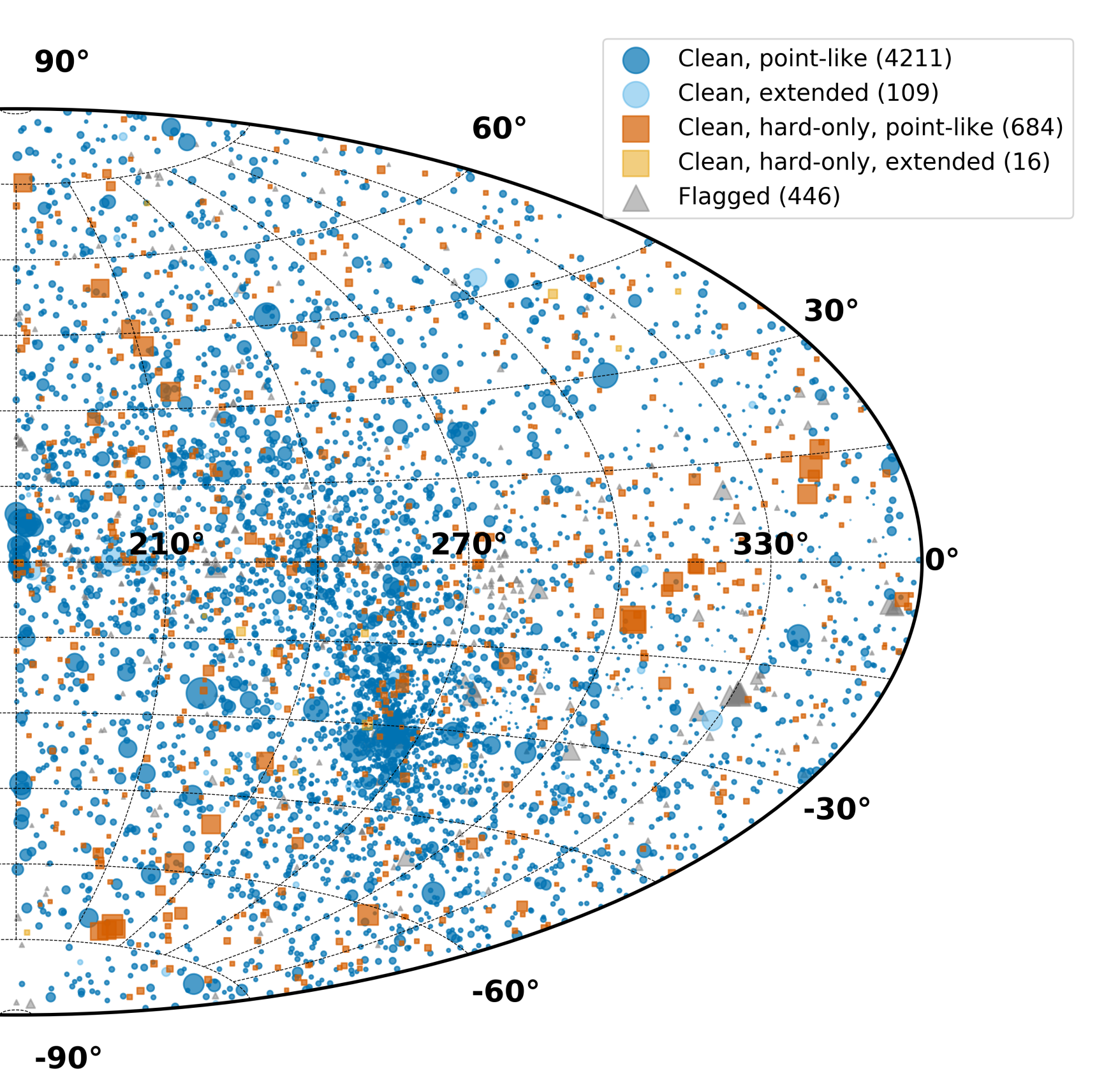
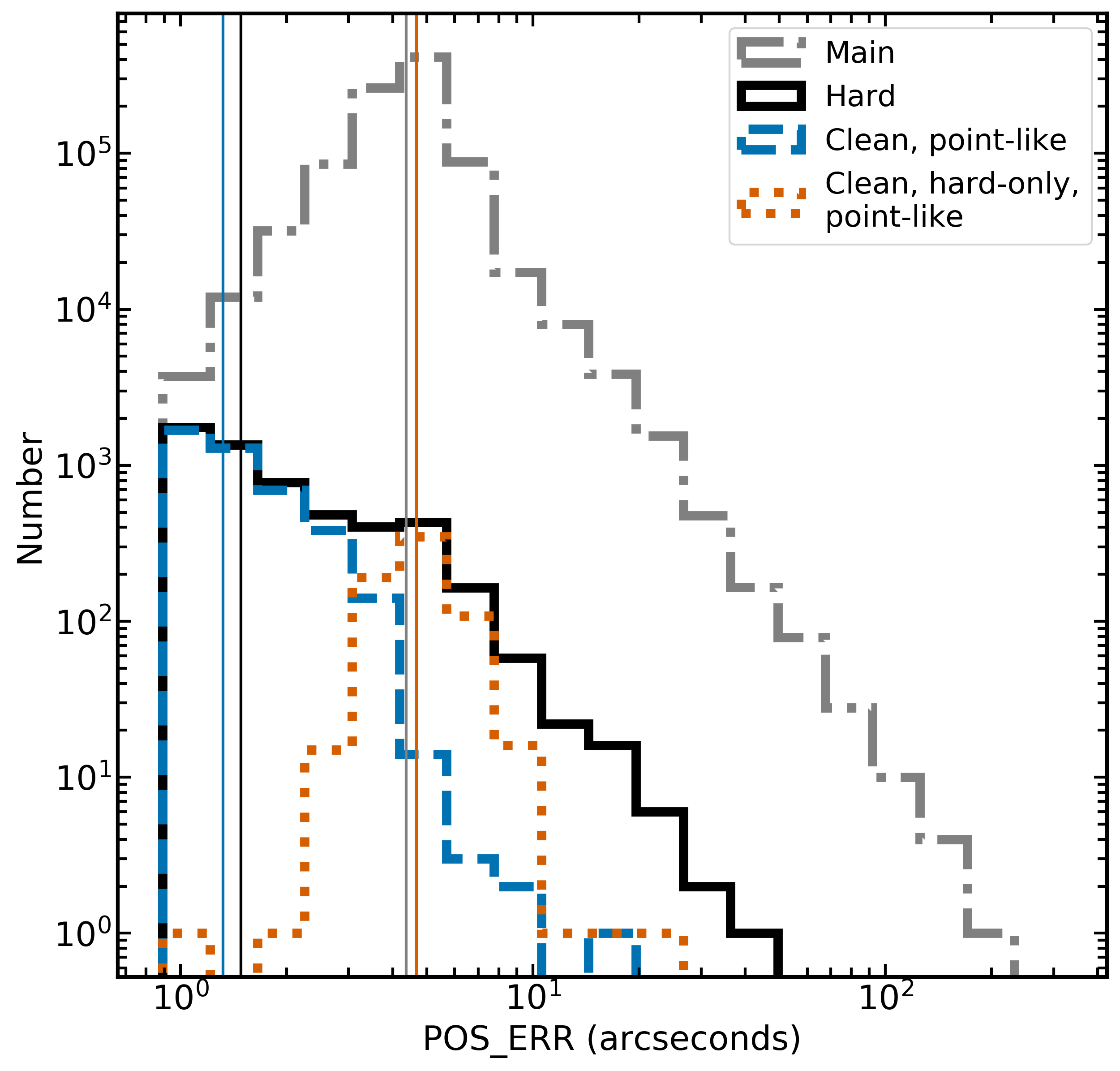
The eROSITA instrument aboard the Spectrum Roentgen Gamma (SRG) satellite has performed its first all-sky survey between December 2019 and June 2020. This paper presents the resulting hard X-ray (2.3-5 keV) sample, the first created from an all-sky imaging survey in the 2-8 keV band, for sources within western galactic sky. The 5466 hard X-ray selected sources detected with eROSITA are presented and discussed. The Bayesian statistics-based code NWAY is used to identify the counterparts for the X-ray sources. These sources are classified based on their multiwavelength properties, and the literature is searched to identify spectroscopic redshifts, which further inform the source classification. A total of 2547 sources are found to have good-quality counterparts, and 111 of these are detected only in the hard band. Comparing with other hard X-ray selected surveys, the eROSITA hard sample covers a larger redshift range and probes dimmer sources, providing a complementary and expanded sample as compared to Swift-BAT. Examining the column density distribution of missed and detected eROSITA sources present in the follow-up catalog of Swift BAT 70 month sources, it is demonstrated that eROSITA can detect obscured sources with column densities $>10^{24}$ cm$^{-2}$, but that the completeness drops rapidly after $10^{23}$ cm$^{-2}$. A sample of hard-only sources, many of which are likely to be heavily obscured AGN, is also presented and discussed. X-ray spectral fitting reveals that these sources have extremely faint soft X-ray emission and their optical images suggest that they are found in more edge-on galaxies with lower b/a. The resulting X-ray catalog is demonstrated to be a powerful tool for understanding AGN, in particular heavily obscured AGN found in the hard-only sample.
Motivation & Objective
- To create the first large, uniform sample of hard X-ray selected AGN from an all-sky imaging survey in the 2–8 keV band.
- To characterize the multiwavelength properties of these AGN using astrometry, photometry, and spectroscopy from legacy surveys and archival data.
- To assess eROSITA's sensitivity to obscured AGN, particularly those with high column densities (>10^23 cm⁻²), and compare its performance with Swift-BAT and HEAO-1.
- To identify and analyze a sample of 'hard-only' AGN—sources detected only in the hard X-ray band—indicating extreme obscuration.
- To evaluate the completeness of the survey across different column density regimes and understand the limitations in detecting the most obscured AGN.
Proposed method
- The eROSITA all-sky survey (December 2019–June 2020) provided the primary X-ray data in the 2.3–5 keV band, forming the basis of the hard X-ray selected sample.
- The Bayesian counterpart-finding code NWAY was used to match X-ray sources to optical/infrared counterparts in multiwavelength catalogs, including Legacy Survey DR10.
- Source classification was based on multiwavelength photometric and morphological properties, with spectroscopic redshifts from literature used to refine classifications.
- X-ray spectral fitting was performed on the hard-only sources to constrain their intrinsic properties, including soft X-ray flux and column density.
- The column density distribution of missed and detected sources was compared between eROSITA and the Swift-BAT 70-month catalog to assess completeness.
- Statistical analysis quantified the sensitivity of eROSITA to Compton-thick AGN, particularly in the N_H > 10^24 cm⁻² regime.
Experimental results
Research questions
- RQ1What is the completeness of eROSITA in detecting AGN with high column densities, particularly those with N_H > 10^24 cm⁻²?
- RQ2How does the eROSITA hard X-ray sample compare in depth and redshift range to previous hard X-ray surveys such as Swift-BAT and HEAO-1?
- RQ3What fraction of hard X-ray selected AGN are detected only in the hard band, and what does this imply about their obscuration and host galaxy properties?
- RQ4What are the spectral and morphological characteristics of 'hard-only' AGN, and how do they differ from typical AGN?
- RQ5To what extent does eROSITA’s sensitivity to obscured AGN improve upon previous all-sky surveys?
Key findings
- eROSITA detected 5,466 hard X-ray sources in the 2.3–5 keV band, forming the first all-sky imaging survey above 2 keV.
- Of these, 2,547 sources have high-quality multiwavelength counterparts, with 111 detected exclusively in the hard band, indicating extreme obscuration.
- The survey probes a broader redshift range and fainter fluxes than Swift-BAT, providing a more complete census of AGN across cosmic time.
- eROSITA can detect AGN with column densities >10^24 cm⁻², but completeness drops sharply beyond N_H ~ 10^23 cm⁻², indicating a detection threshold for highly obscured sources.
- The 'hard-only' AGN sample shows extremely faint soft X-ray emission and are preferentially found in edge-on galaxies with low axial ratios (b/a < 0.7), supporting their high obscuration.
- X-ray spectral fitting confirms that these hard-only sources are consistent with Compton-thick absorption, with N_H values exceeding 10^24 cm⁻² in many cases.
Read this paper
Open the full text in the Nubint reader and ask about any passage as you read.
Read this paper on NubintThis review was generated by AI from the original paper. Please check the paper before citing it.