
[論文レビュー] The Taurus Boundary of Stellar/Substellar (TBOSS) Survey I: far-IR disk emission measured with Herschel
本研究では、ヘーシェル・パックスを用いて、タウルス星形成領域における遠赤外線域の円盤放射の包括的アンケート調査を実施し、星-準星境界に跨る153個のM4-L0対象を分析した。星-準星境界で中心源の放射に対する円盤過剰が顕著に変化しないことが判明し、中央源の放射に類似した傾向で70 μmの中央値放射度がスペクトル型に従って滑らかに低下した。24–70 μmスペクトル指数が急峻である5つの新たな遷移円盤候補が特定された。
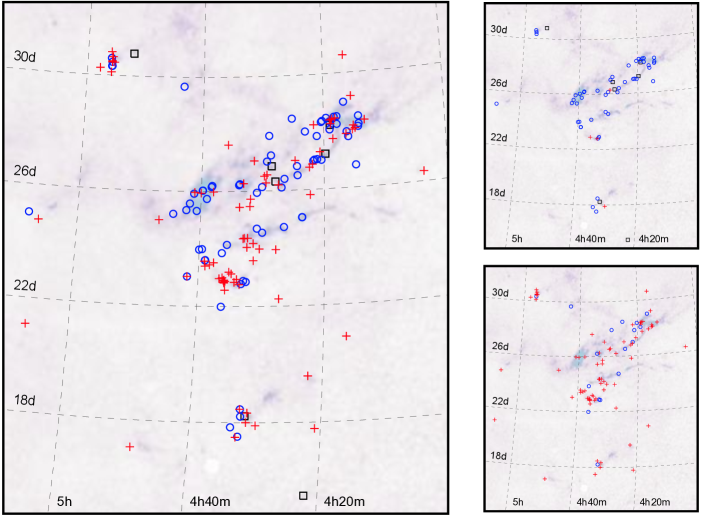
With Herschel/PACS 134 low mass members of the Taurus star-forming region spanning the M4-L0 spectral type range and covering the transition from low mass stars to brown dwarfs were observed. Combining the new Herschel results with other programs, a total of 150 of the 154 M4-L0 Taurus members members have observations with Herschel. Among the 150 targets, 70um flux densities were measured for 7 of the 7 ClassI objects, 48 of the 67 ClassII members, and 3 of the 76 ClassIII targets. For the detected ClassII objects, the median 70um flux density level declines with spectral type, however, the distribution of excess relative to central object flux density does not change across the stellar/substellar boundary in the M4-L0 range. Connecting the 70um TBOSS values with the results from K0-M3 ClassII members results in the first comprehensive census of far-IR emission across the full mass spectrum of the stellar and substellar population of a star-forming region, and the median flux density declines with spectral type in a trend analogous to the flux density decline expected for the central objects. SEDs were constructed for all TBOSS targets covering the optical to far-IR range and extending to the submm/mm for a subset of sources. Based on an initial exploration of the impact of different physical parameters; inclination, scale height and flaring have the largest influence on the PACS flux densities. From the 24um to 70um spectral index of the SEDs, 5 new candidate transition disks were identified. The steep 24um to 70um slope for a subset of 8 TBOSS targets may be an indication of truncated disks in these systems.Two examples of mixed pair systems that include secondaries with disks were measured. Finally, comparing the TBOSS results with a Herschel study of Ophiuchus brown dwarfs reveals a lower fraction of disks around the Taurus substellar population.
研究の動機と目的
- タウルス星形成領域における星-準星境界に跨る円盤の頻度と性質を調査すること。
- 低質量星と準星形(M4–L0スペクトル型)の間で円盤特性が異なるかどうかを特定すること。
- 若いM4–L0対象の光学的からサブミリ波長域にかけての包括的スペクトルエネルギー分布(SED)サンプルを構築すること。
- 遠赤外線域のSED形態に基づいて遷移円盤を同定・特徴付けること。
- タウルスの円盤特性とオphiuchus星形成領域の特性を比較し、環境的要因や質量依存的傾向を評価すること。
提案手法
- 134個の低質量タウルスメンバー(M4–L0スペクトル型)に対して、ヘーシェル・パックスを用いた70 μm帯域の深紫外・赤外線測光を実施した。
- ヘーシェルデータを既存の調査と統合し、153対象(150件がヘーシェルデータ、3件がスパイイザー調査)の99%完全なサンプルを構築した。
- 光学的からサブミリ波長域にかけてのSEDを構築し、利用可能な長波長データを組み込んだ。
- 24 μmから70 μmまでのSED勾配を分析し、急峻なスペクトル指数を示す候補遷移円盤を同定した。
- SEDモデリングを用いて、傾斜角、スケール高さ、フラーリングの影響がパックス帯域の放射度に与える影響を評価した。
- 高分解能連星系調査と照合し、連星・複数系構造における円盤を有する系を同定した。
実験結果
リサーチクエスチョン
- RQ1星-準星境界(M4–L0スペクトル型)で、原始星周囲円盤の頻度や形態に顕著な変化が見られるか?
- RQ2M4–L0範囲のスペクトル型に応じて、クラスII円盤の遠赤外線(70 μm)放射度はどのように変化するか?
- RQ3準星領域における遷移円盤と標準的クラスII円盤との間で、遠赤外線域のSED特性に顕著な差異が見られるか?
- RQ4タウルスにおける円盤特性は、同程度の年齢と質量を持つオphiuchus星形成領域のものと比較してどのように異なるか?
- RQ5傾斜角、フラーリング、スケール高さなどの物理的パラメータのうち、観測された70 μm放射度に最も強く影響を与えるものは何か?
主な発見
- 150件のTBOSS観測対象のうち、70 μm放射度が測定されたのは、クラスIの7体中7体、クラスIIの67体中48体、クラスIIIの76体中3体であった。
- 中央源の放射に類似した傾向で、スペクトル型に従って70 μmの中央値放射度が低下しており、これは質量依存的円盤の放射度傾向を示している。
- M4–L0範囲の星-準星境界で、中心源の放射に対する円盤過剰に顕著な変化は認められなかった。
- 24–70 μmスペクトル指数が急峻であるという特徴に基づき、5つの新たな遷移円盤候補が同定された。外縁部のSEDは標準的クラスII円盤と区別がつかなかった。
- 8体のTBOSS対象の一部は、24–70 μmの勾配が急峻であり、断片化した円盤を示唆するが、外縁半径は追加データがなければ特定できない。
- 2つの混合ペア系で、円盤を持つ第二星がヘーシェルデータで検出され、連星系における円盤の存続を確認した。
- 同質量帯で比較した場合、タウルスの準星対象における円盤の割合は、オphiuchus領域よりも低かった。
より良い研究を、今すぐ始めましょう
論文の読解から最終レビューまで、研究時間を劇的に削減しましょう。
クレジットカード登録不要
このレビューはAIが作成し、人間の編集者が確認しました。