
[Paper Review] The $z \gtrsim 9$ galaxy UV luminosity function from the JWST Advanced Deep Extragalactic Survey: insights into early galaxy evolution and reionization
The paper derives the rest-frame UV luminosity function at z>9 using JWST/JADES, reaching Muv ~ -17, and finds a bright-end excess and a steep faint-end slope, with implications for early galaxy evolution and reionization.
The high-redshift UV luminosity function provides important insights into the evolution of early galaxies. JWST has revealed an unexpectedly large population of bright ($M_\mathrm{UV} \lesssim -20$) galaxies at $z\gtrsim10$, implying fundamental changes in the star forming properties of galaxies at increasingly early times. However, constraining the fainter population ($M_\mathrm{UV} \gtrsim -18$) has been more challenging. In this work, we present the $z\gtrsim9$ UV luminosity function from the JWST Advanced Deep Extragalactic Survey. We calculate the UV luminosity function from several hundred $z\gtrsim9$ galaxy candidates that reach UV luminosities of $M_\mathrm{UV}\sim-17$ in redshift bins of $z\sim9-12$ (309 candidates) and $z\sim12-16$ (63 candidates). We search for candidates at $z\sim16-22.5$ and find none. We also estimate the $z\sim14-16$ luminosity function from the $z\geq14$ subset of the $z\sim12-16$ sample. Consistent with other measurements, we find an excess of bright galaxies that is in tension with many theoretical models, especially at $z\gtrsim12$. However, we also find high number densities at $-18\lesssim M_\mathrm{UV} \lesssim-17$, suggesting that there is a larger population of faint galaxies than expected, as well as bright ones. From our parametric fits for the luminosity function, we find steep faint end slopes of $-2.5\lesssimα\lesssim-2.3$, suggesting a large population of faint ($M_\mathrm{UV} \gtrsim -17$) galaxies. Combined, the high normalization and steep faint end slope of the luminosity function could imply that the reionization process is appreciably underway as early as $z=10$.
Motivation & Objective
- Constrain the rest-frame UV luminosity function at z>9 with JWST/NIRCam imaging from JADES.
- Probe the faint-end regime down to Muv ~ -17 to understand the full galaxy population.
- Assess the evolution of the UV luminosity density and its implications for cosmic reionization.
- Compare observations with theoretical galaxy formation models to identify tensions and possible explanations.
- Characterize the redshift range where the reionization process is underway based on LF measurements.
Proposed method
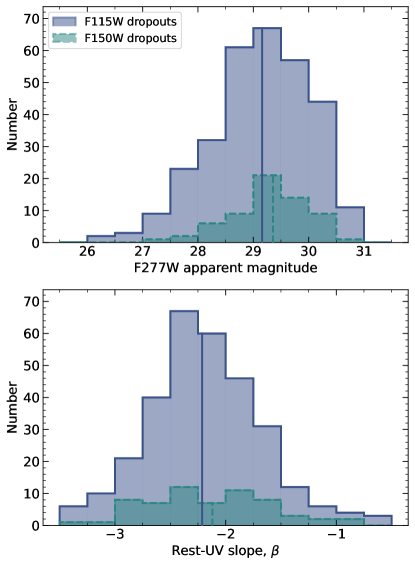
- Photometric dropout selection in F115W, F150W, and F200W to identify z~9-17 galaxy candidates.
- BEAGLE spectral energy distribution fitting to derive photometric redshifts and probabilistic redshift posteriors.
- Use eight JWST/NIRCam filters (F090W–F444W) to construct rest-frame UV photometry and measure LFs.
- Compute the UV luminosity function in redshift bins z~9-12 and z~12-16, and place an upper limit at z>16.
- Estimate the rest-UV luminosity density evolution with redshift.
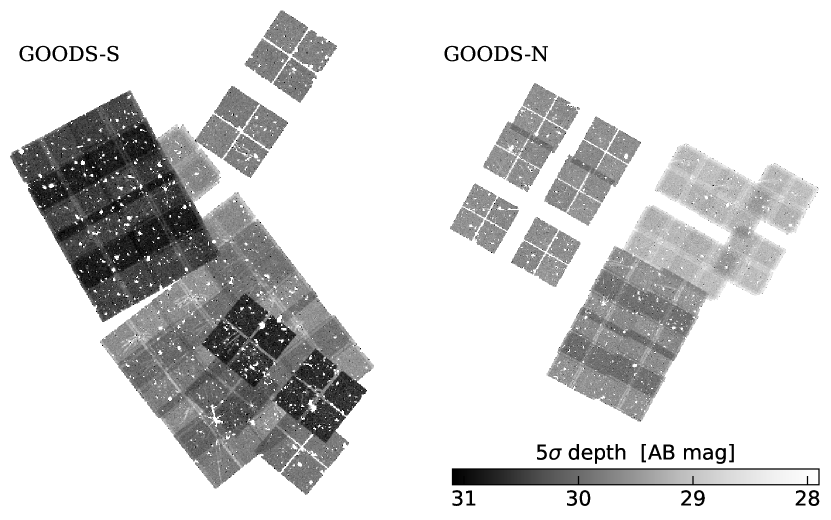
- Incorporate depths and survey area variations to constrain the faint end of the LF.
Experimental results
Research questions
- RQ1What is the shape and normalization of the rest-frame UV luminosity function at z~9-12 and z~12-16?
- RQ2Is there an excess of bright z>12 galaxies compared to theoretical models, and what does this imply for early star formation?
- RQ3What is the faint-end slope (alpha) of the UV LF at z>9, and do faint galaxies dominate the UV luminosity density?
- RQ4How does the UV luminosity density evolve toward higher redshift, and what are the implications for the timeline of cosmic reionization?
Key findings
- There is an excess of bright galaxies at z>12 that is in tension with many theoretical models.
- There are high number densities at -18 ≲ Muv ≲ -17, indicating a substantial faint-galaxy population.
- Parametric fits yield steep faint-end slopes: -2.5 ≲ α ≲ -2.3, suggesting many faint galaxies (Muv ≳ -17).
- The combined high normalization and steep faint-end slope imply reionization could be underway by z ≈ 10.
- No z~16-22.5 candidates are found, placing an upper limit on the UV LF at these redshifts.
- The results at z>9 show consistency with a slow evolution of bright galaxies up to z~13 and indicate a broad range of luminosities contribute to the UV luminosity density.
Read this paper
Open the full text in the Nubint reader and ask about any passage as you read.
Read this paper on NubintThis review was generated by AI from the original paper. Please check the paper before citing it.