
[Paper Review] Theory of Mind as Intrinsic Motivation for Multi-Agent Reinforcement Learning
This paper proposes using second-order theory of mind—predicting other agents' beliefs—as an intrinsic reward signal in multi-agent reinforcement learning. By grounding semantically meaningful beliefs via an information-theoretic residual method, the approach improves coordination and deception in mixed cooperative-competitive environments, with empirical results showing significant performance gains over baselines using only first-order beliefs or no beliefs.
The ability to model the mental states of others is crucial to human social intelligence, and can offer similar benefits to artificial agents with respect to the social dynamics induced in multi-agent settings. We present a method of grounding semantically meaningful, human-interpretable beliefs within policies modeled by deep networks. We then consider the task of 2nd-order belief prediction. We propose that ability of each agent to predict the beliefs of the other agents can be used as an intrinsic reward signal for multi-agent reinforcement learning. Finally, we present preliminary empirical results in a mixed cooperative-competitive environment.
Motivation & Objective
- To develop a method for grounding semantically meaningful, human-interpretable beliefs within deep RL policies.
- To investigate whether predicting other agents' mental states (theory of mind) can serve as an intrinsic reward signal in multi-agent RL.
- To improve multi-agent performance in mixed cooperative-competitive settings through intrinsic motivation derived from second-order belief prediction.
- To evaluate the efficacy of this approach in enabling complex social strategies such as deception and coordination.
Proposed method
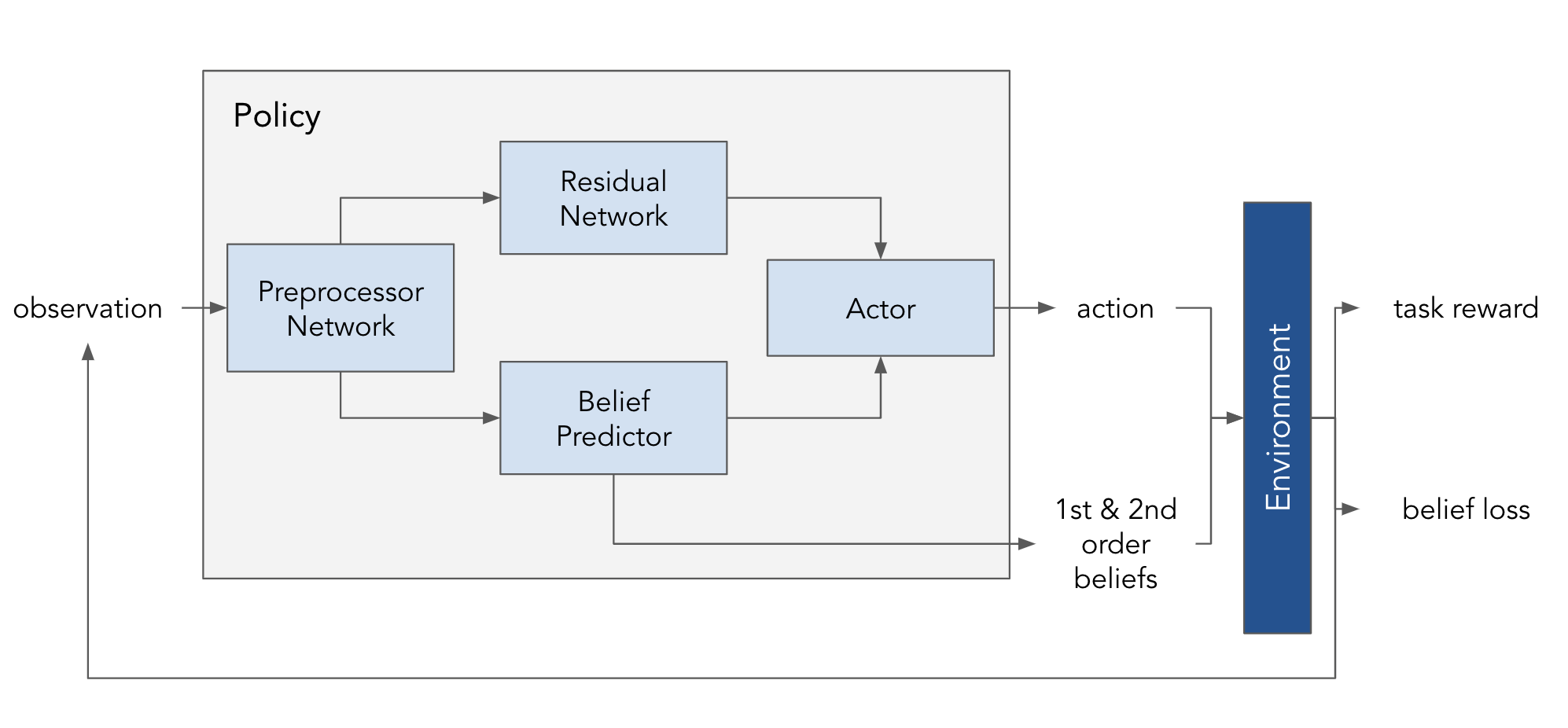
- An information-theoretic residual variant of concept bottleneck learning is used, minimizing mutual information between input observations and belief representations to enforce semantic grounding.
- Each agent maintains first-order beliefs about the environment (e.g., target location, reward coefficients) and second-order beliefs about other agents' first-order beliefs.
- The intrinsic reward is computed as the prediction accuracy of other agents' beliefs, encouraging agents to model others' mental states.
- Multi-Agent Proximal Policy Optimization (MAPPO) with centralized training and decentralized execution (CTDE) is used for training.
- Training alternates between optimizing good agents and the adversary every 100k timesteps, with fixed weights for the other.
- The belief prediction task is integrated into the policy network via a residual connection that enforces disentangled, interpretable representations.
Experimental results
Research questions
- RQ1Can second-order belief prediction—modeling what other agents believe—serve as an effective intrinsic reward signal in multi-agent reinforcement learning?
- RQ2Does grounding beliefs in semantically meaningful concepts improve the interpretability and performance of multi-agent policies?
- RQ3How does intrinsic motivation via theory of mind compare to intrinsic rewards based on state novelty or action influence in mixed cooperative-competitive environments?
- RQ4Can this approach lead to the emergence of complex social strategies such as deception and coordinated evasion?
Key findings
- Good agents trained with second-order belief intrinsic reward significantly outperformed baseline variants, achieving higher mean episodic rewards in the physical deception task.
- The adversary also performed better when trained with second-order belief intrinsic reward, showing increased decisiveness and faster convergence to the target.
- Qualitative analysis revealed that agents with second-order intrinsic rewards exhibited more complex, adaptive strategies, including landmark switching and coordinated evasion, which were absent in baseline and first-order belief settings.
- The 2nd-order belief intrinsic reward led to more strategic behavior, such as deliberate misdirection and coordinated movement, not observed in models without theory of mind supervision.
- The method demonstrated that intrinsic motivation based on belief prediction can drive the emergence of socially intelligent behaviors without explicit task shaping.

Read this paper
Open the full text in the Nubint reader and ask about any passage as you read.
Read this paper on NubintThis review was generated by AI from the original paper. Please check the paper before citing it.